

Image © Adobe Images
The U.S. dollar looks vulnerable to a meaningful reversal as hot U.S. data deliver diminishing returns and softer figures would deter the Federal Reserve from raising rates in January.
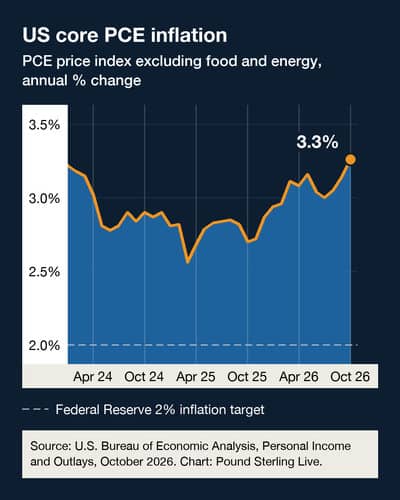
The dollar barely moved despite Wednesday's figures showing U.S. core PCE inflation, the Federal Reserve's preferred measure of underlying price pressures, rising to 3.3% in October from 3.1%, above the 3.2% economists expected.
For Pound Sterling Live, the USD's response is instructive: it's very difficult to get a response out of the USD, so we're looking at a case of diminishing returns, where each new piece of equivalent input is generating diminishing output.
In such scenarios, the rate of return on negative surprises starts to build. The USD is looking vulnerable to a meaningful reversal here.
"The initial USD rally was fueled by inflation and reinforced by Fedspeak, prompting a rapid repricing in rates. A further leg higher now requires validation from activity data and wider US rate differentials," says a recent FX analysis from UBS, the Swiss investment bank.
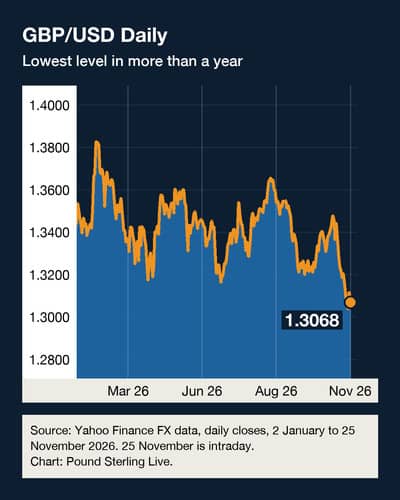
The pound-to-dollar exchange rate was at 1.3067 some 20 minutes after the 13:30 UK release, against 1.3070 just before it. The euro-to-dollar exchange rate was at 1.0946, against 1.0948 before Wednesday's October PCE figures.
January pricing is exposed to this kind of data. Money markets price 26 basis points of Fed tightening by the 9 December meeting, a quarter-point hike in full, and 43 basis points by 27 January, leaving roughly two-thirds of a second hike priced for January. A basis point is one hundredth of a percentage point.
The dollar was already off its highs before Wednesday's figures: the U.S. dollar index, a measure of the dollar against six major currencies, hit a 2026 high of 104.53 on Monday as AI stocks rallied on Nvidia's reinstatement of Jensen Huang as chief executive, but it fell back on Tuesday as technology shares sold off, Pound Sterling Live reported.
The dollar has risen further than the gap between U.S. and other countries' short-term interest rates would justify: it "has certainly overshot short-term rate differentials," says ING, the Dutch investment bank.
"With a December hike fully priced in, core PCE could shape expectations for the Fed's subsequent policy path. A firmer print could bring forward expectations for further hikes and support the dollar, while a softer reading could extend its decline," said MUFG, the Japanese investment bank, ahead of Wednesday's October PCE figures.
Wednesday's October figures were firmer on the annual measure. Core inflation's monthly pace of 0.3% matched forecasts.
December's hike is fully priced, meaning investors have already bought dollars in anticipation of it. The dollar would therefore lose its January rate support first if the data soften. Lower expected Fed rates push down the yields on U.S. government bonds and reduce foreign demand for those bonds and the dollars needed to buy them.
The UBS analysis names personal income against personal spending as one of three growth datapoints that "will either validate or pause the USD rally." Wednesday's October figures showed consumer spending adjusted for inflation edged down, but personal income jumped 0.7%, partly on one-time payments tied to a Medicare premium rebate.
However, J.P. Morgan forecasts three consecutive quarter-point Fed hikes, in December, January and March, more than money markets price. "We stay positive on USD, which should benefit from a faster rate of and larger cumulative rise in Fed tightening, with risks skewed to higher terminal to be priced in," says a recent analysis from the U.S. investment bank.
For GBP/USD, support sits at 1.3011, Monday's low and the lowest in more than a year, a level where buyers have stepped in to halt the fall. A daily close beneath it would show the dollar's rally resuming on bets that the Fed raises rates beyond December, and open the way to 1.30, J.P. Morgan's forecast for the end of 2026.
Resistance sits at 1.3144, Monday's high and a level where sellers have halted rises. A break above it would show the dollar's reversal under way and point the pair towards 1.32, UBS's model estimate of where GBP/USD should trade.