
Image © Adobe Images
The U.S. dollar risks further losses if AI stocks keep selling off, as the currency now trades as a proxy for U.S. technology shares.
The U.S. dollar fell with AI stocks on Tuesday as it now trades like a technology share, says Karl Schamotta, Chief Market Strategist at Corpay.
"The dollar is now trading as a proxy for US equity valuations, which are in turn heavily dependent on the AI-led technology sector," he explains in a note released November 24.
Schamotta says the optimism that followed Nvidia's reinstatement of Jensen Huang as chief executive "is now fading: US equity indices are slipping, Treasury yields are falling... and the dollar is edging lower against a basket of major currencies."
The U.S. dollar index, a measure of the dollar against six major currencies, fell back to around 103.8 on Tuesday from a 2026 high of 104.53 on Monday as the Philadelphia Semiconductor Index, a measure of chipmakers' share prices, dropped nearly 8%.
The pound-to-dollar exchange rate rose as much as 0.6% on Tuesday to 1.3118 as the dollar fell, a day after its lowest close in more than a year at 1.3032, but it has since eased to 1.3078. Most of that gain came before a Bloomberg report on U.S. tariffs.
Huang's return "did little to resolve broader concerns about returns on AI spending," says a new analysis from MUFG, the Japanese investment bank. Tuesday's selling in chipmakers' shares followed that Bloomberg report, which said the U.S. could raise tariffs on goods from China, the European Union and more than a dozen other economies, as Pound Sterling Live reported.
Tuesday's fall reversed Monday's move, when the dollar climbed almost 0.5% against a basket of major currencies as Nvidia's shares surged 31% on Huang's return.
Nvidia's board reinstated Huang eleven days after he resigned amid reports he was the target of a foreign intelligence effort. The board voted unanimously after input from senior levels of the U.S. government. Investors welcomed his return, says MUFG.
Schamotta says the dollar's rise alongside Nvidia's shares on Monday "does not fit the playbook currency market participants have relied upon for decades." Under that playbook the dollar is a safe haven, a currency investors buy when stock markets fall and sell when they rally.
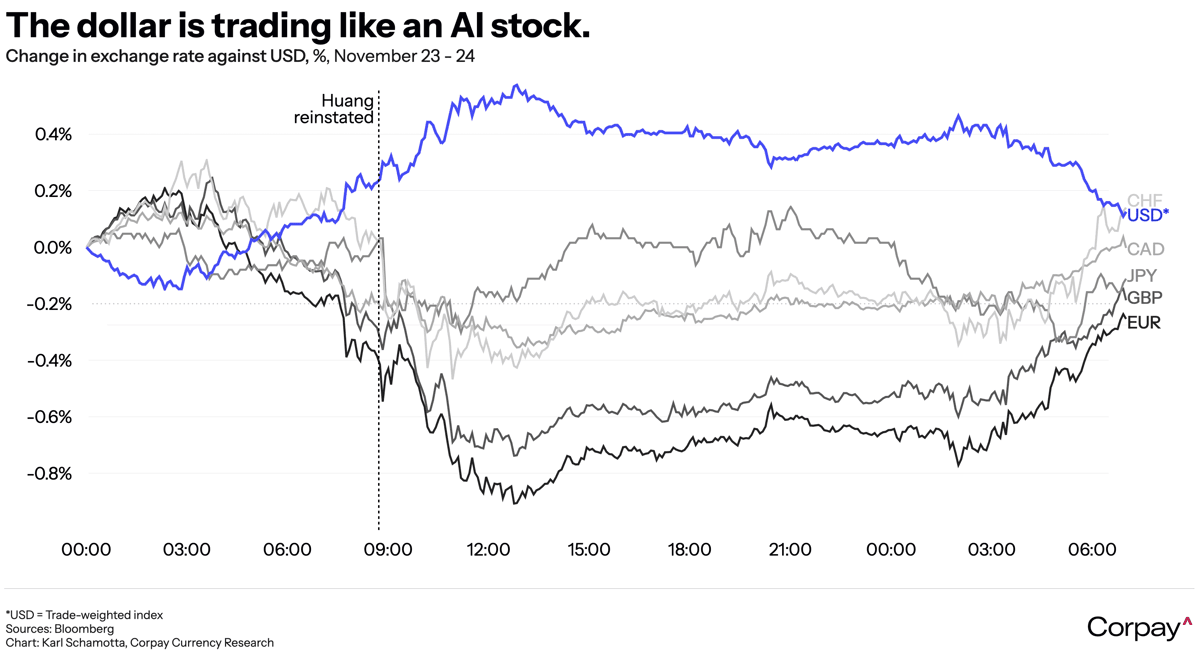
Above: The trade-weighted dollar, a measure of the dollar against a basket of its trading partners' currencies, and five major currencies against the dollar on 23 and 24 November. The dollar jumped when Huang's reinstatement was announced on Monday and fell back below that level by Tuesday morning. Image courtesy of Corpay.
Monday's high capped a rise of about 9% in the dollar index from its 2026 low of 95.55 in late January, over a year in which AI-related capital investment "has contributed almost two-thirds of marginal output growth," says Corpay's Schamotta.
"The buildout affects the economy and interest rates through multiple channels, from capital investment... to more abstract wealth effects, but the overall effect has been to juice corporate profits, lift demand, raise prices, and keep the Fed on its tightening trajectory," he adds.
Higher expected Fed interest rates raise the yields on U.S. government bonds and draw in foreign investors who need dollars to buy them, which lifts the dollar.
New York Fed President John Williams said on Monday that "the optimism and enthusiasm in the AI sector have been big drivers of the US economy of late," and that if that "were to change in a material and sustained way, I think it would affect my outlook."
Money markets, where investors bet on future rate moves through interest rate contracts, fully price a quarter-point rise in U.S. interest rates on 9 December, CME FedWatch data show. Economists expect Wednesday's October PCE inflation figures, the Fed's preferred inflation measure, to show core inflation, which excludes food and energy prices, rising to 3.2% from 3.1%. With a December hike fully priced in, MUFG says a firmer reading could bring forward expectations for further rate rises and support the dollar.
Pound Sterling Live holds that AI drives the dollar through Fed rate expectations, so a deeper AI sell-off would weigh on the dollar by lowering what investors expect from the Fed.
However, analysts at ING, the Dutch investment bank, doubt the dollar's link to technology shares is consistent: "One could ask: if the dollar did not fall during last week's tech sell-off, why should it rally now?"
ING adds that the dollar "has certainly overshot short-term rate differentials," meaning it has risen further than the gap between U.S. and other countries' short-term interest rates would justify.
Elsewhere, MUFG says the Fed remains on course to raise interest rates in December, but that tighter financial conditions, meaning costlier borrowing for companies and households as share prices fall, and lower energy prices cast doubt on expectations for several more rate rises in 2027.
Higher financing costs could erode the AI narrative, and if they do "the dollar's appeal to foreign investors could diminish," says Corpay's Schamotta.