

Image © Adobe Images
The Australian dollar's recoveries risk being capped as an RBA official signals policy is already restrictive and markets keep pricing rate cuts in 2027.
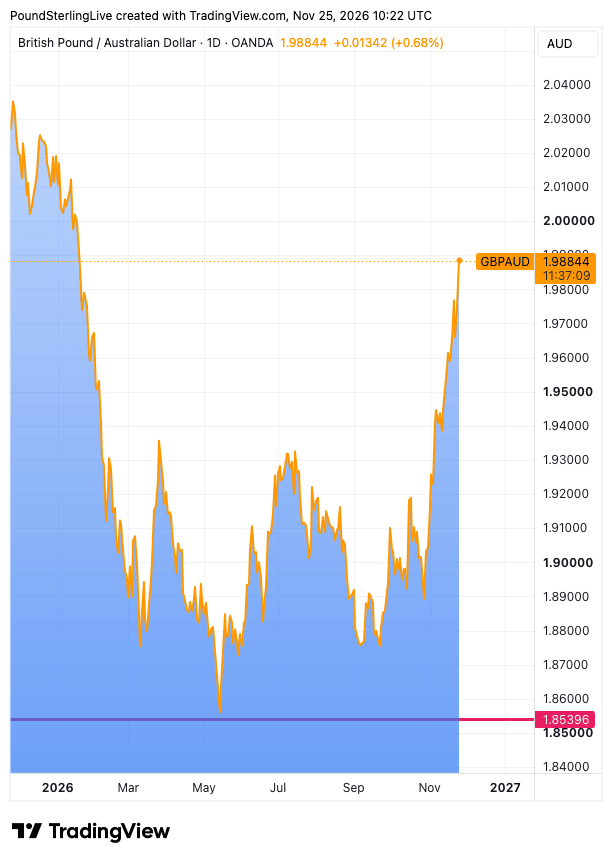
The Australian dollar fell to its lowest level against the pound since January on Wednesday, despite official figures showing annual inflation in Australia rising to 4.9% in October from 4.3%, above the 4.8% expected.
The Australian dollar rose in the minutes following the midweek release, confirming the market's initial reaction to the inflation beat was textbook: the AUD/USD exchange rate rose from 0.6638 to 0.6663, but had fallen back to 0.6566 by 08:00. The pound-to-Australian dollar exchange rate dipped 0.4% from 1.9755 to 1.9675, but it rose to 1.9912 by 08:00, its highest since 21 January. By the time of publication, it's at its post-January high at 1.9883.
"The concentration of recent price increases in volatile categories and some easing in persistent inflation suggest the underlying picture is more mixed than the trimmed mean result alone implies, helping to push AUD/USD back down to near 0.6590," says a new FX market analysis from Commonwealth Bank of Australia (CBA), the Sydney-based lender.
Prices rose 0.5% on the month against the 0.4% expected, taking annual inflation to the highest since the full monthly series began in April 2025. The trimmed mean, a measure of underlying inflation that strips out the biggest price swings, rose 0.5% on the month and 3.8% on the year, against forecasts of 0.3% and 3.6%.
Under the usual playbook, an inflation beat lifts a currency because it raises expectations of higher interest rates and so the returns foreign investors earn on Australian bonds, which they need Australian dollars to buy. This time money markets, where traders put odds on future RBA moves through interest rate contracts, kept pricing rate cuts in 2027, as analysts concluded the figures do little to change the view that the RBA has finished raising interest rates.
The release came shortly after the RBA's Head of Domestic Markets, David Jacobs, told a Sydney conference that "financial conditions are now clearly restrictive" after the cash rate, the RBA's main interest rate, reached its highest level in 18 years.
Restrictive means interest rates are already high enough to slow the economy. Jacobs' remark signals the RBA sees less need for another hike, which takes away a source of support for the Australian dollar.
CBA says AUD/USD was "also likely weighed down" by those comments.
GBP/AUD now trades within 0.5% of 2.00, a round figure the pair has not reached since 20 January and where sellers would be expected to slow any further advance.
Analysts See the RBA Holding Its Fire
Westpac found the October figures were "a shade above our nowcast (less than 0.1%pt)".
"We see nothing to change our view that the RBA is likely finished hiking rates but will still be considering another move in coming months. Nor do we see anything to change our view that the most likely date for the first interest rate cut is August next year," says Luci Ellis, Chief Economist at Westpac.
Westpac expects October to mark the peak for inflation, with falling fuel prices set to deliver a monthly fall in the headline figure in November.
CBA also expects a first cut in August 2027 and says that is "more than fully priced", meaning money markets already bet on more RBA easing than CBA forecasts.
ANZ brought forward its forecast for the first RBA cut to June 2027 after last week's October jobs figures, which it says "weakened the AUD".
However, UOB reads the inflation figures as a sign that "domestic price pressures remain persistent and that progress towards the RBA's 2-3% inflation target remains slow," and expects the cash rate to hold at 4.85% through the third quarter of 2027.
Some Analysts See Room for an Australian Dollar Bounce
Commerzbank, as Pound Sterling Live has reported, thinks markets have been too quick to price RBA cuts and sees the Australian dollar's recent slide as "somewhat overdone".
"We therefore see scope for the Aussie to recover in the near term, particularly if the cooling of the labour market does not accelerate further or inflationary pressures prove more persistent," says Norman Liebke, FX & Commodity Analyst at Commerzbank.
A move is priced in when investors have already bought or sold the currency in anticipation of it, so the Australian dollar would rise if the RBA turns out to cut less than markets expect.
Liebke adds that "even more dovish signals" from the RBA, meaning hints of a readiness to cut, "could be enough to revive rate-cut expectations and weigh on the AUD, even if the RBA ultimately leaves interest rates unchanged throughout 2027."