
Image © Adobe Images
Businesses believe in AI's transformative power but remain stuck bolting it on, shows new EY research.
A new study confirms what the data has led us to suspect for a while now: businesses aren't leveraging AI's capabilities to the depth required to unlock real productivity gains.
EY, the professional services provider, explains in a new research paper that action lags ambition when it comes to AI's deployment.
"Everyone's invested in AI, but most have yet to see the return they were expecting on those investments," says Raul Villar Jr., CEO of governance software firm Optro, in the report.
This finding helps fill another piece of the great AI puzzle of 2026: that adoption is everywhere and yet transformation is almost nowhere: i.e., we're using it but aren't really benefiting meaningfully from it.
Barclays economists recently found that despite steadily broadening AI usage, evidence of a measurable productivity acceleration "remains weak at best," a finding I explored in my analysis of that research.
My argument was that the economy is stuck at the bolt-on stage, where AI is attached to existing processes and the saved minutes evaporate, rather than the built-in stage, where processes are redesigned around the technology and the gains become structural.
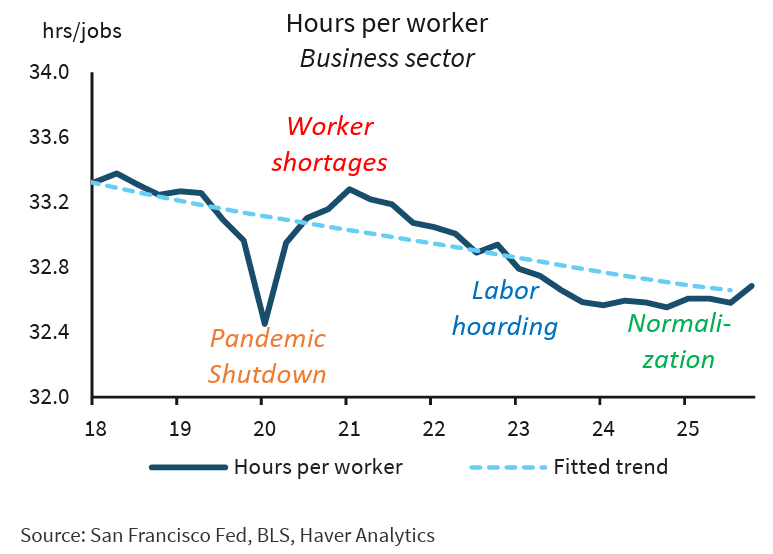
Despite the advent of the 'AI age ', productivity data is yet to reflect a meaningful pickup.
Everyone Invested, Few Rewarded
EY's Global Risk Transformation study, drawing on a survey of 1,200 senior risk professionals at billion-dollar-plus organisations, now documents that same trap from inside the enterprise, and it even uses the same vocabulary.
"The real value realisation opportunity is not from using AI as a bolt-on but making AI built-in to processes and functions," says Dan Diasio, EY's Global Consulting AI Leader.
The study's headline finding is there's a chasm between belief and action.
Seven in ten of the firms EY classes as "Risk Strategists" agree AI will fundamentally transform their function's operating model, yet adoption of generative AI within those functions sits at just 28%, prompting the report's blunt three-word verdict: action lags ambition.
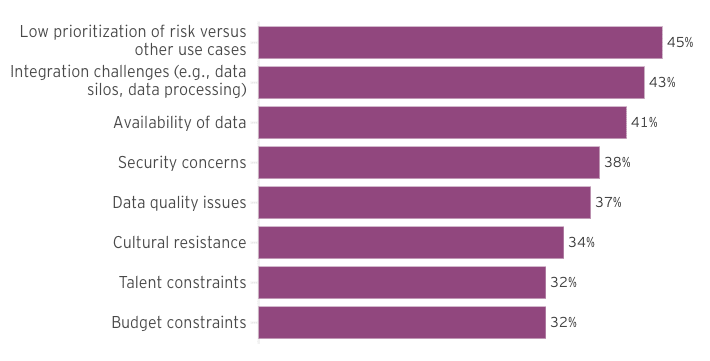
Above: "Percentage of respondents ranking each factor among the top three biggest barriers to adopting emerging technologies for the organisation’s risk management function across the enterprise."
Even where AI has been deployed, the returns have disappointed.
"Everyone's invested in AI, but most have yet to see the return they were expecting on those investments," says Raul Villar Jr., CEO of governance software firm Optro, in the report.
EY's diagnosis is that most deployments automate the past rather than build the future: bolting AI onto existing workflows delivers quick proof of concept and near-term efficiency, but it is, in the report's words, not where the biggest gains lie.
"When organisations add AI use case-by-use case, value rises incrementally, then plateaus," says Diasio, arguing that value only compounds when firms rebuild capability by capability instead.
That plateau, multiplied across thousands of firms, is precisely what a macroeconomist would observe as an economy where AI is visible everywhere except the productivity statistics.
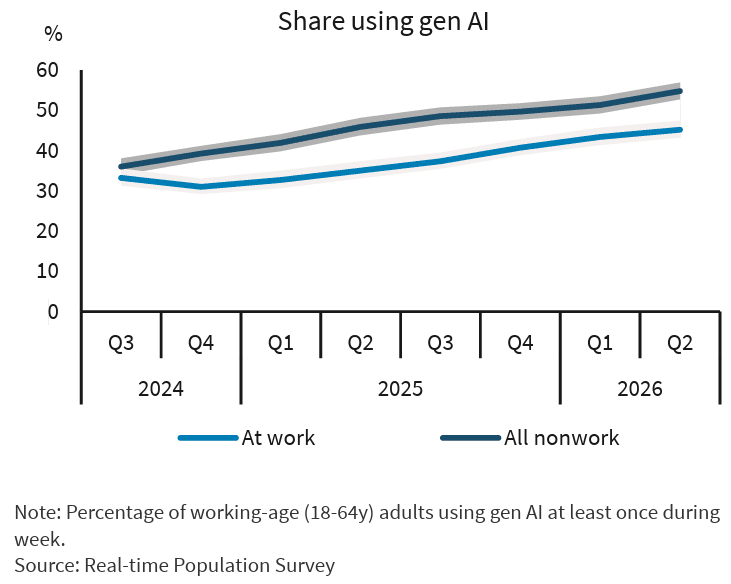
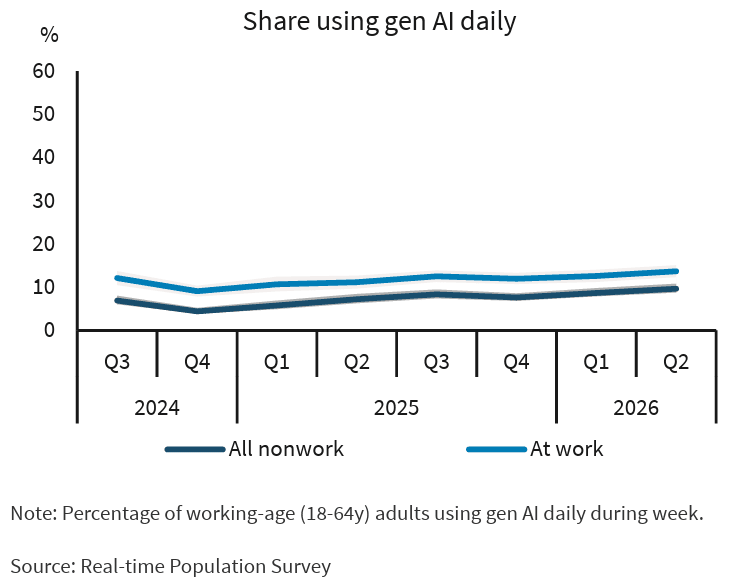
Above: The charts show a gap in engagement, which could imply there are productivity gains waiting to be unlocked.
What Built-In AI Actually Looks Like
The report's most instructive material comes from the organisations that have crossed over.
The Global Chief Risk Officer of a large European automotive manufacturer describes replacing manual, siloed risk reporting with a multi-agent system of roughly fifteen AI agents, monitoring geopolitics and markets in real time, with an orchestrator agent connecting the dots.
The system is not yet fully live, but its proof of concept identified the impact of the Strait of Hormuz closure on helium supply to the firm's manufacturing processes "well before this topic was being explored in the media."
At Uber, the finance risk team has gone from buying automation tools to building AI-native ones in-house.
"Rather than simply accelerating existing manual processes, we use AI to fundamentally change how information is consumed, interpreted, and applied across the compliance lifecycle," say Adam Frank and Ramesh Raju of the company's financial risk management function.
Note what both examples share: neither is about doing the old job faster; both redesigned the job, with humans moving to what EY calls human-on-the-loop oversight.
"Keeping humans in the loop is certainly appropriate in some situations, but as technology matures, we will increasingly move to human-on-the-loop," says Sinclair Schuller, EY Americas Responsible AI Leader.
The View from a Rebuilt Newsroom
This all maps exactly onto my own experience rebuilding a publishing operation around AI.
The bolt-on version of AI in publishing is asking a model to draft the article a human would otherwise have written: it saves minutes, the minutes get reabsorbed, and nothing structural changes.
The built-in version looks different: a governed evidence library, locked house-style rulebooks, scheduled generation, and human judgement repositioned to direction, verification and quality control, on the loop rather than in it.

The first version is a faster typewriter; the second is a different production function, and only the second shows up in output per hour.
What EY's survey adds is an honest account of why so few organisations make the crossing: the top adoption barrier, cited by 45%, is that AI for the function simply isn't prioritised, and the barriers behind it, data, talent, budget, integration, form what the report calls a self-reinforcing doom loop in which each constraint deepens the others.
The trap, in other words, is organisational rather than technological, which is why model capability keeps improving while measured productivity does not.
Two caveats, though: EY's survey dates from spring 2025 and covers risk functions specifically, and the firm is selling the cure as well as diagnosing the disease, since the report doubles as marketing for its transformation framework.
The diagnosis still rings true, because it independently matches what the macro data show and what practitioners live.
The Leading Indicator
The findings reveal organisations overwhelmingly stuck at the bolt-on stage of AI adoption, and practitioners who have gone built-in report that the gains are real but conditional on slow, unglamorous organisational rebuilding.
The conclusion I keep returning to is that the numbers worth watching are not adoption figures, which will drift to saturation and tell us nothing, but the measures of depth: daily usage among workers, and built-in deployment among firms.
Those are the cohorts in which AI is load-bearing, and history's lesson, from Solow's computers to this cycle, is that the productivity statistics move only when the rebuilders stop being a minority.
Until then, expect the strange spectacle to continue: total belief, record investment, and an economy that cannot yet find the boom in its own data.