
Image © Adobe Images
Companies Still Don't Know Where Their Potential AI Gains Lie.
It's frequent AI usage and not simply broad adoption that signals genuine productivity gains, shows new Barclays research.
Two statistics in a new research note from the bank tell almost everything about where the AI economy really stands: nearly 55% of working-age Americans have now used generative AI, according to household survey data running through the second quarter of 2026, with work-related use at 45%.
Yet the share using it daily for work sits at just under 14%.
"Exposure to AI is becoming increasingly widespread, but frequent usage remains concentrated among a relatively small share of the population," write economists at Barclays, led by Jonathan Millar and Marc Giannoni.
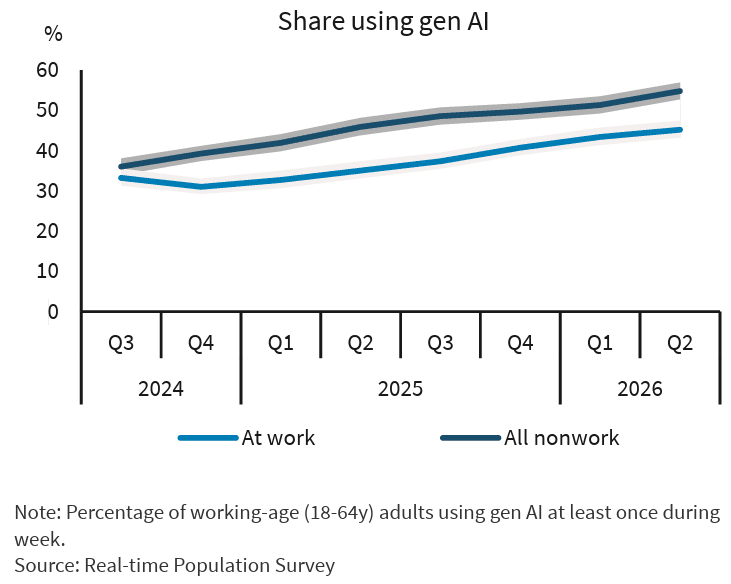
That gap between the two numbers is, to my reading, a story of productivity still waiting to be unlocked: companies know AI is out there and relevant, and most working professionals now feel they should be using it, but the honest position of the typical organisation is that it has not yet found the technology's role.
Trying a tool is curiosity, but using it daily means the workflow has come to depend on it, and that's where productivity improves.
Only when usage becomes frequent do we get the signal that AI is genuinely carrying part of the production process, and by that measure the transformation has barely begun.
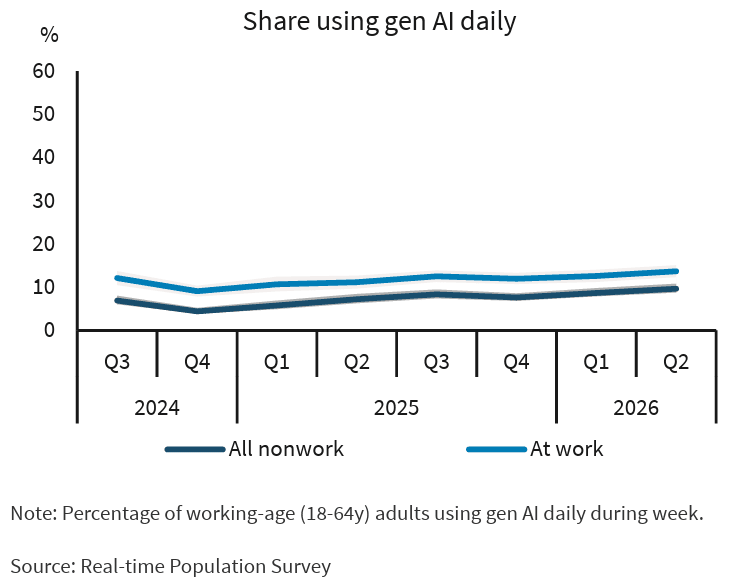
Image courtesy of Barclays.
Thirty Minutes In, Ten Minutes Back
The depth data reinforce the point.
According to the Real-time Population Survey, workers report spending about 6% of their working hours with AI, up from 4% in late 2024; for an eight-hour day, that is roughly thirty minutes.
Of that, they attribute around a third to genuine time savings, about ten minutes per day, up from seven.
Scaled up, those minutes are not trivial: Barclays calculates that time savings equivalent to 2% of work hours would be worth nearly $350BN annually, approximately 1.1% of GDP.
But the bank attaches the caveat that matters: "time savings do not automatically translate into measured productivity gains."
Nobody measures what the saved minutes are redeployed into, whether AI-assisted output is better or worse, or what resources are consumed implementing and supervising the systems.
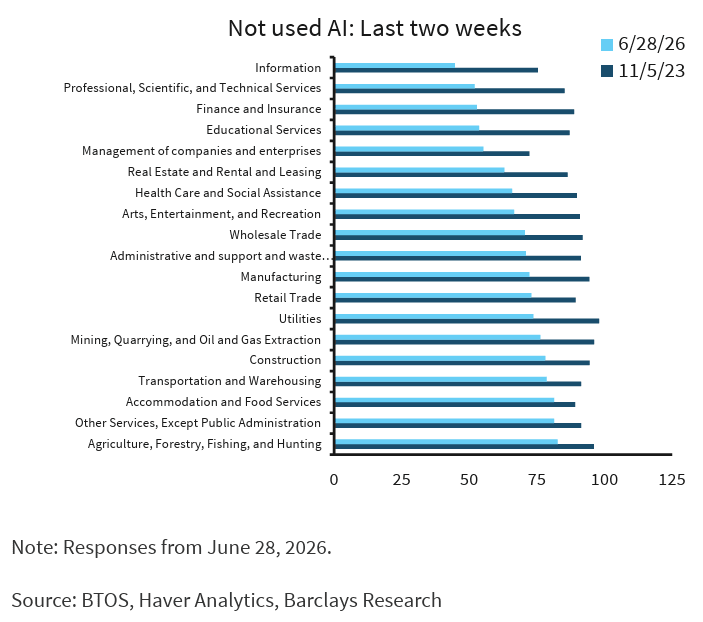
The business survey data are blunter still: only 21% of establishments reported knowingly using AI at the end of June, 69% reported none at all, and researchers at Barclays characterise the diffusion as "evolutionary rather than revolutionary."
Occasional Use Gets Reabsorbed
Why should frequency, rather than reach, be the metric that matters?
Because tools used occasionally produce savings that evaporate into the working day, while tools used daily deliver the real productivity gains: the process is redesigned around them, headcount and output assumptions change, and the gain becomes structural rather than incidental.
A worker who saves ten minutes here and there simply absorbs the slack; an organisation whose daily production line runs through AI has converted the same technology into capacity.
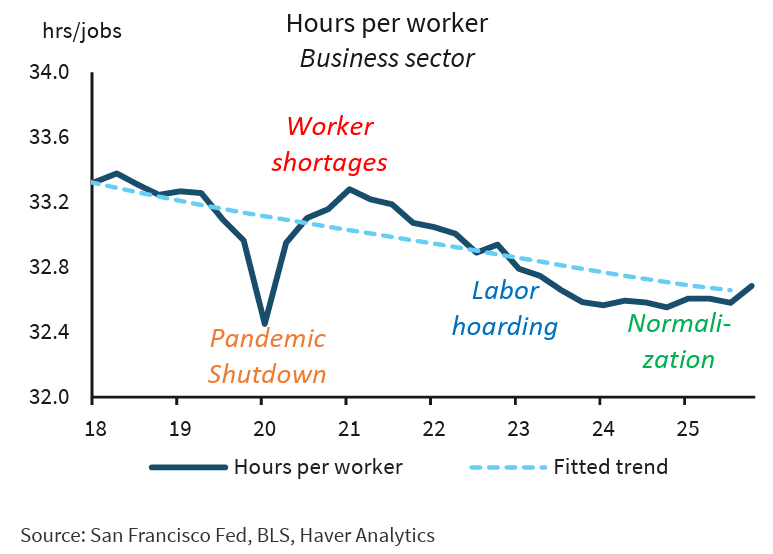
"Much of the pickup in productivity can be traced to normalising utilisation." - Barclays.
The aggregate statistics agree that the second kind of usage is not yet widespread.
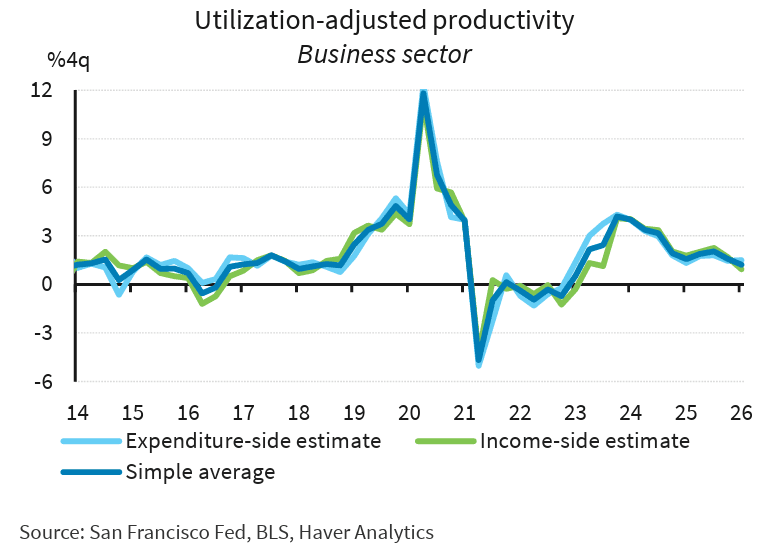
Barclays finds the celebrated post-pandemic productivity acceleration is mostly a cyclical illusion, with utilisation-adjusted estimates putting underlying productivity growth at about 1.2% in the first quarter of 2026, in line with pre-pandemic norms.
And industries adopting AI fastest show no statistically significant productivity advantage, with placebo tests revealing that already-productive industries simply adopt new technology sooner.
This is the Solow paradox playing out on schedule: "You can see the computer age everywhere but in the productivity statistics," economist Robert Solow observed in 1987, a decade before the IT boom finally reached the data.
A View from Inside the 14%
Here I can offer a practitioner's perspective, because I run a publishing operation rebuilt around AI from the ground up and have observed how it has driven real productivity gains while ensuring this publication doesn't become an 'AI slop' machine.
In an AI-native production process, the technology is not an occasional assistant consulted thirty minutes a day; it sits inside the daily workflow, and the human role moves to direction, judgement and quality control.
That is the difference between the 55% and the 14%, and it is why I'd argue the surveys are measuring two different phenomena with one question: bolt-on usage, which produces the reabsorbed minutes Barclays documents, and structural usage, which produces the gains the optimists are waiting for.
The organisational work required to move from one to the other is slow and unglamorous: workflows redesigned, roles redefined, quality systems built, and none of it visible to a survey asking how much time AI saved you this week.
So the series to watch from here is not the share of people who have touched AI, which will drift towards saturation and tell us nothing, but the daily-use share, quarter by quarter.
When that number breaks decisively higher, the productivity statistics will follow it, and my own experience suggests this will reflect the real gains awaiting on the other side for those ready to do the rebuilding.