
Image © Adobe Stock
GBP/NZD's failed breakout targets 2.2800 unless the 100-day average is quickly reclaimed.
The Pound-to-New Zealand Dollar exchange rate has undergone a notable deterioration over the past fortnight, with the sharp rejection from the 2.3491-2.3554 resistance zone evolving into a sustained decline.
The pair has now fallen back below the 100-day moving average at 2.3022, confirming that the July breakout has failed to hold.
The question for the week ahead is whether Sterling can quickly reclaim the 100-day average or whether the latest breakdown marks the beginning of a deeper retracement.
From a tactical perspective, the bears have the upper hand: price is making lower highs and lower lows, while repeated attempts to recover above the 100-day moving average have so far been rejected.
The failure to hold above this key trend indicator suggests sentiment has shifted decisively in favour of the New Zealand Dollar over the short term.
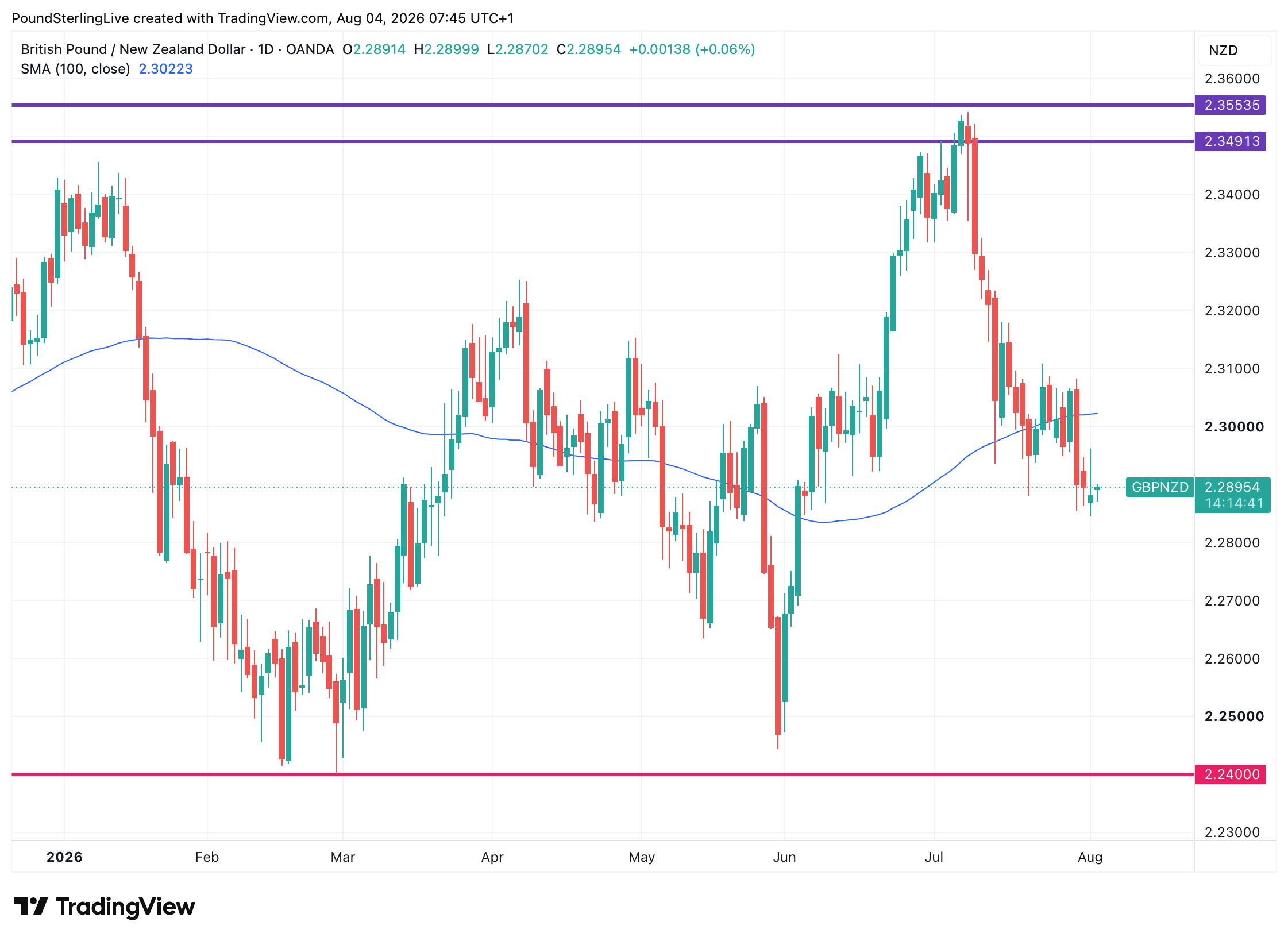
Above: GBP/NZD at daily intervals with the 100-day moving average and the levels that frame the week. Chart: Pound Sterling Live / TradingView.
Key levels
Resistance:
* 2.3022 – the 100-day moving average, now immediate resistance.
* 2.3491-2.3554 – July highs and major resistance zone.
Support:
* 2.2800 – first downside objective following the recent breakdown.
* 2.2400 – major medium-term support and the June low.
The Kiwi Has the Fundamentals
The chart's message is reinforced by the fundamental backdrop, because the New Zealand Dollar currently owns the strongest interest rate story in the G10.
Above-consensus second-quarter inflation locked in expectations for further RBNZ rate hikes, with headline CPI at 4.1% keeping the central bank engaged while easing core inflation lets the tightening proceed at a measured, currency-friendly pace.
Markets price four more hikes by mid-2027, and the RBNZ's deliberate messaging campaign, from the July hike through Governor Breman's radio remarks and Chief Economist Conway's warnings, has given traders little reason to fade that pricing.
The Pound, by contrast, is fighting the reversal of its own rates support, with UK yields falling faster than peers as oil retreats and the spreads that powered July's Sterling rally compressing to 2026 lows.
A pair matching the G10's strongest rate story against a currency losing its yield advantage is a pair with a directional bias, and it is the one the chart is already expressing.
It is also worth noting that the institutional consensus called this: Pound-New Zealand Dollar was the only major Sterling pair forecasters expected to decline through to early 2027, a thesis July's failed breakout is now vindicating.

The Bank Consensus, Without the Terminal
The median, mean, highest and lowest from the October survey update, plus named point forecasts out to 2027.
Free information pack, issued by World Wide Currencies.
Week-ahead Forecast
The short-term outlook favours further weakness while GBP/NZD remains below its 100-day moving average.
What had looked like a constructive medium-term recovery has given way to a failed breakout, and failed breakouts frequently produce sharp moves in the opposite direction as late buyers exit positions.
The first test for Sterling is whether it can regain 2.3022: a daily close back above the moving average would suggest the latest decline has become overstretched and could pave the way for a period of consolidation.
Until that happens, rallies are likely to be viewed as corrective rather than the beginning of a renewed uptrend.
The balance of probabilities therefore favours another test of 2.2800 over the coming sessions, and should that level fail to attract buyers, attention would quickly shift towards the more significant 2.2400 support area.
New Zealand's quarterly labour market report is the domestic highlight of the week and feeds directly into the RBNZ pricing that underpins the Kiwi's advantage: a strong print would harden the four-hike path and add fuel to the downside scenario, while any labour market wobble offers Sterling its best chance of the reclaim.
While the broader recovery from the May lows has not been completely invalidated, the week-ahead technical picture has turned tactically bearish, and unless Sterling can reclaim the 100-day moving average early in the week, the path of least resistance remains lower.
The Bank Consensus, Without the Terminal
The median, mean, highest and lowest from the October survey update, plus named point forecasts out to 2027.
Free information pack, issued by World Wide Currencies.