Image © Adobe Images
Pound-Dollar risks a slide towards 1.3250 unless the Federal Reserve disappoints hawkish expectations.
The picture facing the Pound-to-Dollar exchange rate remains messy, making directional conviction lower than on several other Sterling crosses.
Nevertheless, the chart continues to exhibit characteristics of a market that is struggling to sustain recoveries.
The declining 100-day moving average, repeated rejection from higher levels and a sequence of lower rally peaks collectively suggest Sterling remains on the defensive against the Dollar.
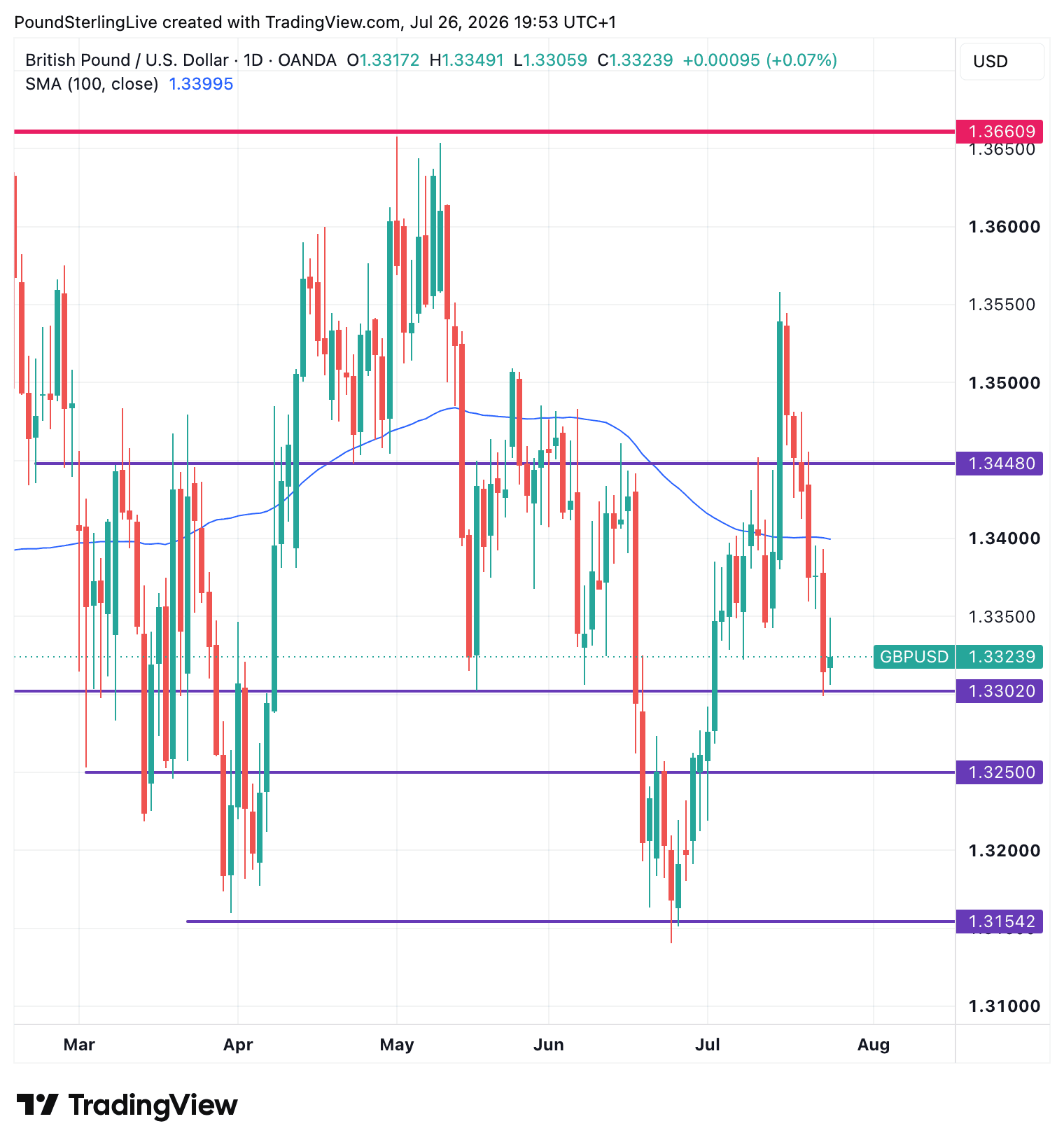
Above: GBP/USD at daily intervals with the declining 100-day moving average capping recoveries. Chart: Pound Sterling Live / TradingView.
Provided 1.3395-1.3400 caps any recovery attempts, the balance of probabilities favours another test of 1.3302, with scope for a move towards 1.3250 and potentially 1.3154 should support give way.
A recovery above the 100-day moving average would improve the short-term outlook and reduce immediate downside risks, but the technical evidence does not yet support that outcome.
USD: A New Kind of Exceptionalism
The fundamental backdrop explains why rallies keep failing: a stronger Dollar setup is still evolving.
The bond market selloff drove the Dollar higher last week, but this was not simply a response to higher oil prices.
What is at stake is the appropriateness of the level of policy rates, with the Federal Reserve at the heart of the issue given the extent of US macro outperformance.
Accordingly, the FOMC's response to this underlying question on Wednesday will determine to a large extent whether market expectations for a September hike will be realised.
In any event, the market narrative is already shifting away from 'de-dollarisation' towards a new form of US exceptionalism, aided by the increasing dependencies of major economies on the US for oil, natural gas and AI.
The Fed Decides on Wednesday
The softer-than-expected June CPI inflation has eased the pressure on the Fed to raise interest rates at this time.
We expect the Fed funds target rate will be left unchanged at the 3.50-3.75% range.
The risk of a hike, however, cannot be completely ruled out, especially after the renewed pickup in energy prices; markets attach about a 1-in-3 probability to a July move.
Policymakers will also assess the potential effect of import tariffs, strong growth indicators and core inflation, which strips out energy and food and has remained above 2% since 2021.
The June 'dot plot' indicated that half of Committee members, excluding Chair Warsh who did not submit a 'dot', anticipate higher rates by the end of the year.
Overall, we expect a majority on the Committee to lean towards waiting for more data, with September the more likely staging post for any move.
For Pound-Dollar, the setups stack neatly: an on-hold Fed that keeps September alive validates the Dollar's rates story and argues for the 1.3302 test the chart is leaning towards.
Only a Committee that actively pushes back against hike pricing would hand Sterling the fuel to reclaim the 100-day average and ease the downside pressure, and that is not the message we expect.
The Bank Consensus, Without the Terminal
The median, mean, highest and lowest from the October survey update, plus named point forecasts out to 2027.
Free information pack, issued by World Wide Currencies.