

Image © Adobe Images
The yen should keep the support of an expected December Bank of Japan rate hike even though Tokyo inflation missed forecasts, with core price growth still climbing further above the Bank's target.
Tokyo's headline inflation rate rose to 2.8% in November, short of the 3.1% economists expected, but the core measure that strips out fresh food climbed to 2.9% from 2.6% in line with forecasts, official data showed on Friday.
Following Friday's November inflation figures, the pound-to-yen exchange rate edged to 208.75, and the dollar-to-yen rate went from 159.25 to 159.29 over the same minutes, a muted reaction that suggests Friday's figures did little to change expectations for the Bank of Japan's December decision.
"The BOJ considers the underlying rate of inflation to be broadly consistent with its 2% target and is likely to focus on upside risks in its policy decisions for the time being. The possibility of a December rate hike therefore remains high," says a note published on Monday by Nomura, the Japanese investment bank.
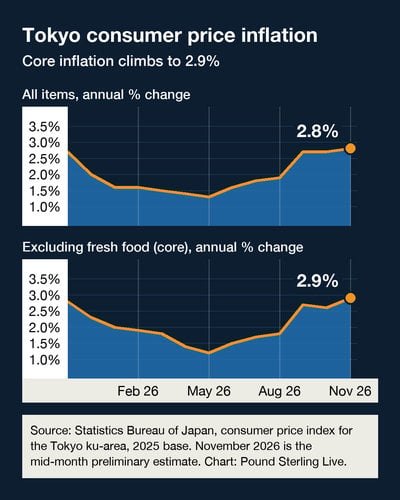
Headline inflation and the measure that strips out both fresh food and energy missed forecasts: the headline rate rose only from 2.7% in October, and the underlying measure slowed to 2.5% from 2.6% against a 2.7% consensus.
The yen risks a slightly weaker near-term outlook from an undershoot of this kind, because money markets tend to trim the odds of a rate rise when inflation misses forecasts. Inflation running well above the Bank of Japan's 2% target keeps the yen's broader rate support in place.
Higher expected Bank of Japan rates lift yields on Japanese government bonds and draw in foreign buyers who need yen to buy them, which is why firmer inflation tends to support the currency. A hike that markets already expect moves the yen only if the outcome or the Bank's guidance differs from what is priced.
On Wednesday, money markets priced about 17 basis points of tightening for the Bank's December meeting, roughly a two-in-three chance of a quarter-point hike. A basis point is one hundredth of a percentage point.
Goldman Sachs had forecast core Tokyo inflation of 3.1% for November, above consensus, as electricity and gas price controls unwind. Friday's 2.9% fell short of that call. Its economists expect the national measure that strips out fresh food and energy to stay above 2.5% throughout the first half of 2027.
"We think the BOJ is highly likely to respond to the substantial rise in inflation rate from late 2026 with further rate hikes, out of concern that underlying inflation could exceed 2%. We now expect three 25 bp BOJ policy rate hikes in December 2026, March 2027 and June 2027, bringing the terminal rate to 2.0%," says Goldman Sachs in a recent update.
However, "Whilst the Bank of Japan must prioritise price stability as a key foundation for growth, the current economic backdrop does not warrant aggressive tightening," says Brian Martin at ANZ, reviewing Japan's business surveys released on Tuesday.
Rate support aside, the yen made its biggest one-day gain this month on safe-haven demand: UOB says it was the standout gainer as investors sought safety during the 20 November sell-off in technology shares. The pound-to-yen rate fell from 211.58 on 12 November to a low of 207.07 on 24 November.
Nomura says Japanese government bonds and the yen "may become more attractive as overseas yields peak toward year-end" if Japan's authorities confirm their commitment to the Bank of Japan's rate-hike path and to restraining new government borrowing.
The bank forecasts the dollar-to-yen rate at 154 in one month and 150 in three months, from 159.29 after Friday's November inflation figures.
Over the near term, Nomura says "the risk of yen appreciation, particularly through yen crosses, warrants caution," and the pound-to-yen rate is one of those crosses.