

Image © Leonid Andronov, Adobe Stock
The Japanese yen needs the Bank of Japan to raise interest rates further than markets expect if it is to recover against the pound and dollar, with Friday's inflation data and a hawkish Federal Reserve the near-term tests.
That's according to institutional analysts we follow, as well as the majority of fund managers recently polled on the issue.
Fund managers say a terminal rate of 2.25% or higher is needed in order "to stabilize JPY," according to Bank of America, commenting on their November survey of 41 global fixed income fund managers.
"We expect three more rate hikes to a 2% policy rate by June 2027," says a new 2027 outlook from Goldman Sachs.
"In recent weeks, market pricing for the BOJ has moved significantly towards our own view; our new forecast is now more hawkish than the market's," it adds.
However, the consensus amongst economists puts the policy rate at 1.46% by June 2027, roughly just one hike above today's 1.25%.
If the Bank of Japan hikes according to Goldman Sachs's tune, the gap between Japanese interest rates and those in the UK and US (all else equal, of course) will fall, reducing the yen's viability as a funding currency for carry trades.
That's where investors borrow in low-yielding yen to buy higher-yielding assets, and in turn lifting the yen against the pound and the dollar.
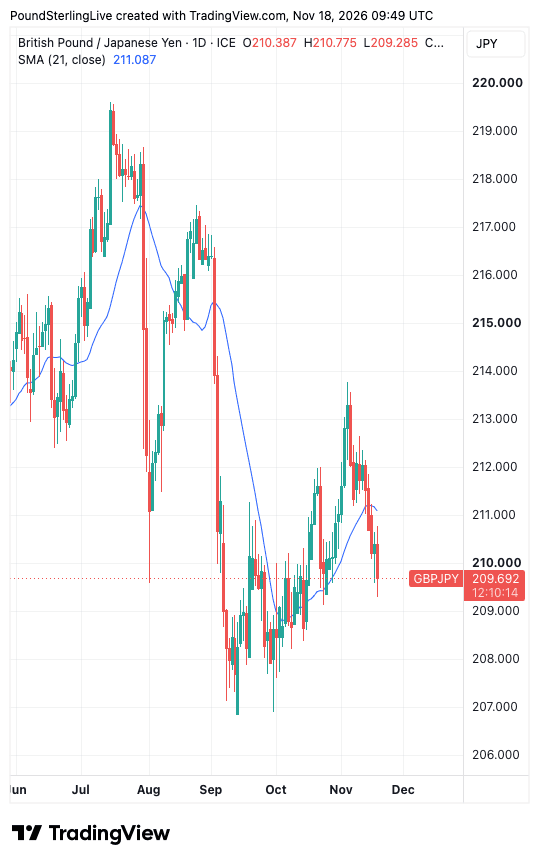
Above: GBP/JPY at daily intervals.
In line with its bullish rates forecast, Goldman Sachs expects the yen to gain through 2027 as Japanese policy turns supportive, "our preferred estimate of fair value suggests that the Yen is roughly 30% undervalued versus the Dollar," says a new FX outlook from the investment bank.
"There have been several important developments in domestic policy over recent months that we think have changed the trajectory for the Yen," it adds.
Hajime Takata, a Bank of Japan Policy Board member who voted for a hike in October, said on 16 November the Bank needs to be nimble on the pace and size of rate hikes and bring the policy rate sufficiently close to neutral, the level that neither stimulates nor restrains the economy.
Takata also urged close attention to the impact of the exchange rate on prices, a reference to the inflation a weak yen imports.
Japan's economy stalled in the third quarter, with GDP flat on the quarter against expectations for 0.1% growth, official data showed on 16 November.
"Overall, we think the slowdown in Japan's economic growth in Q3 is unlikely to sway the BoJ from resuming its hiking cycle in December, following its hawkish hold in October," says a note from Pantheon Macroeconomics, the economic consultancy.
Money markets priced around an 85% chance of a hike at the Bank of Japan's 17-18 December meeting as of 17 November, so a December move alone would do little to lift the yen.
Japan's October inflation figures, due on Friday 21 November, are expected to show headline inflation rising to 2.5% from 2.1%.
A reading above 2.5% would strengthen the case for the further hikes Goldman Sachs expects and lift the yen, although US interest rates remain the bigger obstacle for the currency.
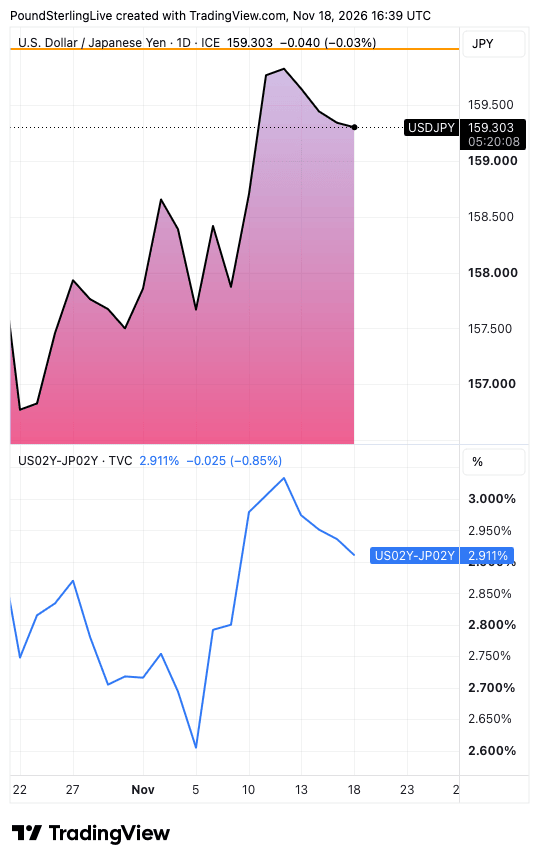
Above: USDJPY and the US-JP two-year bond yield, which is the difference in yield the two countries offer. We note that in November it has become more instructive of USDJPY direction.
US two-year Treasury yields sat above 4.8% on 17 November as money markets priced Federal Reserve rate hikes for December and early 2027.
"For USDJPY, cheap valuation alone is insufficient while rate differentials remain wide," says Lloyd Chan at MUFG.
"A sustained yen recovery ultimately requires further BOJ normalisation and a narrower US-Japan rate differential," he adds.
However, "one near-term risk to our bullish JPY view is that the Fed hikes faster and potentially more than markets currently expect over the coming months," says Goldman Sachs.
Morgan Stanley expects the dollar to keep rising against the yen into 2027, "JPY is caught between the JPY-positive convergence of US and Japanese front-end rates on the one hand and the JPY-negative impact of global risk appetite, terms of trade and the Carry Regime on the other," says the investment bank.
"Ultimately we project the latter will have the larger effect, in part because we think the market will continue to see the BoJ as 'behind the curve', limiting the JPY-positive effect of higher local rates," it adds.
Japan's Ministry of Finance has warned against further yen weakness, with Vice Minister of Finance for International Affairs Atsushi Mimura telling markets on 12 November it is "too early to forget what happened this summer", when Tokyo intervened to support the currency.
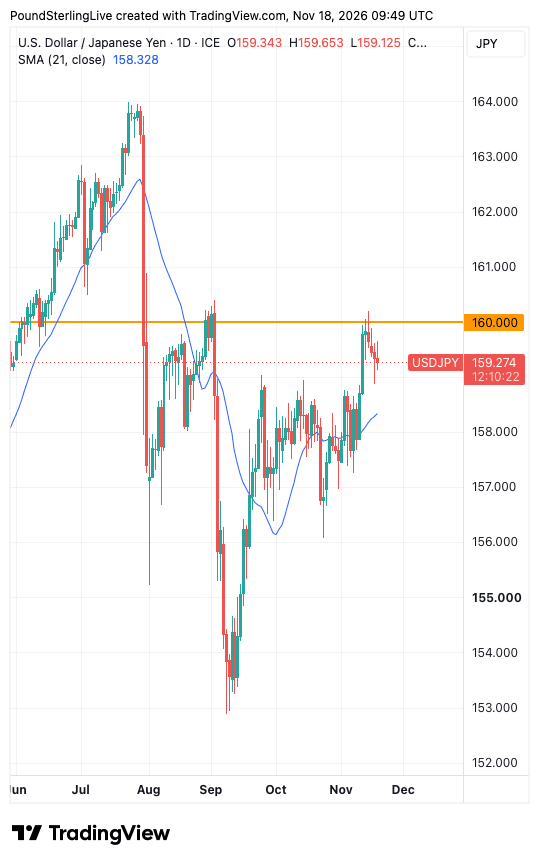
Above: USD/JPY at daily intervals with the 21-day moving average and the 160.00 level. The pair turned lower from 160.19 on 13 November, just short of the September high at 160.39.
Technical analysts at UOB have dropped their call for a break above 160, "upward pressure has eased, and USD has likely entered a range-trading phase between 158.60 and 160.15," says Quek Ser Leang, Senior Technical Strategist at UOB.
Goldman Sachs forecasts USD/JPY at 158 in three months, 155 in six months and 150 in 12 months, a 5.8% fall from 159.27.
Morgan Stanley's target of 162 by the end of 2027 sits 1.7% above that level.
Sterling Keeps a Wide Yield Advantage Over the Yen
Against the pound, the yen faces a Bank of England that raised Bank Rate to 4.00% on 5 November, and money markets on 16 November priced around a 67% chance of a further hike in December.
Bank Rate at 4.00% sits 2.75 percentage points above the Bank of Japan's 1.25%, and the three hikes Goldman Sachs expects would close only part of that gap.
However, "Sterling remains the most structurally overvalued G10 currency per our models, representing an important long-term headwind," says Goldman Sachs.
"All told, we see the net of these offsetting factors as implying broadly balanced risks to Sterling for 2027, though we lean to slight underperformance after strong gains in 2026," it adds.
Pound Sterling Live continues to hold a constructive medium-term view on the pound, with the Bank of England still raising rates as UK inflation proves sticky and slow to fall back to the 2.0% target.
GBP/JPY keeps a downside bias while it trades beneath its 21-day average, and a daily close below the October lows near 208.20 would put the September lows near 207 back in view.