Image © Adobe Images
The New Zealand dollar risks a slower recovery as the governing coalition loses its majority and needs the Opportunity Party's backing to govern.
The New Zealand dollar's recovery from its weakest levels since 2009 risks being held back by weeks of coalition talks, after Friday's official election count stripped the governing coalition of the majority it held on election night, analysts say.
National, ACT and NZ First hold 65 seats in the 130-seat parliament, one short of the 66 needed to govern, the Electoral Commission's official results show, with National down to 40 seats from 42 on election night once special votes were counted. That leaves the centrist Opportunity Party's seven seats as the coalition's only route to a majority.
"The political risk premium weighing on NZD is unlikely to dissipate anytime soon," says a new FX market analysis from Commonwealth Bank.
Friday's result lifted the kiwi only modestly: the New Zealand dollar-to-U.S. dollar exchange rate gained 0.3% to 0.5489 on Friday, and the pound-to-New Zealand dollar exchange rate fell 0.3% to 2.3882.
The modest gain came as stock markets recovered from a two-month downturn, with European shares up on Thursday and Asian shares higher on Friday. Investors usually buy higher-risk currencies such as the kiwi when shares rise.
Commonwealth Bank of Australia adds that NZD/USD "fell briefly on the news that the NZ's election may have resulted in a hung parliament."
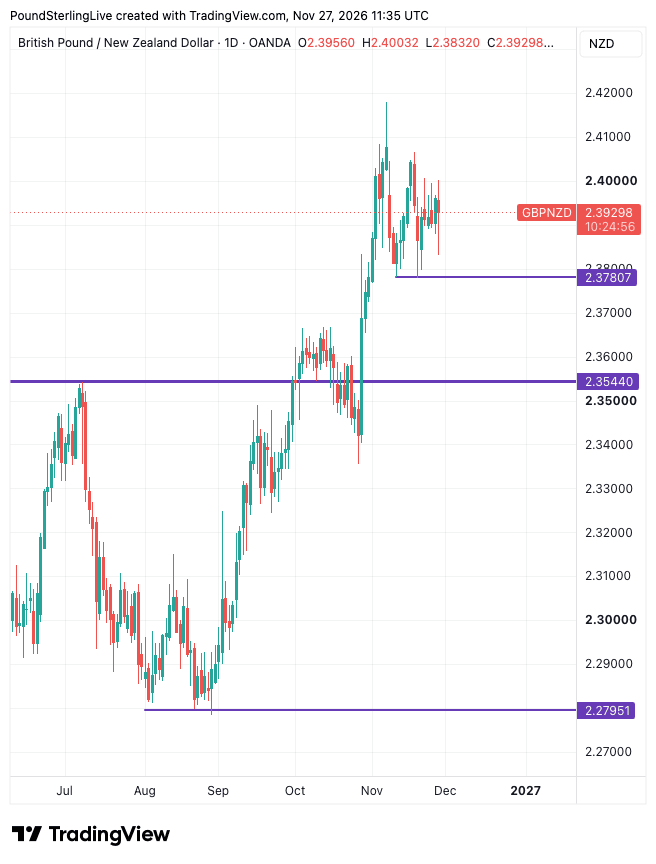
Above: GBP/NZD is off the highs, but would be lower were it not for the political premium weighing on NZD.
The kiwi is lagging the rebound in stocks because investors are charging a real political risk premium.
A risk premium is the extra return investors demand to hold a country's assets when its politics is unsettled, so a drawn-out negotiation keeps some foreign buyers away from New Zealand assets and the currency they need to buy them.
"The kiwi's gains are being held up by political uncertainty," says Raffi Boyadjian, Lead Market Analyst at XM.com, the online broker.
Boyadjian adds that without the Opportunity Party's backing "another election is possible as it would be impossible for other parties to form a majority government."
Labour, the Greens and Te Pāti Māori hold 58 seats between them, so the centre-left bloc would fall short of a majority even with the Opportunity Party on side.
"We think it will be very challenging to form a government before Christmas," say Westpac economists Kelly Eckhold and Darren Gibbs, who warn that "uncertainty may plague markets for a while."
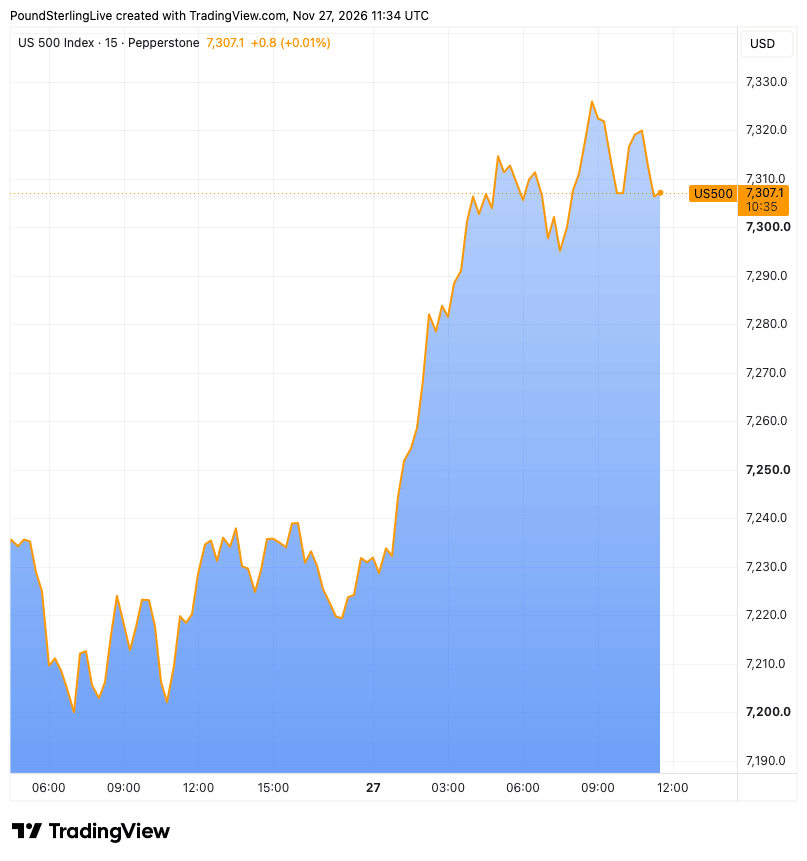
Above: The NZD tens to benefit when stocks recover, but is lagging the current move in global equities.
The kiwi has a direct stake in the outcome through the remit of the Reserve Bank of New Zealand (RBNZ). "A National-led win would preserve the RBNZ's single inflation mandate and a smaller fiscal footprint, supporting the NZD and bonds, whereas a Labour coalition would reinstate full employment into monetary policy," says Citi, the U.S. investment bank.
A central bank with inflation as its only goal is more likely to keep raising interest rates when prices run hot, and higher expected rates lift New Zealand bond yields and draw in foreign investors who need New Zealand dollars to buy those bonds.
Citi's desk reported speculative buying of the kiwi on its trading platform on 9 November, the first trading day after election night, when NZD/USD rose 1.6% and GBP/NZD fell 0.9% to 2.3871.
Those gains unwound as a selloff in AI-linked stocks took NZD/USD to 0.5449 on 23 November, its lowest close since 2009.
"The wobbles across risk markets continue to hold down cyclical currencies like the AUD and NZD," says Corpay's Peter Dragicevich.
The RBNZ is likely to make its next decision without a new government in place: ahead of the vote, Goldman Sachs judged that "a new government is unlikely to be formed until after the RBNZ's 9 December meeting."
Money markets priced a better than 80% chance on Thursday that the RBNZ raises its Official Cash Rate, its main interest rate, to 3.00% on 9 December.
Bank of America's Oliver Levingston says the RBNZ "is likely to hike in December, taking the OCR to 3.0%," a move he calls "supportive of NZD in the short-term," which would help the kiwi during the coalition talks.
Failed coalition talks, or the threat of a second election, would leave the pound free to retest its 2026 high against the kiwi at 2.4179, set on 6 November, a level where sellers have halted the pound's rally.
A coalition deal that removes the political risk premium would give the kiwi room to push GBP/NZD back to 2.3781, the 19 November low and a level where buyers stepped in to halt the pound's fall.
A daily close beneath 2.3781 would show sellers in control and open the way to 2.3544, which capped the pair in July and where buyers halted the fall on 9 October.