

Image © Adobe Images
The French economy risks a longer recession as investment keeps falling and job losses weigh on households.
The French economy contracted 0.2% in the third quarter, a sharper fall than the 0.1% first estimated, INSEE figures show.
"Following a 0.2% decline in the first quarter, the French economy has therefore contracted for three consecutive quarters. It has technically been in recession since the beginning of the year," says Charlotte de Montpellier, Senior Economist, France and Switzerland at ING.
INSEE rounds second-quarter output to flat, but its volume data show a 0.02% fall, making three declines in a row, one more than the two quarters of falling output that usually define a technical recession.
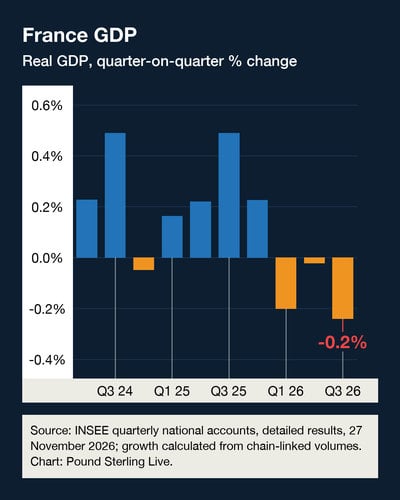
Above: French GDP, quarter-on-quarter % change. The second quarter's fall is visible only in INSEE's unrounded volume data.
INSEE says Friday's downward revision mainly reflected weaker investment in construction and in information and communication.
Investment fell 0.9% in the third quarter after a 0.5% drop, with spending on construction down 0.9% and on manufactured goods down 1.8%.
"The sharp fall in exports was the main reason for the GDP contraction," says de Montpellier.
Exports dropped 1.6% after rising 2.9% in the second quarter, and with imports up 0.1%, trade took 0.6 percentage points off growth.
A build-up in company stocks added 0.3 points to growth.
"Without this support, the contraction would have been much deeper," she adds.
Household spending rose 0.3%, although final domestic demand as a whole stayed flat and made no contribution to growth.
Purchasing power per consumption unit, INSEE's measure of household income adjusted for prices and household size, rebounded 0.2% after a 0.5% fall, with households saving 17.4% of their income.
That gain is at risk from a weakening jobs market: private sector salaried employment was 0.3% lower than a year earlier in the third quarter, a loss of 69,800 jobs, INSEE's flash figures show.
Unemployment stood at 8.2% in the third quarter, 0.4 percentage points higher than a year earlier, INSEE data show.
"The weakening labour market will increasingly weigh on household confidence, income and consumption," says ING's de Montpellier.
November's business surveys showed no turn, with France's composite PMI, a survey-based gauge where readings below 50 signal contraction, falling to 46.2, as Pound Sterling Live reported.
ING calls easing inflation "the only good news": harmonised inflation fell to 3.2% in November from 3.7%, provisional INSEE figures show.
ING now expects zero growth in the fourth quarter, leaving the economy to grow just 0.1% in 2026 and 0.4% in 2027.
"France will enter next year without economic momentum," says de Montpellier.