Bookmakers Betway have revealed they are quoting odds of 3:1 for the GBP to USD exchange rate to achieve a rate of between $1.1-$1.19 at any point in 2016.
The call comes amidst a new concerted sell-off in the British Pound complex at the start of October.
The lowest-ever quote on GBP/USD, as per Bank of England data is 1.042 reached on 26th February 1985.
"The currency had been under pressure for the past few weeks but now that key support levels have been broken, many are wondering if the British pound will hit parity versus the U.S. dollar and/or euro," says Kathy Lien at BK Asset Management in New York.
Betway quotes 5:1 for the pound to trade in the region of $1-1.09 once again.
It’s 50:1 for the US Dollar to be stronger than the Pound at any stage this year.
Betway’s Alan Alger, said:
“The Pound has been wobbling ever since the UK’s historic Brexit vote on June 23rd and now punters are looking to capitalise on its weakness by backing it to slip further.
“While we expect Cable to remain above $1.20 at odds of 4:9, we’ve had plenty of interest at 3:1 for sterling to dip below that mark. And, at 5:1, it isn’t out of the question for the Pound to plummet further and trouble the historic low water mark of $1.05.”

For GBP/USD to hit parity it would need to fall another 20% and for EUR/GBP to reach this same value, it would need to rise 14%.
"Given how fast Sterling has fallen in the past month, it does not seem implausible but for that to happen, the process of Brexit would need to decimate the U.K. economy," says BK Asset Management's Kathy Lien.
Scotiabank: More Downside in GBP/USD, But Not Quite Below 1.20
GBP has dropped to a fresh multi-decade low with a technically-driven break through the July low around 1.28, pressured by sentiment and Brexit-related concerns.
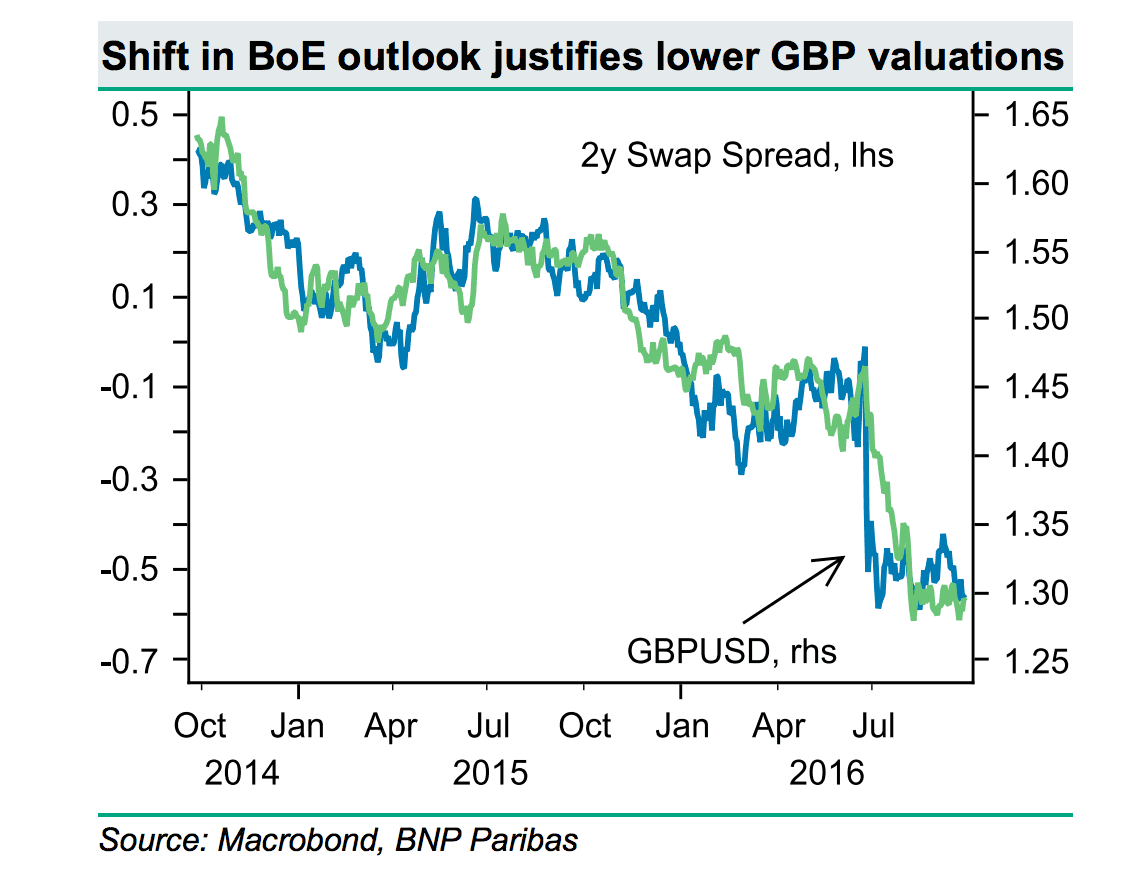
"The U.K.-U.S. 2Y yield spread is at historical lows, pushing beyond -70bpts, and measures of implied GBP volatility are inching higher, generating a rise in the premium for protection against GBP weakness. We look to further GBP weakness toward 1.25," says Eric Theoret at Scotiabank.
Latest Pound / US Dollar Exchange Rates
  | Live: 1.3327▲ + 0.18%12 Month Best:1.3867 |
*Your Bank's Retail Rate
| 1.2874 - 1.2927 |
**Independent Specialist | 1.3141 - 1.3194 Find out why this is a better rate |
* Bank rates according to latest IMTI data.
** RationalFX dealing desk quotation.
GBP/USD short-term technicals remain bearish argues Theoret according to momentum signals and the RSI is only just approaching the oversold threshold at 30.
With Sterling not being oversold the prospect of a near-term bounce remains slim.
DMI’s are providing confirmation and MA’s are bearishly aligned across a range of time horizons.
"There are no major/significant technical levels ahead of the February 1985 low at 1.0520," says Theoret.
Also seeing further weakness is Societe Generale's Kit Juckes who tells clients:
“Sterling will get support from the economic data only if their resilience lasts long enough to challenge the view that rates will be cut again due course. The better recent data clearly reduce the chances of a near-term cut, but that doesn't matter so much as what happens over the next year or so.
What this means for the exchange rate is that it will probably continue tumbling well into the 1.20s.
“If I extrapolate the correlation between GBP/USD and rates, GBP/USD 1.25 is reached if the market prices a 12-month forward rate differential of 1%,” says Juckes.
But Some Say the Pound is Now Undervalued
Indeed, the market is still very negative on the GBP with speculative market positions remain stretched to historical extremes: net speculative shorts are nearly 2 standard deviations above the historical mean.
The consensus forecast for the GBP/USD at year-end is 1.27.
However, not everyone agrees with the view that the only way is down for Sterling.
Aurelija Augulyte, currency analyst with Nordea Markets believes the GBP is already undervalued by most long-term measures; the PPP suggests the GBP/USD cross is some 10% too low relative to fair value.
While domestic politics matter, global factors will play a big role in the coming months too.
"As the GBP remains the most “risky” of the G4 currencies, higher oil prices, long yields and in general positive risk sentiment, which we expect into the year-end, should be GBP supportive," says Augulyte.
Nordea Markets are thus more positive than the consensus and see GBP/USD higher by end-year, at 1.32, and EUR/GBP at 0.84.
Others agree that chasing the Pound lower at this juncture is risky.
"In our view, the bulk of the GBP’s post-Brexit decline has now taken place," says BNP Paribas' FX analyst Sam Lynton-Brown. “The GBP has now fallen to very low levels both historically and according to valuation metrics, which likely represents an attractive entry point for long-term GBP buyers.”
BNP Paribas forecast GBP/USD at 1.37 by the end of 2017, which infers a massive recovery from present levels during the next year.
That said, in the near term the GBP is likely to remain weak admit's Lynton-Brown. "Our end of year GBP/USD forecast is 1.28.”
In the short-term, the UK economy is likely to find itself in a challenging environment.
Growth may drag and Lynton-Brown expects the BoE to cut interest rates again to 0.1% (from 0.25% presently) and to increase QE by a further 50bn in February.
The cut to interest rates should ensure the interest rate differential between the US and UK should ensure the GBP remains subdued:
Sterling Aided Higher by Data
Better than expected U.K. services growth helped stem losses in the under-pressure Pound.
U.K. services growth moderated in September after posting a record rebound in August which was no surprise.
The data leaves the average level of the economy-wide composite PMI over Q3 as a whole consistent with GDP growth of about 0.2% says Paul Hollingsworth at Capital Economics.
While this is a considerable slowdown from the 0.7% expansion seen in Q2, it is still better than most were expecting in the immediate aftermath of the referendum.
"And if the PMI remains around its current level then we could even see growth accelerate in Q4," says Hollingsworth.