
Pound Sterling is under notable pressure against the Euro - we look at why this is and ask analysts where they see the UK currency heading from here.
- British Pound to Euro exchange rate today: 1.1438, 2016 low at 1.1428, day's best: 1.1483
- Euro to Pound Sterling exchange rate today: 0.8742, today and 2016's best exchange rate: 0.8750
- Forex.com tell us the Pound is nearing a bottom
- AFEX, ING see no reason to believe the sell-off will end anytime soon
GBP suffered a fresh 2016 low against the Euro on Tuesday 4th October as currency traders continue to sell the currency on fears the UK will get a distinctly crumby deal out of impending Brexit negotiations.
The sell-off was triggered by confirmation from Prime Minister May that Article 50 of the Lisbon Treaty will be triggered before the end of March 2017, thus beginning a two-year negotiation process to leave the EU.
While the clarity will be welcomed the positives appear to be overshadowed by May’s pitch for an outcome that will hand the UK full sovereignty.
Indeed, the Government appears keen to make the free movement of people a red line in negotiations which will likely mean the UK loses full access to the European single market.
The freedom of movement of people between members of the single market is a fundamental cornerstone of the European project.
The imposition of tariffs on UK imports by Europe, and potential loss of financial services passporting, would likely have a negative impact on economic growth over coming years and imply a Bank of England that keeps interest rates lower for longer.
Latest Pound/Euro Exchange Rates
  | Live: 1.1656▲ -0.01%12 Month Best:1.1828 |
*Your Bank's Retail Rate
| 1.126 - 1.1306 |
**Independent Specialist | 1.1493 - 1.1539 Find out why this is a better rate |
* Bank rates according to latest IMTI data.
** RationalFX dealing desk quotation.
Forecasting Declines to 1.1340 and Lower
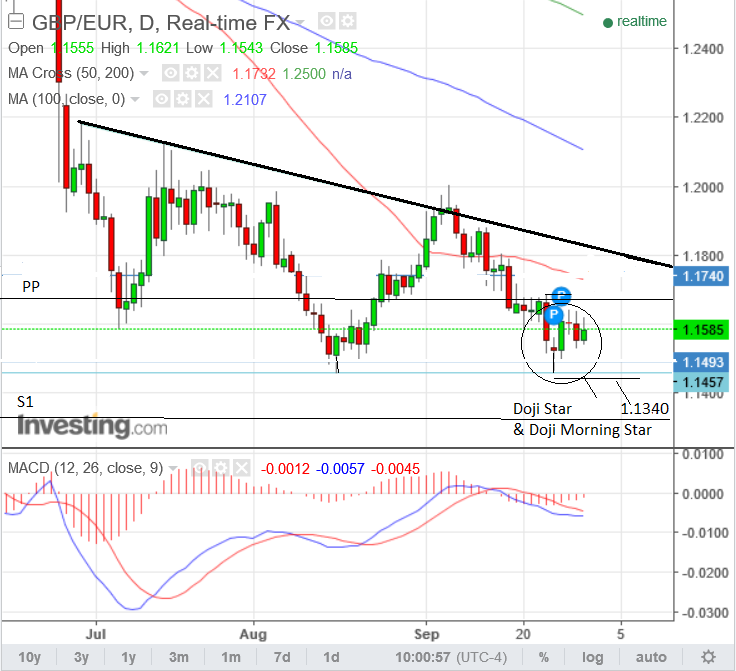
From a technical perspective we expect the run lower in the GBP/EUR exchange rate to extend noting last week's upside momentum has reversed.
There is strong resistance capping gains at the 1.1688 highs which is likely to mean a break higher will not materialize.
As such we see a break lower as more likely on balance.
The move below the August lows at 1.1450 is the trigger we believe suggests an extension lower towards our downside target at 1.1340:
"As with other Sterling crosses little evidence exists to suggest emergent strength here is anything other than corrective and indeed even if prices exhaust themselves temporarily on the downside no major bottom is expected to form," says Lucy Lillicrap, an analyst with AFEX in London.
An attempt has been made to re-stabilise above 1.1500 in recent days but the environment remains dominated by supply and Lillicrap says a sell-off towards 1.1150/1.1050 is likely before support firms again.
"To reduce current bear risk a swift rally back through 1.1725 is needed but looks increasingly difficult to realise," says Lillicrap.
Meanwhile, analysts at ING have confirmed to clients at the start of October that the UK currency is likely to fall to 1.11.
"We still expect the political impasse from Brexit to weigh on GBP over the next six months, stretching EUR/GBP towards extremes of valuation at 0.90," says ING's Chris Turner in London.
EUR/GBP at 0.90 = GBP/EUR at 1.11.
The BoE appears to have no fears about inflation expectations, where those derived through the two year inflation swap remain above 2.80% - largely on the back of GBP-inspired imported inflation and perhaps BoE credibility.
"Thus real GBP rates are falling. These should keep GBP soft," says Turner.
But, Could the Worst Now Have Passed?
Sterling has been under pressure since the infamous June 23rd referendum and analysts continue to question just how low the currency can go, particularly in the face of strong economic data.
"While one could argue that it may be a bit premature to start feeling bullish on the pound again, most of the negative news is out of the way now," says Fawad Razaqzada at Forex.com.
We had the initial Brexit vote shock, then the Bank of England’s response in the form of a rate cut and re-introduction of QE, and now we know that the Article 50 will be triggered before April next year.
"The markets are forward-looking and for sterling to weaken significantly further investors will be keen to find out what the next trigger might be. Specifically, they will be wondering if there will be any further Bank of England interest rate cuts to look forward to," says Razaqzada.
On that front, the BoE’s outgoing deputy, Minouche Shafik, has recently said that it may be necessary to loosen policy further. But she’s a known dove and is leaving in February anyway.
Razaqzada argues if UK data continues to improve like it has over the past several months then there is no need to do that anyway.
"The pound may well be very close to finding a base, though at this stage I wouldn’t rule out the possibility for it to weaken a little bit further in the short-term. What this means from a trading point of view is that we could start seeing the dips being bought and rallies sold into, leading to more range-bound activity until probably the buyers come out on top at some point in the near future," says Razaqzada.
The Pound’s potential strength could become visible more against currencies where the central bank is even more dovish than the BoE.
Razaqzada does say against the dollar however it may struggle, especially if this week’s US economic numbers, including the jobs data on Friday, come out ahead of expectations.
UK Economy Strong but Could Weaken Notably Going Forward
The UK economy continues to defy pre-referendum predictions that it would weaken substantially in the case of a Brexit, and this continues to keep the pound in its current 1.14-1.20 range against the Euro.
Some relief was provided on October 3rd with the release of some impressive manufacturing PMI data which showed the sector to be growing at its fastest rate since 2014 having in September posted a joint-record highest reading.
"In the short term the UK economy is benefiting from the current course of events as the lower Pound continues to spur manufacturing demand. Today's UK PMI reading was sharply higher than forecast coming in at 55.4 versus 52.1 projected. Presently, the UK is enjoying the best of both worlds as its firms have full access to the European market but while seeing their exports becomes instantly competitive after the Pounds 15% decline since Brexit vote," says Boris Schlossberg at BK Asset Management.
We await Wednesday's release of Service PMI for further data guidance as this sector accounts for over 80% of all UK economic activity.
Unicredit’s, UK Economist, Daniel Vernazza argued, that Friday’s UK Services Output data which resoundingly beat forecasts of 0.1% by rising 0.4% in July, was a strong positive sign for growth since Services Output has a major impact on the economy.
“Services output accounts for almost 80% of GDP and today’s number suggests the UK economy was much stronger than we had initially expected in the immediate aftermath of the vote,” said Vernazza.
Other data released by the Office for National Statistics (ONS) on Friday, revised growth up in Q2 to 0.7%, from 0.6% previously, which is also – remarkably -- above the long-term average of 0.5-0.6%.
Longer-term the Unicredit economist is sceptical about whether the economy can continue to lay such ‘golden eggs’:
“Services output release for July suggests the risks to even our upward-revised forecast are now to the upside, but importantly it’s still early days.
“Looking ahead, we expect the UK economy to slow materially, with GDP growth of 0.2% in 2017, as it faces a lengthy period of heightened uncertainty ahead,” he said.
Indeed, many believe it is not until Article 50 is triggered that Brexit will become an economic reality, with more impact on the economy.
Citibank’s analysis focuses more on Brexit negotiations as a driver of sterling, which it concludes is likely to lead to weakness.
“The current consolidation in sterling is likely to give way to lower levels.
“GBPUSD triggers stops below 1.3000 overnight as the unit remains highly sensitive to UK – EU trade negotiations later this year,” said CIBC.
They also fear a ‘Hard Brexit’ devaluing sterling.
“As time has progressed, the likelihood of a so-called ‘hard-Brexit’ has increased.
“That situation would involve giving up single market access for control over immigration.
“While the Bank of England can’t offset the long-term growth implications of such a scenario, it is increasing the chances that the MPC decides to take rates down to its effective lower bound of 0.10% in the coming months.”
Most analysts still expect a move from the BOE before the end of the year.
The main hard data releases in the week ahead come in the form of Manufacturing, Construction and Services PMI’s on Monday, Tuesday and Wednesday respectively.
Manufacturing is expected to fall to 51.2 from 53.3, Construction to 49.0 from 49.2 and Services to 52.0 from 52.9.
Manufacturing and Industrial Production on Friday, Oct 7 is another key metric to follow.
Outlook for the Euro: Deutsche Bank to Keep Currency Supported
For the Euro, there is a risk of further negative headlines concerning the future of Deutsche Bank.
Germany’s largest lender, is facing a financial crisis after having been slapped with a 14bn dollar fine by the US Department of Justice (DOJ) for mortgage-backed security violations, during the great depression.
The combination of the high cost of the fine and anaemic profits due to low deposit and lending rates in the Eurozone, which provide banks with restricted profit margins have put pressure on the bank’s shares, a significant asset on the balance sheet.
Fears of instability in the Eurozone banking system have led to the most recent fall in the EUR/USD pair from the 1.1250s down to the current 1.1160s.
“The resulting cash crunch could test the bank's liquidity and send financial markets into a panic,” said Kathy Lien, Director of BK Asset Management.
On Thursday it was reported by Bloomberg that major hedge funds and investors were pulling capital out of the DB en masse leading to even greater concerns about its financial stability.
Deutsche is the world’s fourth largest bank so any failure would have serious ramifications for the world’s financial system.
“It's highly unlikely that officials will allow it to fail given its importance not only to the European economy but to the global economy as well,” added Lien.
Interestingly, the Pound tends to suffer and the Euro benefit in times of heightened risk, so Deutsche Bank has been more of a threat to the Pound of late.
According to CIBC Economics, the euro has remained resilient during the DB crisis because it lessens the chances of the European Central Bank (ECB) increasing stimulus since this would put even more pressure on bank balance sheets.
It also increases the chances of the ECB embracing a pro-bank strategy such as BOJ’s recent yield-targeting, and possibly changing it to a less stimulus-orientated one – another positive for the euro which weakens from stimulus, as it tends to keep rates low and dilutes individual currency unit strength.
The euro may actually – counter-intuitively - gain succour from Eurozone bank weakness as the financial system will be even less able to recycle the region’s current account surplus.
If DB fails, the resulting global financial crisis might even send supportive flows to the euro, offsetting the immediate damage.
This would be via the repatriation of euro-denominated money lent to purchase riskier emerging market debt due to the region’s low borrowing costs, and the profitability of the carry trade.
Clearly, there is the potential for a counter-intuitive reaction from the euro to the DB crisis, or at least a less volatile-than-expected reaction, except possibly in Swiss Franc or Yen pairs, given these are both even stronger safe havens than the euro.