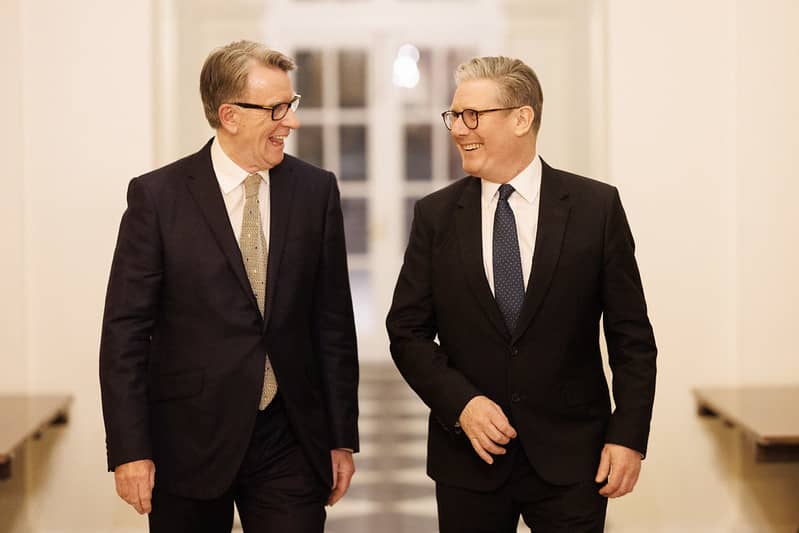
Above: Peter Mandelson and Keir Starmer in Washington following Mandelson's appointment as U.S. Ambassador. Picture by Simon Dawson / No 10 Downing Street.
Pound Sterling rocked by politics and Bank of England decision.
The British pound is vulnerable to further losses against the euro and other currencies, warn analysts following a tough Wednesday and Thursday session for the UK currency.
Sterling was rocked by renewed political intrigue and a signal from the Bank of England that it will cut interest rates next month, with some economists suggesting there are as many as three reductions in store this year.
"An earlier rate trough supports near term GBP downside," says Jeremy Stretch, FX strategist at CIBC Capital Markets, following Thursday's Bank of England decision.
The pound to euro exchange rate reached a new four-month high as recently as Wednesday when it hit 1.1606. It then collapsed to 1.1472 in a matter of hours.
Most investment bank analysts expect pound sterling to be particularly vulnerable against the euro, which will continue to benefit from the Eurozone's cyclical economic growth recovery and a protracted period of stable interest rates at the European Central Bank.
"We have raised the conviction on our long EUR/GBP trade to 5/5," says Dominic Bunning, FX strategist at Nomura, saying to buy the euro against the pound on the view that the Bank of England will cut faster than its European peer.
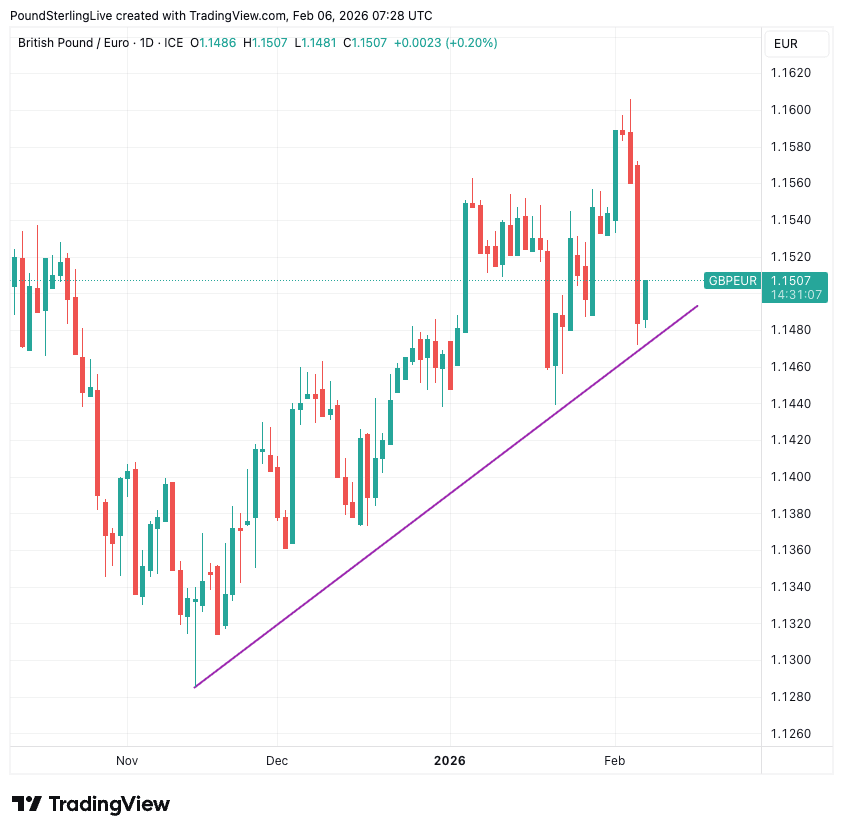
Above: GBP/EUR drops, but EUR buyers will take hope that it's still defending its uptrend line.
The trade looks for a EUR/GBP move to 0.8950, which would give a GBP/EUR target of 1.1173, a level that is consistent with the consensus of investment bank forecast points for 2026. (Request this forecast data here).
CIBC's Stretch says the subsequent failure of GBP/EUR to hold above the 200-day moving average points towards scope for an extension towards strong support at 1.1433, and below there towards 1.1367.
An under-pressure pound saw losses accelerate after the Bank of England left interest rates on hold but sent a series of signals that it was prepared to lower rates again next month.
Money market pricing shows investors have adjusted to expecting another interest rate cut after March, but some economists say the market has further to adjust as the Bank will cut three times in total this year.
"BoE seems to be decidedly more dovish than before - risks are skewing towards a cut next meeting AND more than two cuts this year," says Kallum Pickering, an economist at Peel Hunt.
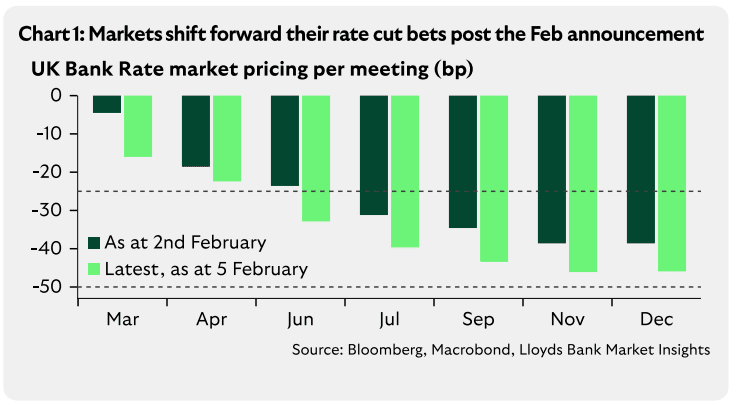
Above: The Bank of England has victory in its sights, predicting inflation is about to fall, and stay, at 2.0%.
The Bank said it would be appropriate to lower rates in the future as it is now more confident that inflation will hit 2.0% in April and stay there for a protracted period.
The Bank of England's decision landed on a pound that was already under pressure as pressure mounted on Prime Minister Keir Starmer over his handling of the Mandelson-Epstein affair.
The Prime Minister conceded in Parliament midweek that he knew of Peter Mandelson's ongoing relationship with convicted paedophile Jeffrey Epstein when appointing him to the position of U.S. Ambassador. This triggered a backlash by many in his own party.
"Should PM Starmer be forced from office, potentially beyond May local elections, this could add a degree of additional political risk into the UK curve, further compromising Sterling," says Stretch.
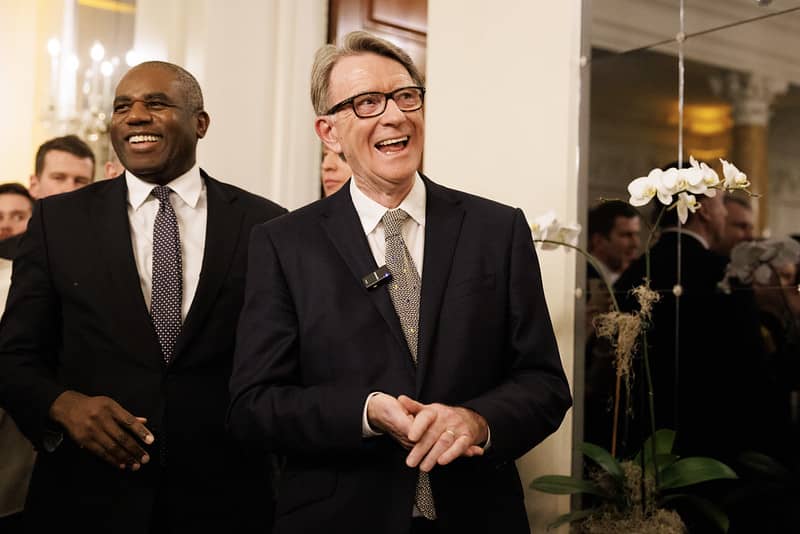
Peter Mandelson, UK Ambassador to the United States of America, and Foreign Secretary David Lammy listen to Prime Minister Keir Starmer speak at the British Embassy to the United States of America. Picture by Simon Dawson / No 10 Downing Street.
The fear for markets is that Starmer's replacement will be less committed to fiscal discipline.
"GBP and gilts plunged driven by UK political uncertainty. Prime Minister Keir Starmer is facing intense leadership speculation over his decision to appoint Peter Mandelson as US ambassador, despite knowing about his connection to Jeffrey Epstein. Markets worry that a Starmer exit could push the Labor government towards more left-leaning fiscal and regulatory policies," says Elias Haddad, a strategist at Brown Brothers Harriman.
Analysts at Investec say political developments will likely remain in the spotlight for UK markets in the coming days, given the pressure on PM Starmer over his previous appointment of Peter Mandelson as ambassador to the U.S.
"Reports of a potential leadership challenge early Thursday morning led to selling in gilts and sterling, the fall in gilts only arrested by the dovish surprise in the BoE’s voting at midday. The curve though has steepened materially. As such political developments over the coming days could have the potential to have a larger impact on domestic markets than economic data," warns Investec.
We entered this week thinking the multi-week rally in the pound could continue a little longer if domestic fundamentals remain low-key.
That they have not.