
Image © Adobe Images
The Bank of England almost cut rates today, and a March move is now firmly on the table.
The British pound plunged deeper into the red after the Bank of England left interest rates on hold, but a surprisingly close vote meant a cut next month is almost assured.
The 5-4 vote in favour of a hold was closer than anticipated and signals momentum building behind another rate reduction on the Monetary Policy Committee.
The development weighed on the pound, which was already under pressure owing to concerns about the stability of the Keir Starmer government. "Today’s dovish communication from the BoE has added to a softer pound – already under pressure from local politics," says Chris Turner, head of FX analysis at ING.
The pound to euro exchange rate has sliced through 1.15 to go to 1.1496, marking an extraordinary turnaround for a currency pair that had hit a new four-month high just the day before. The pound to dollar exchange rate is now lower by half a per cent on the day at 1.3565.
Political uncertainty and building bets for lower central bank interest rates are proving a negative cocktail for sterling that threatens to bring an end to a multi-month recovery.
The Bank of England said in a statement that it expects to hit the 2.0% inflation target in April, allowing it to focus on the deteriorating labour market.
With job losses mounting, the Bank will lower interest rates to underpin businesses and households and limit job losses. However, from a textbook FX perspective, that will weigh on the pound.
"The risk from greater inflation persistence has continued to become less pronounced, while some risks to inflation from weaker demand and a loosening labour market remain," said the Bank.
"On the basis of the current evidence, Bank Rate is likely to be reduced further," it adds.
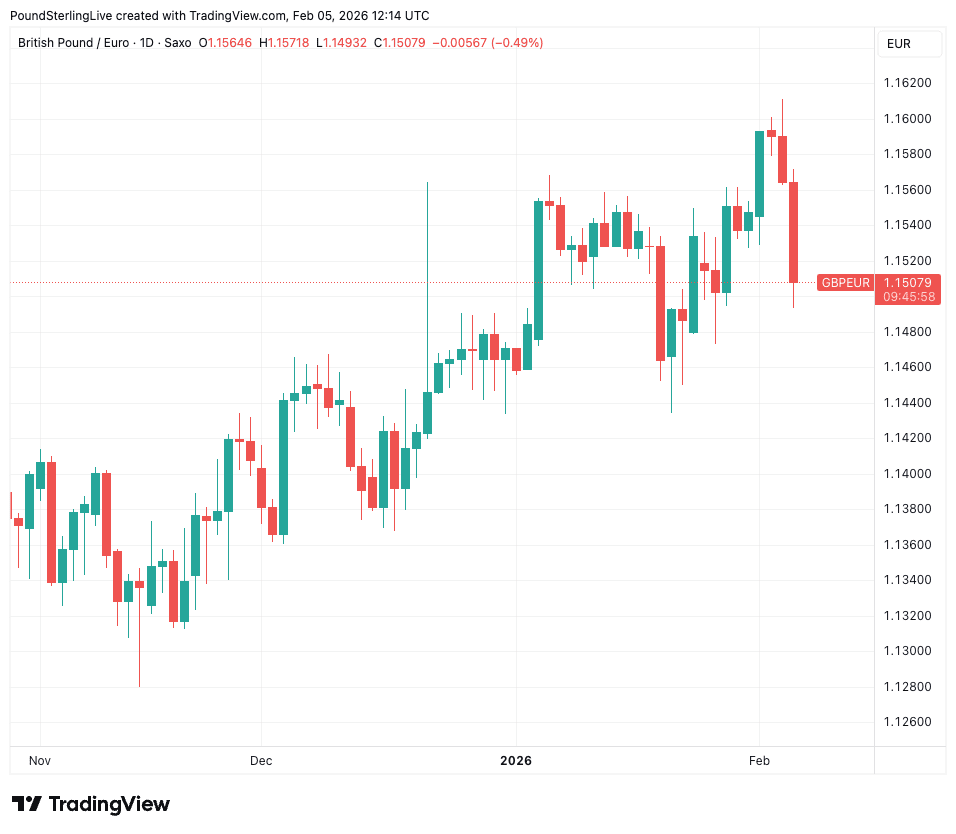
Above: GBP/EUR endures a sizeable selloff.
Money market pricing (OIS) shows the market is now priced for 50 basis points of rate cuts (two full cuts) by year-end, up from 35bp.
"So long as the data continues to follow recent trends – weaker employment, lower wage growth, easing inflation – then we think a March cut is likely to be followed by another in June," says James Smith, Developed Markets Economist at ING.
The Bank of England's in-house economists issued new forecasts and analysis showing wage growth is trending down and is now consistent with the 2% inflation target.
Consensus projections for the next four quarters, compiled from leading investment banks.
Access the full forecast →
ING thinks inflation will fall even further, forecasting a decline to 1.8% in April and that it will stay around 2% through the spring/summer.
Progress towards these targets should become evident before the Bank's March meeting, which will prompt Governor Andrew Bailey to side with those MPC colleagues wanting to cut interest rates.
"Bailey and Mann can now both be considered potential tie-breaking votes for a March cut, having exhibited dovish tilts in their paragraphs," says Julie Ioffe, European Macro Strategist at TD Securities.
The Bank's new forecasts also show in-house economiests lowered GDP forecast for 2026 from 1.2% to just 0.9%.
This would be slower than last year's estimated 1.4% and, more worryingly, a full half a percent lower than the OBR’s forecast of 1.4% for 2026 which was baked into the last Budget.
Bank staff also raised their forecasts for the unemployment rate for every year from 2026 to 2028.