Image © Adobe Images
The pound could struggle to extend a recent rebound against the dollar.
GBP/USD enters the new week at an important technical juncture: the pair has staged a recovery from the June low, but the rally has now run into a major descending trendline that has defined the broader downtrend since January.
At the same time, buyers continue to defend a rising trendline from the late-June low, leaving price compressed inside a symmetrical triangle.
The coming sessions are therefore likely to determine whether the pound-to-dollar rate resumes its broader bearish trend or breaks into a more sustained recovery.
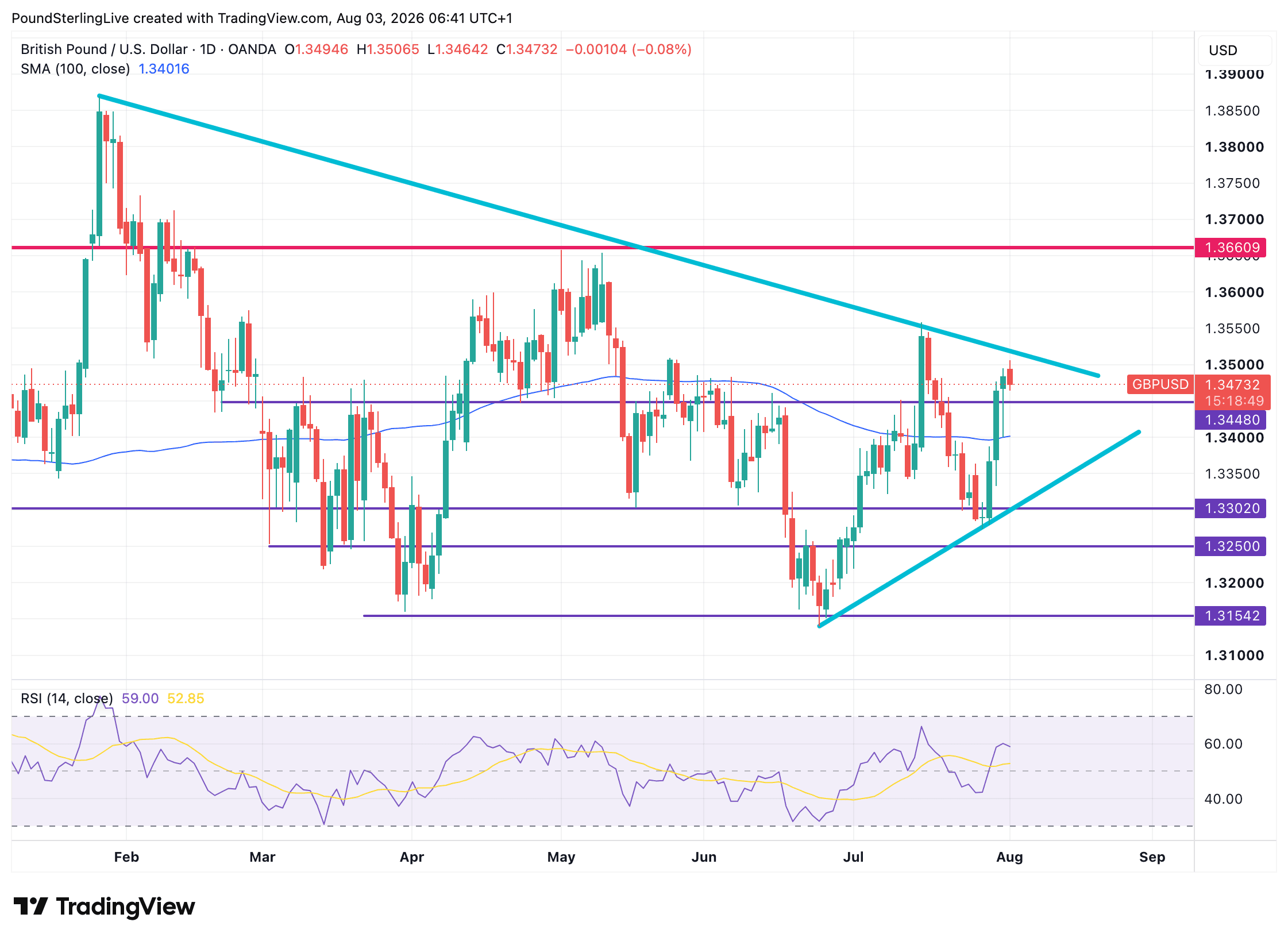
The technical backdrop reflects this balance as sterling has reclaimed the 100-day moving average at $1.3400, signalling that near-term momentum has improved, while RSI has recovered to around 59, comfortably above neutral but below overbought territory.
However, neither indicator is sufficiently strong to confirm a fresh uptrend.
Instead, the market remains trapped between converging trendlines, suggesting volatility is being compressed ahead of a larger directional move.
The key question for the week ahead is whether buyers can finally overcome the descending trendline that has repeatedly capped rallies throughout 2026.
A convincing break would mark the first meaningful violation of the sequence of lower highs that has characterised the broader technical picture.
Failure at trendline resistance, however, would reinforce the view that recent gains are corrective within a larger bearish structure.
Dollar Weakened by Intervention
A major driver of recent USD weakness has been concerted selling of the dollar to support Japan's yen, implying that much of last week's USD weakness could be artificial.
Japan and the US acted in a coordinated manner to stem JPY weakness over the last two days of last week.
On 30 July, Japan undertook a unilateral intervention and the NY Fed conducted rate checks; then on 31 July, Japan sold USDJPY again and the US sold EURJPY.
"The scale of the JPY appreciation on the first day of intervention was 3.5% (versus USD) on an intra-day basis and 3.0% relative to the level of USDJPY immediately before the plunge, broadly consistent with the 3.2% move at the time of the Golden Week intervention," says a note from Barclays.
The Dollar meanwhile looks set to endure ongoing support from persistent market expectations for U.S. Federal Reserve rate hikes in response to elevated U.S. inflation levels.
Even after a 'less hawkish' Fed policy update last week, and recent downside surprises in U.S. inflation data, the futures market continues to price in two Fed hikes by mid-2027.
That expectation can continue to underpin the dollar's medium-term outlook.