Image © Adobe Stock
The British pound's advance against the dollar reaches an important technical junction.
The pound-to-dollar exchange rate trades at 1.3463, slightly higher than where it ended Friday, suggesting that the weekend's escalation in geopolitical tensions in the Middle East has had a limited effect on FX markets.
"In fact, the dollar should probably be doing better than it is," says Chris Turner, lead FX analyst at ING Bank. "In a relatively quiet week for data, expect investors to continue favouring energy-exporting currencies, including the dollar."
That's an ominous call for the coming week if it forebodes a USD catching up with the geopolitical fundamentals.
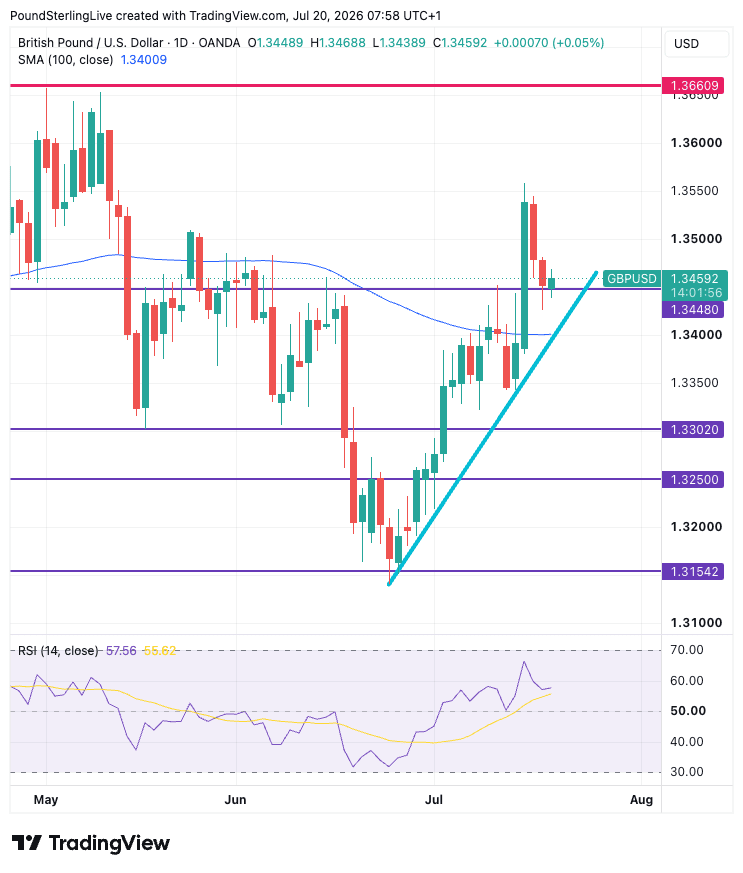
Nevertheless, a robust GBP/USD is consistent with a technical outlook that has improved following the exchange rate's break above the descending trendline and recovery through the 100-day moving average:
However, the pair is now entering an important confirmation phase.
The balance of probabilities favours further gains, provided buyers can defend the 1.3448-1.3401 support zone and establish the 100-day moving average as a new floor.
A successful hold would increase confidence that the late-June rebound has evolved into a broader trend reversal and expose 1.3500 initially, followed by a retest of 1.3560.
Conversely, a sustained move back below the 100-day moving average would suggest the breakout has stalled and raise the prospect of renewed consolidation, although the broader recovery would remain intact while 1.3302 continues to hold.
The key question for the week ahead is whether GBP/USD can turn the 100-day moving average, currently at 1.34, into support as a sustained defence of the 100-day moving average would shift the medium-term technical outlook in favour of the bulls.
The Dollar Ought to be Stronger
With the U.S. economic calendar entering a lull, foreign exchange markets and the 'big dollar' are likely to be heavily influenced by geopolitical developments.
U.S. forces over the weekend hit Iranian command centres, maritime capabilities, missile and drone launch sites, and communications networks to "further diminish" Iran's ability to attack commercial vessels and civilian mariners.
The U.S. and Iran have engaged in a series of tit-for-tat attacks, with the U.S. responding to Iranian missile and drone strikes, and Iran retaliating against US allies in the Middle East, including Kuwait.
The conflict has led to a rise in oil prices, with Brent crude rising almost 4% to trade above $90 a barrel, and has resulted in significant material losses and injuries in Kuwait, as well as damage to vital institutions.
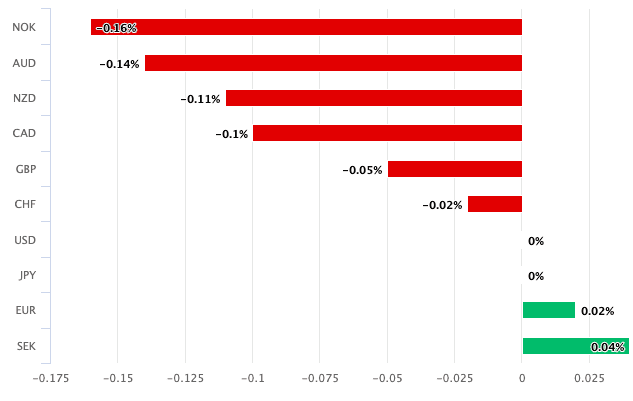
Above: USD underperforms on Monday.
ING's Turner reflects that these events should be bullish for the dollar.
"We are particularly focused on natural gas prices, which are now very close to their March highs again. And there is increasing focus on refined products, such as diesel, where higher prices can only add to fears of inflationary pressures being handed down global supply chains," he explains.
The pressures on these energy products should penalise energy importers, such as the Eurozone and UK while favouring exporters, such as the U.S.
"It is slightly surprising not to see the dollar a little stronger," says Turner. "The DXY dollar index is still about 1% off its June highs. This probably owes to last week's soft June US CPI and PPI data, which has taken some of the sting out of the hawkish Federal Reserve story."
Regarding the Federal Reserve, markets now only price about 40bp of Fed easing over the next nine months, compared to the 55-60bp of tightening priced for the eurozone and the UK.
"However, higher energy prices mean that the Fed will have to remain alert, and in this environment we struggle to see that any investors already owning dollars will be inclined to sell," warns Turner.
Any uplift in Fed hike expectations could rejuvenate the dollar and pressure GBP/USD once again.

The Bank Consensus, Without the Terminal
The median, mean, highest and lowest from the October survey update, plus named point forecasts out to 2027.
Free information pack, issued by World Wide Currencies.