
The British Pound is the talk of the FX markets on Friday 7th October having been the victim of a flash crash in early Asian trade that took the GBP/NZD to record lows.
The GBP/NZD pair hit a low on Friday morning at 1.5254 - our historical data suggests the pair has never in its history closed a day below this level.
Of course, there will not be such a low close today as Sterling has recovered from the flash crash that caused the decline and is now quoted at 1.7463.
However, the rapid decent has left confidence in the UK currency badly shaken and the pair is well below the levels quoted ahead of the crash.
Expect the bleed to continue.
The flash crash occurred when liquidity usually is at its thinnest, after US trade has closed and trading in Japan and Australia has just started.
In addition, activity was particallary low due to investors being cautious ahead of the US payroll figure released this afternoon.
The flash crash has left investors baffled with many speculating that computer algorithms trading triggered the fall.
Connor Campbell at Spreadex in London says there seem to be 3 main reasons being used to explain the flash crash:
1) it was a fat finger error,
2) it was an issue with algorithmic trading or
3) it was a reaction to Francois Hollande’s comments that the EU has to act firmly with Britain when negotiating the Brexit if it is to protect the ‘fundamental principles’ of the group. Most likely the rapid decline was caused by a mixture of 2 and 3, with thinner than usual trading ahead of this afternoon’s US non-farm jobs report exacerbated the drop.
Latest Pound / New Zealand Dollar Exchange Rates
  | Live: 2.3468▼ -0.47%12 Month Best:2.4815 |
*Your Bank's Retail Rate
| 2.267 - 2.2763 |
**Independent Specialist | 2.3139 - 2.3233 Find out why this is a better rate |
* Bank rates according to latest IMTI data.
** RationalFX dealing desk quotation.
NZD Strength Dampened by Dairy Results
Flash crashes aside, it has not actually been the best of weeks for the NZD thanks to increased expectations that the Reserve Bank of New Zealand (RBNZ) will cut interest rates at their next meeting in November.
The lower global Dairy prices reached at auction on Tuesday would have been a disappointment to the RBNZ, who follow them closely as they are a major export commodity for the economy, and the -3.0% fall will increase yet further the chances of a November cut.
Interest rate cuts typically weaken a currency, therefore the prospect of another RBNZ rate cut would be considered a dampener on further NZD strength.
Nevertheless, assuming the Bank of England (BOE) also cuts rates before the end of the year - an increasingly more probable scenario – the two cuts will cancel each other from a pure rate differential perspective.
The wide difference in interest rates that exist between New Zealand and the UK is likely to persist given the RBNZ base rate will be at 1.75% after a 0.25% cut, whilst the BoE base rate will be at 0.10% after the proposed 0.15% cut in its case.
This is still a wide 1.65% swap rate difference in support of the kiwi.
Bounce Not Expected to Last Much Longer
From a technical perspective, the pair has completed forming a rare right-angled triangle.
At the start of the week, the exchange rate briefly broke out to the downside as expected given breakouts from right-angled triangles tend to be in the direction of the flat edge:
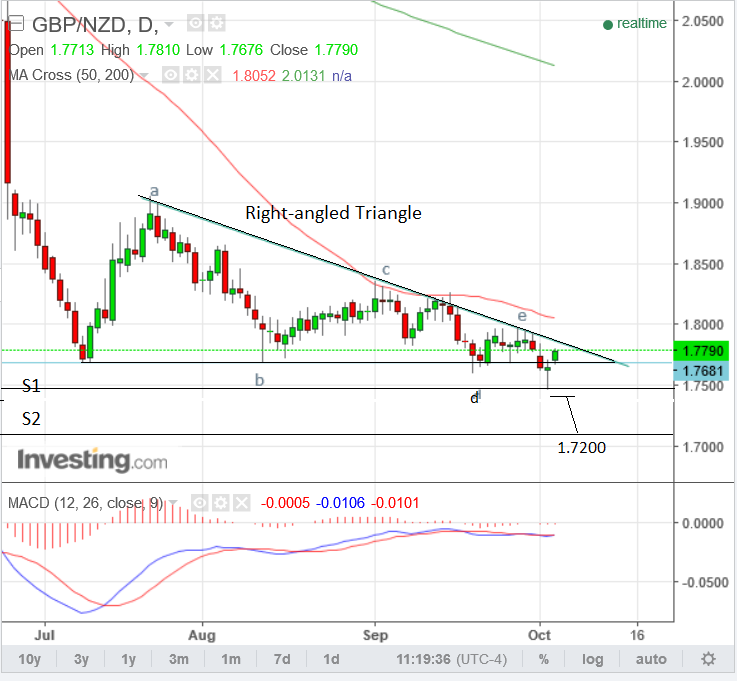
From there the exchange rate moved down to support at 1.7500 fairly rapidly.
This was tough support composed of the S1 monthly pivot, which is a level traders watch to gauge the trend and sometimes even fade.
The pair has since rotated and bounce higher from this level, however, the bounce is not expected to extend much higher given the right-angled triangle suggests an eventual minimum target at 1.7200, perhaps even lower.
Therefore, we still expect further downside to predominate, with a move clearly below the 1.7500 level, confirmed by a break below 1.7400 to an eventual target at 1.7200.