
Image © Adobe Stock
The New Zealand dollar won't be daunted by news of a rise in unemployment.
The kiwi was softer across the board and domestic bonds rallied after New Zealand unexpectedly reported an increase in its unemployment rate.
Unemployment rose to 5.4%, a ten-year high, from 5.3%, whereas the market expected an unchanged read of 5.35.
On paper, this implies there's no imminent need for the Reserve Bank of New Zealand (RBNZ) to raise interest rates, which mechanically raises the value of domestic bonds and weakens the currency.
GBP/NZD rises to 2.2695 from the previous day's low at 2.26. NZD/USD is steady at 0.6042 and EUR/NZD up slightly at 1.9584.
Mark Smith, economist at ASB says the data cautions against expecting an imminent RBNZ rate rise, similar to that seen in Australia on Tuesday: "A large margin of spare labour market capacity remains. The economic hole is still large with the NZ economy still around 32k jobs shy of late 2023 peaks."
However, the details of the report are more constructive and confirm the currency's 2026 rise won't be driven off course just yet.
After all, StatsNZ said the employment rate actually rose 0.5%/qtr, the strongest growth in 18 months.
This confirms that the rise in the unemployment rate is because more people are getting back out there to look for jobs, which is not a bad thing.
Consensus projections for the next four quarters based on our survey of the world's tier-1 investment banks.
Access the full forecast →
In fact, economists expect the ongoing economic recovery to result in a gradual erosion of excess labour capacity.
And that's the takeaway for the New Zealand dollar, which is showing its resilience in midweek trade, ensuring it holds onto its 2026 rally.
Gains for the currency are linked with rising bets the RBNZ will raise interest rates this year.
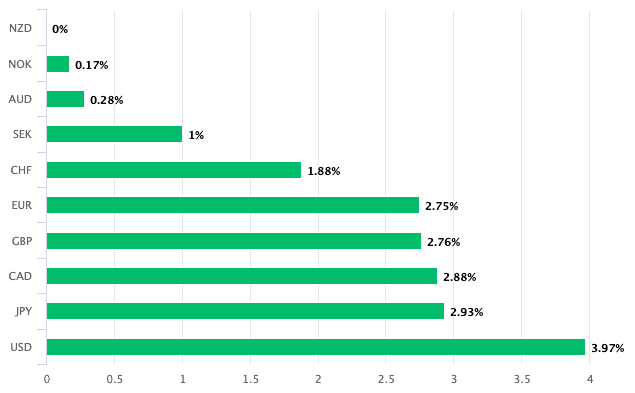
To be sure, odds of a hike receded following the labour market data, but markets are still pricing around 35bp of rate hikes by year‑end, i.e. at least one 25 basis point rise.
This will help the NZD against currencies belonging to central banks that are still in a cutting phase, for example the dollar and pound.
"Further improvement beckons in 2026," says ASB's Smith. "The unfolding economic recovery should see excess labour capacity gradually erode with the unemployment rate moving towards the 4% to 4.5% Goldilocks zone by the end of next year."
He explains that these figures will "not cause any sleepless nights for the RBNZ, with the NZ economy showing few signs of overheating."
ASB says the RBNZ can be patient in normalising monetary policy settings. "We expect a 25bp hike in December and 50bp of hikes in mid-2027."