
Image © Adobe Stock
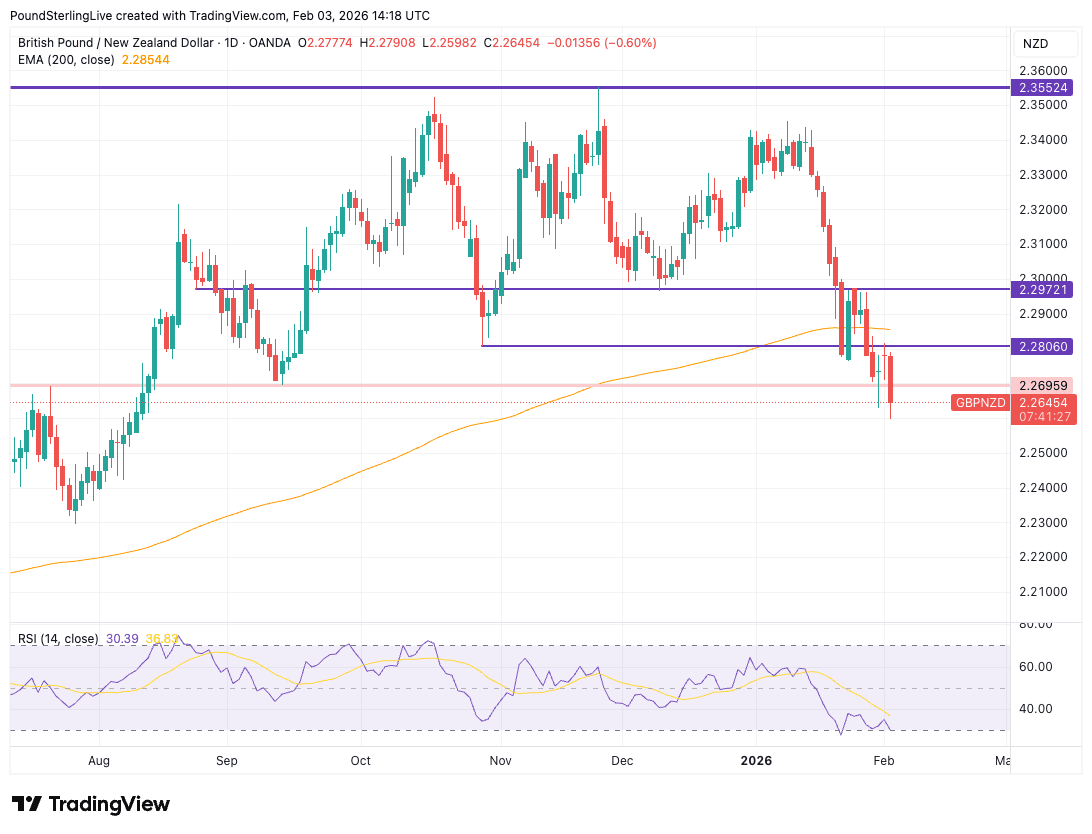
The pound to New Zealand dollar exchange rate has fallen sharply, with GBP/NZD down 0.60% and trading at 2.2638.
New Zealand dollar buyers now face the weakest exchange rate since August 2025, with the most competitive providers offering rates close to 2.2560, down from the offers around 2.33 seen in the middle of January.
The downshift reinforces the view that the path of least resistance remains lower, with GBP/NZD now comfortably below the 200-day moving average, a development that signals a medium-term downtrend is taking shape rather than a temporary correction.
This long-term indicator is widely used to distinguish between bullish and bearish phases, and sustained trading below it typically suggests rallies are likely to be sold rather than extended.
Momentum indicators confirm the strength of the move, with the Relative Strength Index hovering close to 30, a level associated with entrenched downside momentum.
At the same time, an RSI near 30 also flags increasingly oversold conditions, which can slow the pace of losses or prompt short-lived consolidation.

Weakness in GBP/NZD has been reinforced by a parallel selloff in GBP/AUD, highlighting how developments across the antipodean complex are feeding through into the cross.
Both the Australian and New Zealand dollars are being driven by similar cross-currents, most notably shifting interest rate expectations.
The Australian dollar has benefited from Tuesday’s interest rate rise by the Reserve Bank of Australia, which was accompanied by a more hawkish-than-expected message.
Policymakers highlighted strong demand conditions and left the door open to further rate increases, noting that previously flagged external headwinds have yet to materialise.
Consensus projections for the next four quarters based on our survey of the world's tier-1 investment banks.
Access the full forecast →
Those themes resonate beyond Australia, as New Zealand’s economy faces many of the same global influences as its larger neighbour and money markets are also pricing in rate hikes from the Reserve Bank of New Zealand in 2026.
However, unlike Australia, New Zealand’s domestic economy has shown signs of strain over the past two years, raising questions over how much excess demand truly exists.
That puts greater emphasis on upcoming New Zealand data releases, which will need to validate the market’s increasingly hawkish expectations.
Failure to do so could see the New Zealand dollar lose momentum quickly, opening the door to a reversal back toward late-2025 levels despite the current technical pressure on GBP/NZD.