
Image © Alfred Yaghobzadeh, European Commission Audiovisual Services
Euro can advance, but technical headwinds remain acute while the Federal Reserve stands out as the main calendar risk.
The euro-to-dollar exchange rate could extend its recovery in the coming days, although technical resistance overhead suggests gains may prove difficult to sustain.
EUR/USD rises to 1.1607 at the start of the new week as investors welcome progress in Middle East peace talks and take encouragement from lower oil prices, which ease some of the inflationary risks facing the U.S. and Eurozone economies.
From a technical perspective, the pair appears to have established a short-term base at 1.1500 after successfully defending the level on multiple occasions during May and June.
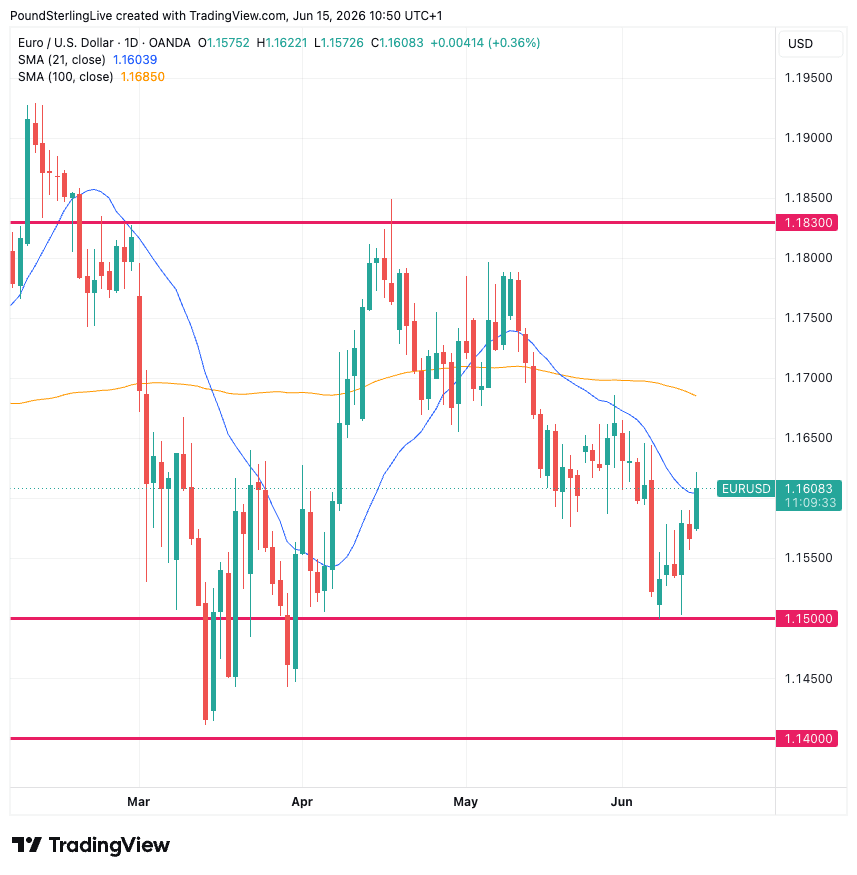
The support zone halted the April-May decline and provided the platform for a period of consolidation, a necessary precursor to any more meaningful recovery.
Although the subsequent rebound above 1.16 suggests downside momentum has faded, the recovery remains unproven from a technical viewpoint.
For starters, EUR/USD continues to trade beneath both its 21-day and 100-day moving averages, indicating that the broader short-term trend remains under pressure.
The 21-day moving average, currently located near 1.1604, is the first obstacle for bulls to overcome, a sustained break above that level would expose the 100-day moving average near 1.1685.
The 100-day is flat and occupies the centre of a multi-month trading range and therefore has a significant gravitational pull for the market. A mean-reversion to the level is therefore possible.
For now, the technical picture suggests the euro has room to recover further against the dollar, but confirmation of a more durable bullish turn will require a decisive break above the 1.1685-1.1690 area.
The Tailwinds
A return to the upper level of the recent range becomes more likely if a freshly minted peace accord between the U.S. and Iran reopens the Strait of Hormuz in the coming days and weeks.
Iran and the U.S. have agreed to a deal that will restart shipping through the important Strait, which will pressure oil and gas prices lower.
For the Eurozone economy, a net importer of energy, this is supportive. For the dollar, falling oil and gas prices are a traditional headwind.
There is always scope for disappointment, as a deal is yet to be finalised, but there's enough to suggest the dollar could be due for a geopolitically inspired setback.
"The consensus has turned more bullish on USD, but there are signs that a reversal lower in the USD could be more probable in the next few months," says Dominic Bunning, FX Strategist at Nomura. "We think it is right to question whether sentiment is already turning too bullish on the US again."
The Headwinds
The Eurozone calendar is light, with the ECB decision to raise interest rates now in the rear-view mirror and eyes are shifting to the upcoming Federal Reserve call, which could well determine where this pair ends the week.
Expect the Fed to remain on hold at Kevin Warsh’s first meeting as chair on 17 June and indicate that the next move in rates is as likely to be up as it is down.
In favour of lower rates is a U.S.-Iran peace deal that will help bring energy costs down and limit a rise in inflation.
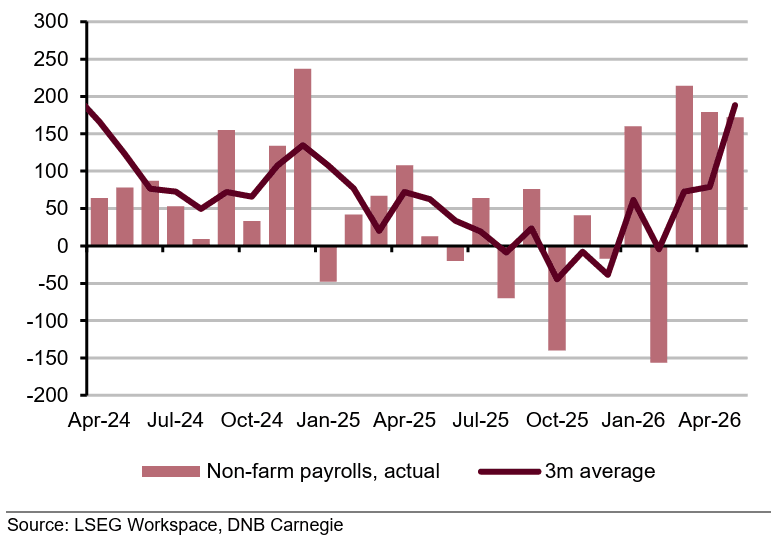
Above: The U.S. jobs market is robust, negating the need for rate cuts.
However, recent U.S. economic data shows higher inflation and a stabilising labour market, suggesting there's no rush to cut rates either.
"Even after the US and Iran struck a deal yesterday, US forwards have reduced but not definitively erased the likelihood of a rate hike by the Fed, with 15bp being still priced by December and 27bp by April 2027. This remains a prospect that may still offer the greenback a shield to the downside in the near term," says Roberto Mialich, FX Strategist at UniCredit Bank.
The U.S. last week announced inflation rose 0.5% in June alone, taking the headline annual rate to 4.2%.
That's well above the Fed's target and is consistent with the repricing in market expectations for the Fed to consider raising interest rates in the coming months.
A nuanced Fed message should be enough to keep latent pricing for a rate hike alive, underpinning the dollar and limiting EUR/USD's recovery potential this week.