

Image © Adobe Images
The Swiss franc risks extending its gains against the pound as investors seek safety from the stock market sell-off and the Swiss National Bank edges towards tighter policy.
The pound's rally against the Swiss franc, under way since May, is at risk of ending as investors buy the franc for safety from the stock market sell-off, analysts say.
The Swiss National Bank's zero interest rate makes the franc a cheap currency to borrow, and a deeper sell-off would see investors close trades that borrow francs to buy higher-yielding currencies such as the pound.
"The Swiss franc is today's undisputed winner. Unlike JPY it fully plays its haven role with EUR/CHF falling below the 0.91 handle for the first time since mid-March," says a new FX market analysis from KBC, the Belgian bank.
The pound-to-franc exchange rate fell 2.6% from a peak of 1.1115 on 18 November to 1.0825 on Wednesday, its lowest since 30 July, before recovering to trade near 1.09.
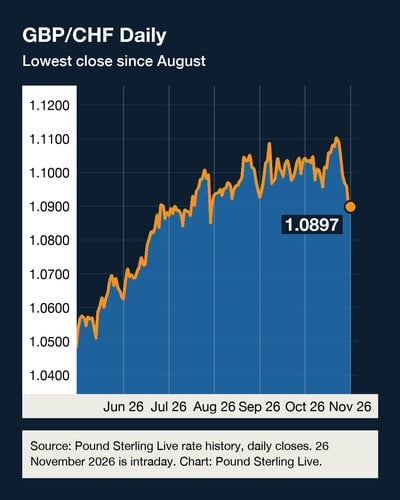
Above: GBP/CHF at daily intervals since May. The latest close is the lowest since August and sits below the 21-day moving average.
ING expects "the defensive currencies of the dollar, yen and Swiss franc to stay in demand" while stock markets remain volatile.
Stock markets could fall further: "A mini-crash can no longer be completely ruled out," says Yves Bonzon, Group Chief Investment Officer at Julius Baer, as Pound Sterling Live has reported.
A mini-crash would hit the pound through those borrowed-currency trades: "Higher-yielding currencies such as the GBP could be hit by the forced liquidation of carry trades," says Lee Hardman, Senior Currency Analyst at MUFG.
That risk, which Pound Sterling Live set out for the pound-to-euro rate earlier today, is already playing out against the franc: the pound has gained about 1.2% against the euro since US technology stocks peaked on 6 October, but it has lost 1.3% against the haven franc.
The franc's gains also suit the Swiss National Bank, which is edging towards tighter policy after Swiss inflation rose to 1.5% in October from 1.0% in September, data from the Federal Statistical Office show. The central bank has viewed a weakening franc as an inflationary impulse as it makes imports more expensive.
Bank J. Safra Sarasin, the Swiss private bank, expects the SNB to deliver a "hawkish hold" on 10 December, keeping its policy rate at 0% but signalling higher rates ahead, then selling foreign currency reserves before raising rates in March and June to 0.5%.
"As a second step, the SNB could sell some of its FX reserves against Swiss francs, which could lead to a stronger exchange rate and lower import prices," says Karsten Junius, Chief Economist at Bank J. Safra Sarasin.
Selling foreign currency reserves means the central bank buys francs in the market, which pushes the franc higher and cuts the cost of imported goods.
"The competitive position of Swiss exporters should be strong and a stronger exchange rate seems acceptable," he adds.
The franc's trade-weighted value, measured after inflation, has fallen 4.5% over the past year, Junius notes.
ING also expects the SNB to hold in December, but says the central bank "will grow increasingly tolerant of Swiss franc strength".
Higher expected Swiss rates would make the franc dearer to borrow and shrink the pound's yield advantage over the franc.
GBP/CHF Buyers Need a Quick Rebound
Over the coming week, Crédit Agricole's positioning model, its gauge of how heavily investors have bought or sold each currency, flags the franc as overbought, a sign the buying is likely to pause, although the same model flags the pound as overbought too.
The pound keeps its own rate support, with money markets pricing about a 75% chance that the Bank of England raises interest rates again on 17 December.
Higher expected UK rates lift the yields on UK government bonds and draw in foreign buyers who need pounds.
Support for GBP/CHF sits at 1.0890, the 2 October low and the floor of the range the pair has held since September, a level where buyers have stepped in to halt falls.
GBP/CHF traded below 1.0890 on Wednesday but closed above it.
A daily close beneath it would show the franc's haven bid has broken that range and open the way to Wednesday's low at 1.0825.
The recent selling has also taken GBP/CHF below its 21-day moving average near 1.10, the pair's average over roughly the past month and the level it tends to return to after a sharp move.
GBP/CHF buyers need to lift the pair back above that average before the SNB decides on 10 December, at which a hawkish hold would give the franc another reason to rise.