Pound sterling recorded its largest weekly move against the US dollar in seven years last week. Is there more strength to be had?
- Pound weaker against USD on Wednesday @ 1.4188, unbroken winning streak comes to an end
- However, the recovery is not dead according to a number of analysts
- Best rates for those buying dollars since February 22nd
The British pound’s unanswered recovery against the US dollar has been capped with the exchange rate having run into and been thwarted by that solid set of resistance that is the 50 day moving average.
The moving averages - ie the average price of the exchange rate over the timeframe in question - appears to be having a strong influence on sterling's direction of late, particularly in the GBP/EUR.
Latest Pound / US Dollar Exchange Rates
  | Live: 1.3341▲ + 0.27%12 Month Best:1.3867 |
*Your Bank's Retail Rate
| 1.2887 - 1.294 |
**Independent Specialist | 1.3154 - 1.3207 Find out why this is a better rate |
* Bank rates according to latest IMTI data.
** RationalFX dealing desk quotation.
With data releases being thin at the present time, and arguably irrelevant in the case of GBP, direction in GBP/USD could well remain dictated by technical considerations.
As such, we see the support level being provided by the green line in the below graphic, in short losses should remain contained while above here:
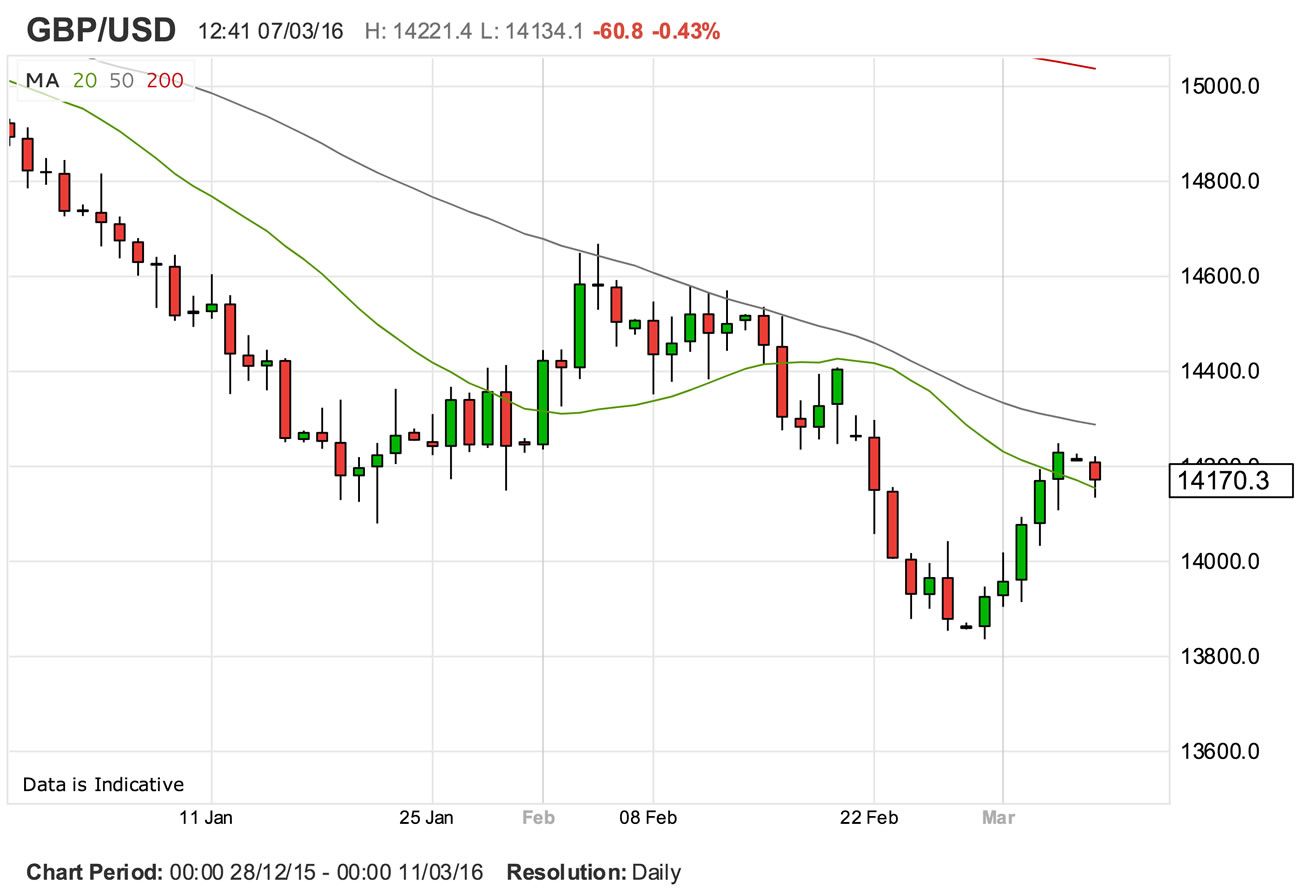
In addition, advances are likely to be capped by the grey line which is the 50 day moving average, in fact this trend line has not been breached since November 2015 givin us an indication of just how entrenched the longer-term downtrend really is.
The problem for sterling bulls is that the channel is pointed lower.
The Uptrend Could Extend
There are however believers out there.
Taking a look at the bigger picture is Bill McNamara at Charles Stanley, the London brokerage, who suggests a run to the mid 1.40’s should not be ruled out at this stage. (Worth a read: Lloyds Bank see steady recovery through remainder of year to 1.47).
McNamara says sterling’s largest weekly move in seven years against the dollar coincided pretty neatly with a test of the low from March 2009.
Back then GBP/USD bottomed out at 1.3746.
"Also worth highlighting is the bullish divergence on the 14-week RSI (at the bottom of the chart) which, at the very least, points towards an easing-off in the selling pressures," says McNamara.
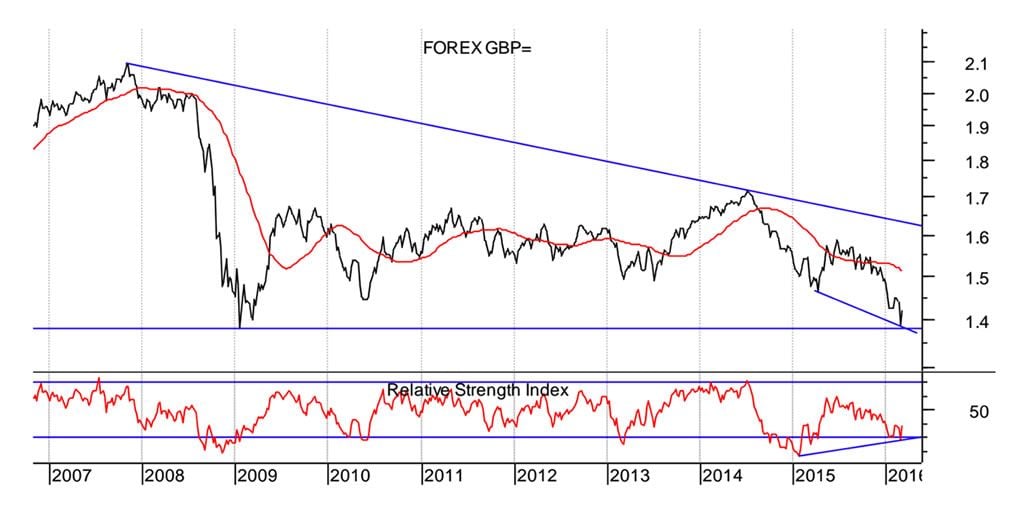
"The next area of possible resistance is at 1.44 or so – that’s where the 50-day MA now stands and it’s worth bearing in mind that it has not been breached since November," warns the analyst.
1.44-1.48 Targets at Forextell, Lloyds and U.O.B
The belief that the market has been too aggressive on sterling over recent weeks has rewarded those that bought what they saw as an oversold currency.
“The market got way ahead of itself and started getting overly bearish at the wrong levels,” says Sean Lee, a professional trader. “I expect to see 1.48 in coming weeks and then we may see some equilibrium return to the market.”
Backing the pound to test the 1.44 target is Quek Ser Leang who however warns that advances beyond here will be unlikely:
"The recent price action is within our expectation wherein we expect the corrective recovery that started late last week to extend further to 1.4400, after meeting the first level of 1.4230.
"At this stage, a move above 1.4400 is not expected. Overall, only a move back below 1.4050 would indicate that the prevalent upward pressure has eased, 1.4130 is already a strong support."
Lloyds Bank are waiting for the price to break through the ceiling at 1.4250 - 1.4350 to confirm further gains are on offer.
“A move through this resistance region would suggest a broader correction is going to be seen, which would potentially take us back to the 1.4550/1.4600 previous reaction highs from February 2016,” says Robin Wilkins at Lloyds.
Ultimately we doubt the British pound will be able to aggressively advance against the dollar with prices around 1.44 looking too generous for a currency that will be undermined by the EU referendum over coming months.
The US Dollar Will Get Stronger
We are also hearing talk of the US dollar enjoying a solid run through the remainder of 2016.
Consensus is that the dollar will amble along and be a mid-table performer this year having noted that the next interest rate rise at the US Federal Reserve is only likely in September.
Recent data releases confirm this view may be a bit pessimistic as the US economy is firmly in growth territory.
US non-farm payroll figures released at the back end of last week confirm the economy continues to offer a generous amount of work placements, even if pay growth remains subdued.
The picture looks brighter as most economic indicators stopped printing systematically below market’s expectations.
The environment is thus set for the next stage in the US dollar’s longer-term uptrend argues analyst Richard Franulovich at Westpac in Sydney.
“It is rare to see a market effectively flat a currency at a time when the underlying economy is finally showing clear signs of closing its under-utilised resources gap. For the first time in many months the USD looks well positioned to mount a serious attack at the key 100 resistance level,” says Franulovich of the US Dollar Index.
Deutsche Bank’s Alan Ruskin says he believes that even a maturing USD trend could extend for another couple of years, albeit at a much slower pace.
“The USD real broad TWI is within 5% of fully recouping its prior cycle losses, but will achieve much stronger levels than the prior cycle peak, if China’s currency depreciation accelerates even modestly,” says Ruskin.
The USD is not dead yet.