Pound sterling is relinquishing strength against the US dollar and next week we could see a return to the 1.42's.

The US dollar has found unexpected strength on news that 151K people found work in the United States in January, much less than the 190K forecast by the markets and confirmation that the jobs market is starting to slow.
The dollar rose as markets focused on news that average hourly earnings rose 0.5% in January, and 2.5% over the past twelve months, this is the highest year-on-year reading since mid-2009.
"To us, this upward trend in wage gains is fundamentally more than warranted given the fact that the US economy is approaching full employment," says Harm Bandholz, Chief US Economist at UniCredit.
The dollar had a poor month ahead of the jobs report allowing the GBP to USD conversion to rise from as low as 1.41 in January to 1.46 on Wednesday the 3rd of February.
Also putting a lid on the gains were a subdued set of Bank of England forecasts and a new poll on the UK's membership of the European Union showing a clear preference for a Brexit, more on this here.
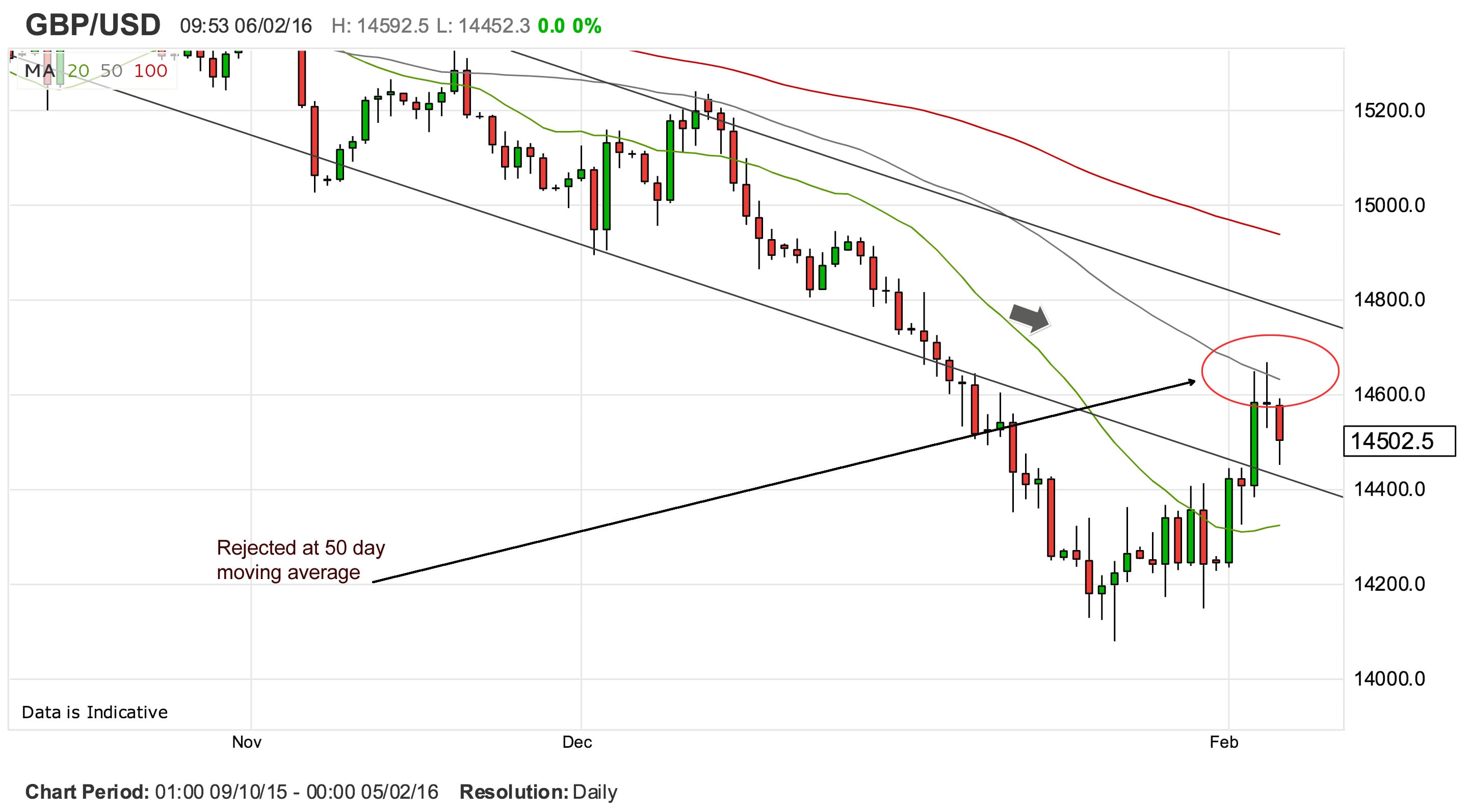
From a technical perspective we see the rally has failed at the 50 day moving average:
Intesa Sanpaolo Cut GBP Projections on Bank of England Forecasts
Sterling's February advance against the dollar has been called into question by the Bank of England (BofE) which left the basic Bank Rate unchanged at their February meeting.
This time all of the 9 MPC members voted in favour of unchanged interest rates, with Ian McCafferty dropping his call for a rate hike.
Latest Pound / US Dollar Exchange Rates
  | Live: 1.334▲ + 0.27%12 Month Best:1.3867 |
*Your Bank's Retail Rate
| 1.2887 - 1.294 |
**Independent Specialist | 1.3154 - 1.3207 Find out why this is a better rate |
* Bank rates according to latest IMTI data.
** RationalFX dealing desk quotation.
Markets took this, alongside the cutting of inflation expectations in the Inflation Report, as a bearish signal for the UK currency.
Inflation forecasts were slashed from 1.2% to 0.8% in 2016 and from 2.0% (exactly at target) to 1.9% in 2017.
“This significantly reduces the probability of an initial rate increase this year. However, this possibility cannot be entirely ruled out yet, because inflation has been left unchanged at 2.2% in 2018,” says Asmara Jamaleh, Economist with Intesa Sanpaolo in Milan.
Jamaleh and his research team have, on the back of these events, revised down their forecasts for the pound against the dollar.
GBP to USD forecasts are revised down from GBP/USD 1.45-1.50-1.60-1.62 on the 3m-6m-12m-24m horizon to 1.42-1.48-1.55-1.60.
“This is not a large revision, mainly because the market was already pricing in an extremely gradual BoE rate hike path. However risks are still tilted to the downside, especially in the case of unfavourable developments as far as the EU referendum is concerned,” says Jamaleh.
TD are Forecasting Business as Usual for the Pound
Currency price action following this month’s edition of the Bank of England’s policy pronouncements leave sterling with a mixed set of signals.
“While some of the immediate headline elements, such as the shift in the MPC’s vote and cut to the near-term inflation outlook, skewed to the dovish side, Carney went to notable lengths to temper these conclusions during his press conference,” notes James Rossiter at TD Securities in London.
In Rossiter’s opinion this backdrop is likely to leave the GBP more reactive to external considerations than domestic ones, particularly as the UK economic data release calendar is relatively quiet over the next week or two.
“This suggests the broader near-term trends are likely to remain intact over the next several sessions,” says Rossiter.
So it seems business as usual for sterling. But what is business as usual?
Buy the Pound Against the Dollar Say Westpac
The British pound has been advancing against the US dollar of late as the US currency is undermined by some less-than-stellar economic numbers.
We have seen some pretty hefty declines in the USD complex that have allowed the pound to dollar exchange rate to recover from lows just below 1.42 to back above 1.46.
Could business as usual be a continuation of this GBPUSD recovery?
Yes, says Martina Song at Westpac who has issued a strategy note to clients suggesting they buy GBP/USD into 1.4330 with a stop-loss placed at 1.4150.
“For a second week in a row we have two bullish arrows on GBP giving us a buy on weakness signal. Our model remains downbeat but our macro and technical views are aligned,” says Song.
According to Song Brexit risk is overdone (a view incidentally shared with the team at ING) as UK polls are a poor guide to the national mood if polling for the last general election and Scottish independence are anything to go by.
It is suggested that PM Cameron should emerge from EU membership renegotiations with a strong hand, helping tip the case in favour of continued EU membership.
UK rates markets have gone too far as well, notes Song, now leaning toward small odds of a base rate cut by year's end (40%).
“ECB easing risk into March another factor that should constrain EUR/GBP upside,” says the Westpac analyst.
Dollar to Struggle in 2016 as Economy Cools
We continue to monitor that camp of foreign exchange analysts who see 2016 as being bearish for the US dollar.
As an example, included in the camp are Standard Chartered who are calling an end to the dollar's bull run primarily because the US Federal Reserve is going to be forced to temper their agressive interest rate raising agenda.
In their December meeting the US Fed raised interest rates and marked the start of the next cycle of higher interest rates and markets bought the dollar accordingly.
However, the Fed may have been a little optimistic on their 2016 economic forecasts. “What surprised me, and what I think was a mistake, was how forceful they were after the interest rate rise in presenting their case for future rate rises throughout 2016 - up to four," says Dominic Rossi at Fidelity.
The US economy stalled in Q4 according to the Bureau of Economic Analysis’ advance estimate of just 0.7% annualised growth.
"And not surprisingly, because of the dollar’s surge, one of the main sources of drag on the economy was trade," says Stéfane Marion at National Bank Canada, "the USD surge is responsible for the fact that import prices are now contracting at the fastest pace since 2009."
This translates into a potentially poor year for the Greenback.
"If, as we expect, the Fed finds itself forced to tone down its tightening bias in light of softer growth than it expects and rising threats of disinflation, the USD could struggle this year," says Marion.