
The Pound to New Zealand Dollar exchange rate could find its legs and recover lost ground over the near-term but a protracted recovery remains unlikely.
The NZD starts the new month in firm fashion against its G10 rivals largely thanks to positive data out of the Chinese economy.
At the time of writing GBP/NZD is quoted at 1.7094 while the NZD/USD is at 0.7172.
With China being a key export market for New Zealand any improvement in the economy will ultimately support the domestic currency.
Chinese Caixin Manufacturing and official Services PMI data showed improvements in both sectors of the economy.
Manufacturing read at 51.2 in October, the fastest pace of improvement since March 2011 while Services PMI rose to 54.0 confirming growth in this important export market is picking up speed once more.
After rebounding from the flash-crash lows GBP/NZD has traded in a range between 1.6830 and 1.7160.
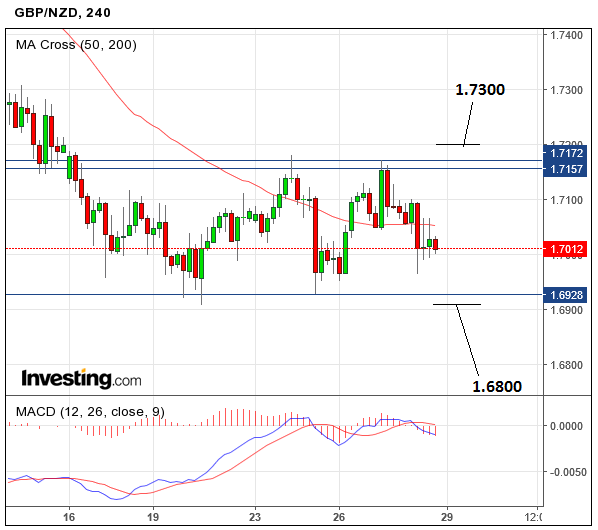
The long exhaustion bar which formed on the daily chart on the day of October's flash-crash is probably a sign the pair has bottomed and is, therefore, likely to eventually move higher.
The pair will probably continue oscillating within the range but eventually, a breakout higher is expected, with a move above 1.7200 confirming a move higher, towards a target at 1.7300.
A breakout below the range lows, on the other hand, signified by a move below 1.6910 would probably reach an eventual target at 1.6800.
Latest Pound / New Zealand Dollar Exchange Rates
  | Live: 2.3579▼ -0.16%12 Month Best:2.4815 |
*Your Bank's Retail Rate
| 2.2778 - 2.2872 |
**Independent Specialist | 2.3249 - 2.3344 Find out why this is a better rate |
* Bank rates according to latest IMTI data.
** RationalFX dealing desk quotation.
Interest Rate Direction will help Shape the Outlook
Recent higher than expected inflation data has changed the market’s view of the likely policy course of the Reserve Bank of New Zealand (RBNZ).
From expecting a rate cut in November and possibly several more, some analysts, such as those at ANZ, see a cut in November as signalling the final phase of the bank’s easing cycle.
"For NZD, a November RBNZ rate cut looks to be the end of the easing cycle, and with domestic growth looking strong, at worst the NZD will be range-bound, and at best it will move higher," says a note from ANZ Research in their latest FX Monthly Outlook release.
This indicates further probable upside versus the Pound, especially given the still-high chance of the BoE cutting rates this week and New Zealand’s much higher 2.0% interest rate and its ongoing attraction to international investors.
The key fundamental for the Pound is whether the Bank Of England (BOE) cuts interest rates any lower at its meeting on Thursday.
Markets appear to be attributing a roughly 50/50 chance to the possibility.
What will also be of interest are the changes made to growth and inflation forecasts in the Bank's Quarterly Inflation Report.
The Bank's forecasts could well hint at future policy decisions, particularly if they believe inflation will rise faster than previously anticipated.
It is because of inflation that markets are starting to price in higher interest rates in the future:
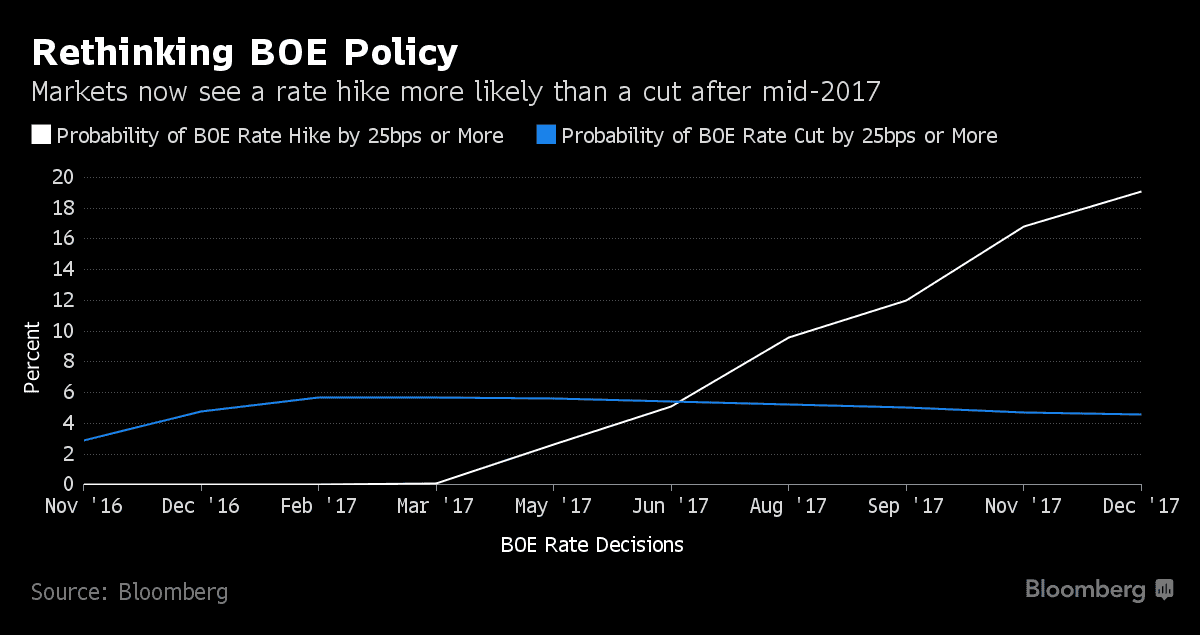
Overnight index swaps indicate that there is now more of a chance of an interest rate rise than a rate cut in 2017.
Rising interest rates are deemed to be supportive of a currency in that they attract capital inflows as global investors seek out yield. Clarity on Brexit, combined with rising interest rates, will be the ultimate catalyst for a longer-term and more sustainable Pound recovery.
Traders are re-evaluating how long monetary policy policy will remain accommodative following better-than-forecast economic growth data and BoE Governor Mark Carney’s suggestion two days ago that the prospect of faster inflation is diminishing the case for easing.
The other major theme for Sterling relates to the current high court challenge to the government’s authority to trigger Article 50 on its own without the agreement of parliament.
The failure of a similar challenge in a high court in Belfast is thought to have set a precedent which the London court is likely to follow.
If the challenge is unsuccessful the pound will fall; if not it will rally strongly.
It is not clear when the London court will make its decision.
The main data releases in the week ahead are the trio of October Purchasing Manager Indices (PMI) releases.
Tuesday, November 1 sees release of the final estimate for Manufacturing PMI for October at 10.30 GMT, which is expected to come out at 54.5 from a preliminary estimate of 55.4.
Construction PMI is out on Wednesday at 10.30 (GMT) and is forecast to moderate to 51.8 from 52.3.
Thursday sees the release of Services PMI at 10.30 (GMT), which is forecast to come out at 52.1 from a preliminary estimate of 52.6.
Data for the New Zealand Dollar
The main releases during this week are Global Dairy Trade Prices at auction on Tuesday (after 15.00 London Time (LT)) and Employment Data, also on Tuesday at 22.45 (LT).
Apart from those two releases Sunday evening at 22.45 (LT) sees the release of Building Consents mom in September, whilst on Monday ANZ Business Confidence in October is out.