
The Pound to New Zealand Dollar exchange rate is expected to consolidate further in the near-term while remain exposed to fresh all-time lows over the mid-term.
GBP/NZD is currently trading in the middle of a range between 1.71 and 1.68 as the frantic selling pressures exerted on Sterling start to ease.
We believe markets have priced as much hard-Brexit news into the currency as can be expected at this time.
At best the Pound should maintain these levels until such a time as more bad news concerning Brexit is made available. The obvious risk here, of course, is that Brexit headlines start turning out positive.
However, the discourse amongst the financial community is resolutely negative and it will take a great deal of convincing to get investors to take a more positive view of the UK currency.
Meanwhile the New Zealand Dollar finds itself supported by a release of higher-than-expected inflation data, which points to more robust growth for the economy.
And of course, higher growth and inflation means limited scope for further NZD-negative interest rate cuts at the Reserve Bank of New Zealand in the future.
"For NZD, a November RBNZ rate cut looks to be the end of the easing cycle, and with domestic growth looking strong, at worst the NZD will be range-bound, and at best it will move higher," says a note from ANZ Research in their latest FX Monthly Outlook release.
The Kiwi still retains much strength from the operation of the carry trade, which involves borrowing in a low-interest rate currency such as the Euro (0.0%) and investing in a higher interest rate currency such as the Kiwi (2.0%); the investor pockets the different – 2.0%.
The carry trade has created substantial inflows for New Zealand pushing up the value of the New Zealand dollar in the process.
Carry trading is likely to support the Kiwi for the foreseeable future, according to analysts at UBS, who argue that even if the Federal Reserve starts to raise interest rates in the US in December, they will so slowly that it will have little effect on dampening the carry.
Their thesis is that on balance interest rates will probably remain ‘lower for longer’ even if the Fed hikes in December and that this will continue to buoy interest in the carry trade.
Expectations remain heightened for a November 0.25% interest rate cut from the RBNZ, from the current 2.0%.
The better-than-forecast inflation result which showed a 0.2% increase in prices in August versus 0.1% estimated, have probably reduced the chances of a November cut marginally, from 88% in the week before, but they still remain high.
Even with a cut the NZD retains an advantage and we would expect weakness to remain shallow.
Latest Pound / New Zealand Dollar Exchange Rates
  | Live: 2.3579▼ -0.16%12 Month Best:2.4815 |
*Your Bank's Retail Rate
| 2.2778 - 2.2872 |
**Independent Specialist | 2.3249 - 2.3344 Find out why this is a better rate |
* Bank rates according to latest IMTI data.
** RationalFX dealing desk quotation.
GBP/NZD Technical Forecast: Downside to Extend
From a technical perspective, the dominant trend remains bearish.
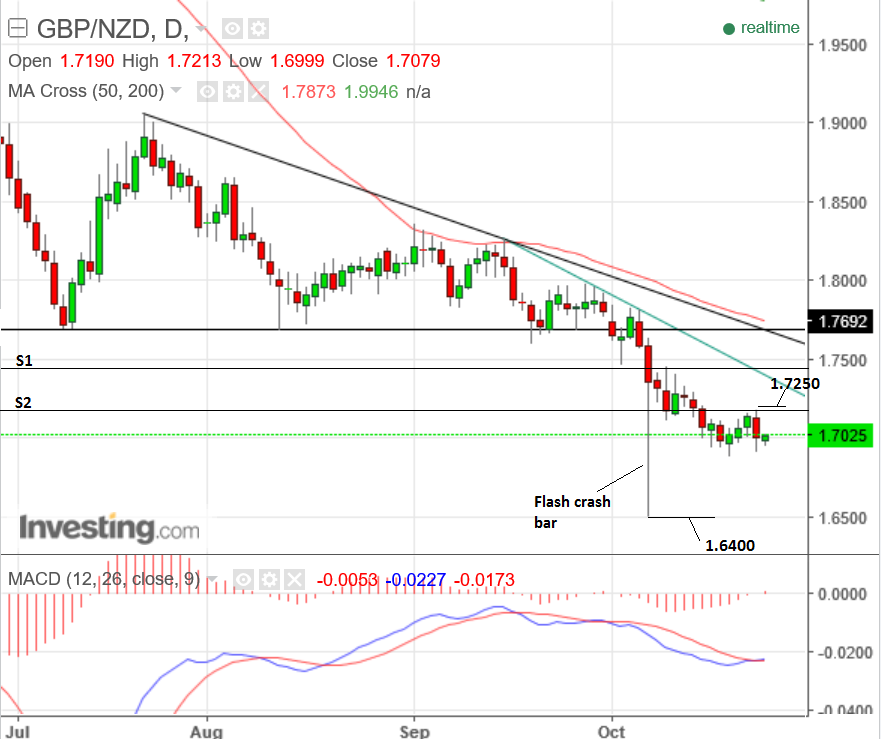
Whilst the pair rebounded from the flash crash lows, it has struggled to follow through and has now fallen into a holding pattern.
The long bar of the crash is a signal the downtrend is exhausted and increases the possibilities the pair could start a more persistent recovery.
However, there is so much resistance directly above the current level from various trend-lines and monthly pivots the pair remains at technical risk of being unable to break above these.
Given the risk the government could lose in the current court case with anti-Brexit campaigners who want the decision as to whether Article 50 should be triggered or not, to be decided by parliament not the executive, there is the potential for a surge after that news, which could bust through these technical levels, however.
As such a break above the 1.7200 level would reach a target at 1.7250 easily, but then find itself capped.
A further move above 1.7300, might then be expected to hit 1.7450.
Alternatively, a move below the 1.6500 crash lows would stimulate bears and be expected to target 1.6400 and then 1.6300 lower.
Trade Statistics Fail to Dent NZD Enthusiasm, But Could be Brewing Problems for the Future
Latest New Zealand trade statistics confirm the country continues to run a notable deficit in its trade balance.
This is perhaps to be expected considering New Zealand commands one of the most expensive currencies in the world - the risk becomes that importing goods becomes cheaper than producing the equivalent domestically.
The New Zealand economy could become structurally addicted to imports which obviously presents long-term issues.
For now though, the NZ Dollar remains undaunted by news that the Trade Balance grew to -1.436M in September, a deficit much greater than the -1.123M forecast by analysts.
Imports were at 4.9BN, ahead of the 4.65BN forecast while goods exports were at 3.47BN, less than the 3.55BN that economists had expected.
New Zealand already has a sizeable current account deficit at $1.826BN which reflects a country that is a net debtor to the rest of the world - in a large part for the growing propensity to import.
The NZ Dollar therefore relies heavily on inbound foreign investment - as does the UK which itself has one of the largest current account deficits in the world.
The problems start when concerns over this inbound investment arise, as is the case with the UK following the Brexit vote.
If those investments fade then the currency needs to adjust sharply lower. New Zealand is far from this situation at present, but this could one day be an issue.