The main event for the GBP/NZD pair in the coming week is the Reserve Bank of New Zealand’s (RBNZ’s) rate meeting, ending on Wednesday, with most analyst’s expecting a cut of 0.25% in interest rates.
The British Pound may have sold-off heavily following the Bank of England's decision to cut interest rates and introduce 70bn more of quantitative easing, but in the days prior to the meeting it was the New Zealand Dollar which was showing signs of weakness.
Indeed, the NZD could continue to suffer now that the impact of the BoE's decision has been digested and focus turns to the Reserve Bank of New Zealand's rate decision due on Tuesday.
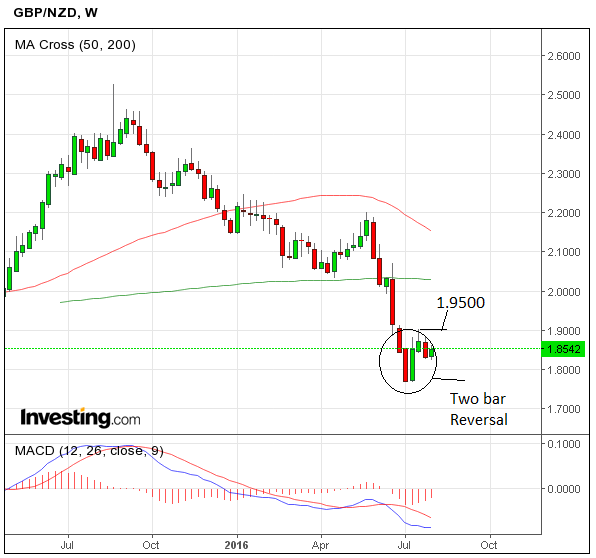
The daily chart for the pair is too chaotic to make much sense and I would avoid it as a result.
However, the weekly chart for GBP/NZD is more telling.
It shows the recent down-trend was punctuated by a clear two bar reversal in July, which was followed by some upside activity.
Two-bar reversals are relatively reliable signs that a new trend is beginning - which in this case was up for sterling and down for the kiwi.
This seems to corroborate the more bullish fundamentals, and suggests an extension of this embryonic up-trend at the break of the 1.9000 highs, with 1.9500 as an initial target.
RBNZ in the Driving Seat
If the RBNZ were to cut rates and strikes a dovish tone regarding the outlook (indicating more cuts on the horizon), the NZ Dollar could well underperform its rivals.
Kathy Lien of BK Asset Management, says that markets have now already priced in a cut of 0.25%, and so now strength or weakness in the pair is based on what the RBNZ say in their statement, and whether they foresee this as a one off or part of a series of loosening measures.
This also seems to be the view of other analysts such as CIBC’s Jeremy Stretch, who notes:
“While a rate move from the RBNZ next week is now fully priced it’s the prospects for additional stimulus in November that matters, at this juncture the market continues to price in a near 50:50 chance of another cut prior to year-end.
"We would expect that investors will increasingly look for additional stimulus as recent NZD gains are set to constrain inflationary pressures. Look for the RBNZ to maintain dovish tendencies, opening up a test of recent double-bottom lows at around 0.6950/60 in upcoming sessions.”
Latest Pound / New Zealand Dollar Exchange Rates
  | Live: 2.3486▲ + 0.08%12 Month Best:2.4815 |
*Your Bank's Retail Rate
| 2.2687 - 2.2781 |
**Independent Specialist | 2.3157 - 2.3251 Find out why this is a better rate |
* Bank rates according to latest IMTI data.
** RationalFX dealing desk quotation.
The RBNZ recently ordered an ‘unscheduled economic assessment’, which was seen as paving the way for an interest rate cut, as the bank would not have requested one had economic conditions been evolving as expected.
New macro-prudential rules, increasing the minimum deposit required for purchasing a property for investment purposes, was also seen as a move to cool the overheating housing market, preparing the way for an interest rate cut and the inevitable knock-on effect of such a move of stimulating mortgage lending yet more.
BK Asset Management’s Kathy Lien, says that given a rate cut is now seen as inevitable, the devil may be in the wording of the accompanying statement, which is especially dovish will see NZD sell off, but if neutral may actually see NZD rise:
“Like the BoE and RBA, the RBNZ is expected to cut interest rates by 25bp and if New Zealand also adopts a neutral stance, NZD will rise because 2% is still one of the most generous yields out there. However if they buck the trend and continue to maintain a strongly worded dovish stance, the currency could sink below 71 cents versus the U.S. dollar.”
CICB market’s Jeremy Stretch agrees with Lien, seeing the 0.25% cut (from 2.25% to 2.00%) as now fully priced in to the kiwi, however, he thinks the potential for volatility now comes from expectations of whether the RBNZ will cut again in November or not, currently a 50/50 possibility.
The Pound: ‘Data in the Driving Seat’
In relation to the pound there are some who think ‘the worst may be behind the currency’, although that does not mean there will necessarily be much upside ahead in the short-term either.
Financial markets sold off heavily after the UK voted to leave the EU, but they have now recovered and made new highs – we maintain that if the fallout was still a major risk factor equity markets for one would not be in such good shape.
The Bank of England also appears averse to lowering interest rates any further, and of the various different forms of monetary stimulus this would be the most negative for sterling; monetary stimulus in general, globally that is, also appears to be losing its impact, the UK included.
Nevertheless, as pointed out by broker TD Securities, the key to the pound remains data for the period after Brexit, in other words for July.
The problem is that there is still a lack of data for July on which to base a fair assessment of the impact of the referendum on the economy, and in the week ahead this remains a problem as there are only two release for the period.
One is the British Retail Consortium's (BRC) retail sales figures out on Tuesday, and the other is the NIESR GDP Estimate for July on the same day.
Whilst BRC sales is normally a tier three release of little significance, in the week ahead its importance will be temporarily exalted.
Clearly a positive result for July data could help sterling recover; whilst a negative would confirm fears that the economy is declining steeply following the impulsive breakaway from Europe.
Has the pound hit bottom?
For BK Asset Management’s Lien, the big question is, has sterling bottomed?
According to her analysis there is a strong possibility the pound has since she sees it as unlikely that the BoE will cut interest rates any lower, after BOE governor Carney expressed a clear aversion to negative interest rates at the last press conference:
While the Bank is ready to lower the bank rate further if needed and increase all elements of Thursday’s package, Carney also made it very clear that the “lower bound in interest rates is above zero” and he is “not a fan of negative interest rates.”
He believes that helicopter money is a “flight of fancy” and he doesn’t see a scenario where negative rates is discussed, so if BoE were to ease again, it would be in other ways like additional bond purchases.
"The bank reduced its GDP outlook for 2017 but kept its 2016 forecasts unchanged. It also believes that inflation will rise given the weakness of the pound. Having taken such an aggressive stance, the Bank of England is now in wait-and-see mode, which could actually lift sterling because of the extreme level of short positioning,” says Lien.