
The British pound is advancing against the New Zealand dollar on Tuesday ensuring the strong start to April continues.
The New Zealand dollar (NZD) is under pressure following the release of poor domestic economic data.
NZIER Business Confidence data for the first quarter of 2016 grew 2%, well below the 15% analysts were forecasting, betraying a downbeat mood amongst New Zealand businesses.
The NZIER index is released by the New Zealand Institute of Economic Research and shows the business outlook in New Zealand.
It is a short term indicator, a rise in the index indicates increases in business investment that should lead to higher levels of output.
What is interesting to us is that the survey betrays a big problem with New Zealand price dynamics which is the likely reason for the kiwi dollar's strong reaction.
The statement accompanying the data from the NZIER reads:
"The effects of rising cost pressures are evident across all the sectors. A net 26% of businesses reported higher costs in the March quarter – the highest level since mid-2012.
"More businesses are also expecting further cost increases ahead. There were particularly large cost increases reported by businesses in the building and financial services industries, likely reflecting capacity pressures in the building sector and increased funding costs in the financial services industries."
This is where it gets interesting:
"However, businesses have been unable to pass on these rising costs in the form of higher prices, and this has impacted negatively on profitability. Nonetheless, businesses expect to raise prices in the next quarter, with expectations of improved profitability at its highest level in two years."
This could be a clear sign of how a lack of inflationary pressure in the New Zealand economy - at the consumer end - could have a negative effect on the economy.
We know the RBNZ is desperate to see higher inflation, as are most developed nation central banks, and this could well prompt the RBNZ into further interest rate cuts.
The most recent inflation reading from New Zealand was at 0.1%, the RBNZ's job is to target inflation at 1-3% and lower rates tend to stimulate inflation as increased lending prompts increase spending.
The side effect of lower interest rates is a lower New Zealand dollar as the country would not attract the strong global investor flows shouild the OCR be cut to 2% or below.
Latest Pound / New Zealand Dollar Exchange Rates
  | Live: 2.3468▼ -0.47%12 Month Best:2.4815 |
*Your Bank's Retail Rate
| 2.267 - 2.2763 |
**Independent Specialist | 2.3139 - 2.3233 Find out why this is a better rate |
* Bank rates according to latest IMTI data.
** RationalFX dealing desk quotation.
Dynamics in the Pound to New Zealand Dollar Exchange Rate
The New Zealand dollar is lower across the board. To be fair, the currency has had a stellar run of late and a pullback was always on the cards.
In fact, the GBP to NZD exchange rate is arguably still merely correcting from oversold conditions and while the advances seen in April will be welcomed by those with NZD payment requirements, this is no relief rally.
The pound to New Zealand Dollar has enjoyed an uncharacteristically strong start to the new week with the pair bouncing from an open at 2.0613 to reach 2.0989 at the time of writing.
The move higher confirms a move higher off a solid level of support, loosely pencilled in at 2.06, which could halt declines in the near-term.
Nevertheless, the move higher flies in the face of hefty downward pressures being exerted on the conversion.
We are looking at a pair that remains caught in a solid down-trend in the medium term.
The New Zealand dollar was the most 'directional currency' last week report UBS who cited strong buying interest dominated by hedge funds as being behind recent strength.
There is no technical evidence this down-trend may be reversing; on Friday April 1 we witnessed the formation of new 10-month lows at 2.0557.
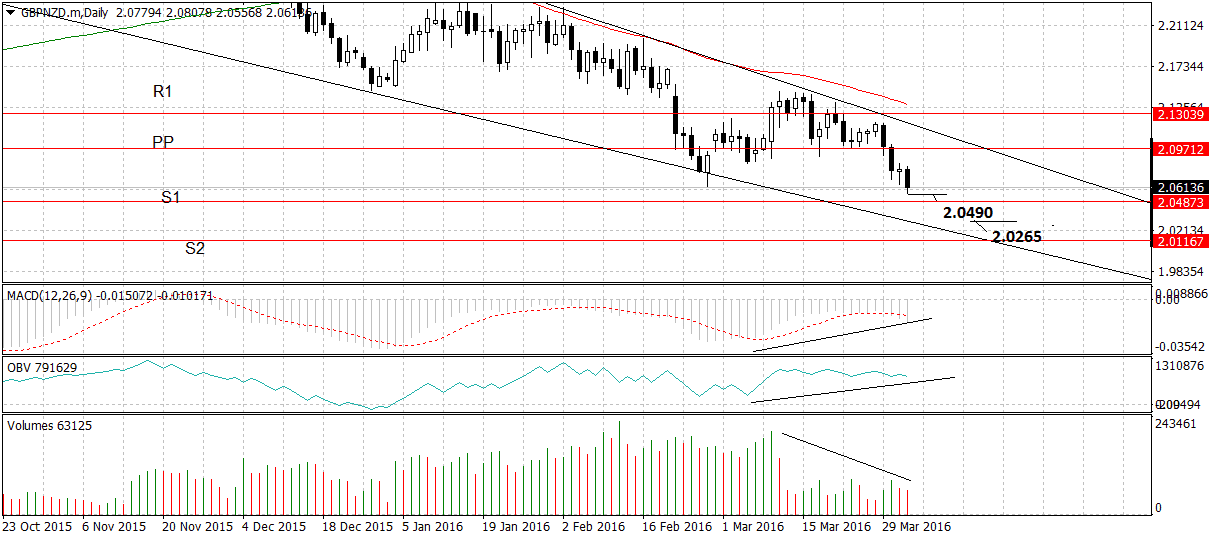
A break below this low will likely invite a continuation down to the S1 monthly pivot at 2.0490.
Monthly Pivots are powerful levels where the exchange rate often stops to consolidate, bounce, or even reverse trend in some cases.
Trader’s use them to fade the dominant trend, scalping short-term bounces.
It is therefore likely GBP/NZD will find support and pause at the S1, this also makes it an obvious initial target for any extension in the move lower.
A break clearly below the S1, however, signalled by a break below 2.0440, would probably confirm a continuation lower to the next target at the 200-week moving average at 2.0264.
Moving averages are widely followed by market participants, money managers and investors.
Again they can become focal points for increased trading activity as bulls and bears wrestle over the direction of the next break, thus the pair will likely pause at 2.0264.
Overall, despite the apparent lack of bearish conviction in the recent leg down, as evidenced by the low momentum and volume indicators in the lower panes (a possible seasonal effect due to Easter holidays), our view remains that there will be more downside to come.
RBNZ Would Welcome a Weaker NZD
The continued appreciation in the New Zealand Dollar has led analysts at both ANZ Bank and Citibank to speculate that the Reserve Bank of New Zealand (RBNZ) could cut interest rates once more.
Citibank have suggested that both the Australian and New Zealand dollars are approaching levels that the RBA and RBNZ will be uncomfortable with.
Reading between the lines, this would suggest Citi see a more muscular RBNZ approach to the exchange rate in future meetings, the next one being on the 28th of April.
The March rate cut had the desired negative impact on the NZD initially, but strength soon returned. The RBNZ would presumably have to become more agressive.
The current base interest rate as set by the RBNZ is 2.25%, which is well above most other G10 nations.
This helps explain the kiwi’s rapid rise, which is being fuelled by investors relocating their capital to New Zealand to enjoy the higher interest rates offered there.
The strong kiwi is a problem for New Zealand exporters, as an expensive New Zealand dollar makes their exports less competitive and less affordable for some.
This, and the combination of the economic plateauing in China, which was a major importer of New Zealand dairy products catering for China’s westernising diet, has meant a decline in New Zealand’s key exports (Dairy products are the country’s greatest export).
“For exporters the run back up above NZDUSD 0.69 and to 73.3 on the NZD TWI is proving eye watering. For dairying, the sector under the most pressure at present, the run back up is especially painful as a lower NZD is a key reason that a better income outlook in 2016/17 has been flagged. If this doesn’t prove to be the case there will be serious industry concern,” say ANZ.
ANZ conclude that the pressure on Dairying and other exports will lead to the RBNZ eventually cutting interest rates, in order to weaken the kiwi.
Despite resolute growth in many other sectors from Forestry to Tourism offsetting the pain from Dairying, the note concludes that the threat of an appreciating kiwi to exporters and the country’s primary industry, will force the RBNZ to cut interest rates by a half a percent during 2016.