
The pound to New Zealand dollar exchange rate (GBP/NZD) could be about to embark on the next stage of its journey lower as buying interest in the NZD accelerates.
The New Zealand dollar has taken the crown as being the best performing currency in the G10 space against the US dollar.
The currency advanced by 2.7% against its American counterpart which was actually the worst performer in G10.
The pound came close to taking the accolade though having managed a meagre 0.5% gain against the embattled US currency confirming there is little buying interest in sterling at present.
After rising in early March, the GBP/NZD pair has since fallen back and is looking to restart the longer-term down-trend after it closed at 2.0628 following the first day of trade in the new month.
It is now knocking on the door of February's lows which are located at 2.0623, a break below the floor would suggest a continuation down to the next target at 2.0400.
However, the achievement of this target will be questioned by a noted lack of momentum in the most recent down-wave.
We must also be awake to the possible outline of an incomplete double bottom; whilst very much speculative and in its early stages, taken together, they urge caution for those looking to bet on further declines.
I have drawn some red lines on the chart below to describe the outline of the potential double-bottom - a shape which consists, as its name infers, of two troughs interspersed by a peak.
Both troughs make lows at a similar level – looking at completion much like a “W” in shape.
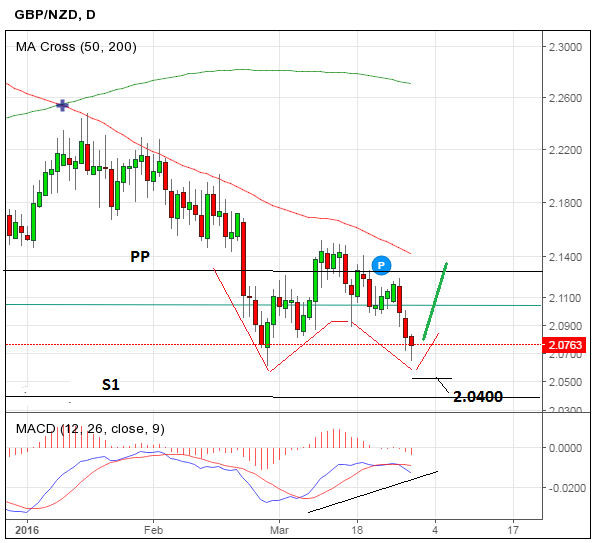
In order to be confident that the pair is actually continuing lower in line with its trend, and to dispel the possibility a double-bottom pattern is forming, a break well below the 2.0623 Feb lows would be needed as confirmatory evidence.
For example below 2.0500. a clean break below 2.0500 would probably see a continuation down to the aforesaid target at 2.0400.
Whilst the trend down remains intact, and our base case is for a continuation to 2.0400, the lack of momentum and the shape of recent market action indicates the possibility that a reversal may also be developing, however, it’s still too soon to be sure, so we remain on balance bearish.
Latest Pound / New Zealand Dollar Exchange Rates
  | Live: 2.3468▼ -0.47%12 Month Best:2.4815 |
*Your Bank's Retail Rate
| 2.267 - 2.2763 |
**Independent Specialist | 2.3139 - 2.3233 Find out why this is a better rate |
* Bank rates according to latest IMTI data.
** RationalFX dealing desk quotation.
ANZ Bank See the Reserve Bank of New Zealand Potentially Cutting 0.50% off Interest Rates
The New Zealand Dollar - or kiwi as it is also known - has continued appreciating as a result of the higher interest rates offered to investors in New Zealand compared to the UK - or any other G10 currency nation for that matter.
This means banks in New Zealand generally offer higher interest rates compared to those in the UK.
Central Banks set the base interest rate for the nation’s other banks, and this dictates what lending rates are throughout the economy.
The RBNZ has set interest rates at 2.25% compared to only 0.50% set by the Bank of England.
This increases the amount of foreign capital New Zealand attracts because international investors are more likely to put their money to work in New Zealand, where they can potentially earn over four times more interest than in the UK.
This has driven demand for the kiwi and gives it a very bullish advantage over other G10 rivals.
Normally this would not be a problem, except that it is for New Zealand exporters, as an expensive New Zealand dollar makes their exports less competitive and less affordable for some.
This, and the combination of the economic plateauing in China, which was a major importer of New Zealand dairy products catering for China’s westernizing diet, has meant a decline in New Zealand’s key exports (dairy products are the country’s largest export).
“For exporters the run back up above NZDUSD 0.69 and to 73.3 on the NZD TWI is proving eye watering. For dairying, the sector under the most pressure at present, the run back up is especially painful as a lower NZD is a key reason that a better income outlook in 2016/17 has been flagged. If this doesn’t prove to be the case there will be serious industry concern.” States the ANZ note.
ANZ conclude that the pressure on Dairying and other exports will lead to the RBNZ eventually cutting interest rates, in order to weaken the kiwi.
Despite resolute growth in many other sectors from Forestry to Tourism offsetting the pain from Dairying, the note concludes that the threat of an appreciating kiwi to exporters and the country’s primary industry, will force the RBNZ to cut interest rates by a half a percent during 2016.