
Image © Adobe Images
The Wall Street bank takes the axe to the euro as dollar strength to linger longer.
Dreams of 1.20 are off the table for those wanting a stronger euro-to-dollar exchange rate, according to a new foreign exchange forecast revision at Goldman Sachs.
Analysts say in a new note, "the forces that have combined to strengthen the Dollar over the last few months look increasingly likely to endure."
The call is an acknowledgement that it, as well as the consensus, was off the mark having come "into 2026 projecting less-exceptional US performance, and a weaker Dollar over time."
The consensus call was for a year of steady dollar decline as the period of U.S. exceptionalism - where everything U.S.-linked rises in unison - allowing the euro to advance, with 1.20 widely held as a year-end target.
But calling the end of U.S. exceptionalism was premature says Goldman Sachs: "the US Dollar has benefited from twin economic shocks - an AI boom and an energy supply bust - that have combined to raise the relative profile of US assets yet again."
The Dollar Benefits from Exceptionalism
Underpinning the U.S. growth case is the AI stock and infrastructure boom, which has spread from AI's initial leaders into a host of companies across the economy; the rally is percolating through to stocks that are expected to benefit from AI efficiencies.
No stock market comes close to that of the U.S. when offering international investors exposure to this trend.
All the while, the original AI leaders (think of Nvidia) continue to do well, while the supply chain required to physically build out the AI computing power is flourishing. There's demand in this economy.
"Economic trends should support the Dollar against low yielders on a tactical horizon," says Goldman.
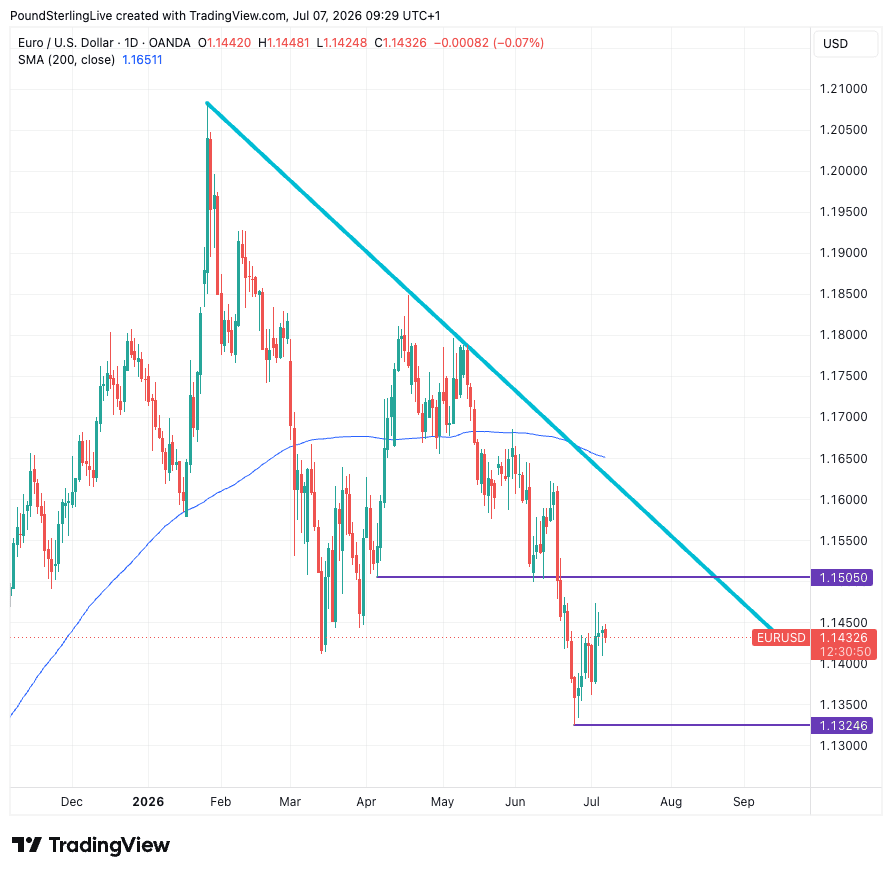
The Fed and Yield Nexus
Economic strength spreads into Federal bonds, which are increasingly attractive to international investors, thanks to their relatively high yields.
At the Federal Reserve, new Chair Kevin Warsh has reasserted the Fed's commitment to controlling inflation.
There were concerns he might be more lenient on the inflation front in order to chase red-hot growth, stoking fears of deteriorating institutional integrity.
His commitment to the inflation mandate at his first Fed meeting unwound some of those concerns that might have been weighing on the dollar.
At the same time, the market has flipped from expecting rate cuts this year to expecting at least one rate rise.
That's dragged U.S. bond yields higher.
And there's a warning here from Goldman Sachs: "there is a scenario confirmation that more restrictive policy is required could lead to outsized FX moves if policy diverges even more than currently discounted by markets."
A Softer Euro-Dollar Profile
Strategists at Goldman Sachs have maintained that economic trends should support the Dollar against low yielders on a tactical horizon, and they revised forecasts in that direction in mid-March.
But, "we increasingly think these forces look likely to linger for longer, and we are unlikely to return to broad-based, sustained Dollar depreciation for some time."
To reflect recent shifts and expectations for a stronger-for-longer dollar, "we are revising our forecasts for EUR/USD to 1.14, 1.12 and 1.12 in 3, 6 and 12 months.
That's from 1.14, 1.18 and 1.20 previously.