Image © Adobe Images
Euro buyers are looking at the best rates since June 2025.
Foreign exchange markets saw the pound-to-euro rate hit 1.1705 on Tuesday, delivering its highest conversion rate since June 30 last year.
There are no headline triggers behind the latest rise; instead, pound sterling advances in stealth mode: it's hit a series of one-year peaks against the euro over recent days, and no one seems to be talking about it.
Press coverage of the move is sparse, and the analyst community, which would usually focus a good portion of its research on observations and explanations for a significant breakout in one of the world's most heavily traded pairs, are conspicuously quiet.
That silence is probably the story itself; it suggests no one has a strong conviction as to why the pound has chosen now as the time to break out of a long-running sideways range.
If anything, the narrative also goes against what the consensus was expecting; this year was supposed to be one characterised by steady GBP/EUR trade with a downside bias.
Why the Pound Has Risen Against the Euro
According to our analysis, the reason for the pound's sudden rise against the euro rests on two pillars: rate support and a technical market repositioning.
The rates support element comes via the bond market, where British bonds yield more than those of the eurozone. That's important, as money tends to chase yield.
But why would this bond yield interplay matter more so now? After all, that yield advantage is well known. Chasing superior bond yields only really works when market volatility is low, and that's certainly the case: measures of volatility are suppressed, and the stock market rally is broadening.
That says the global backdrop is primed to sterling's advantage.
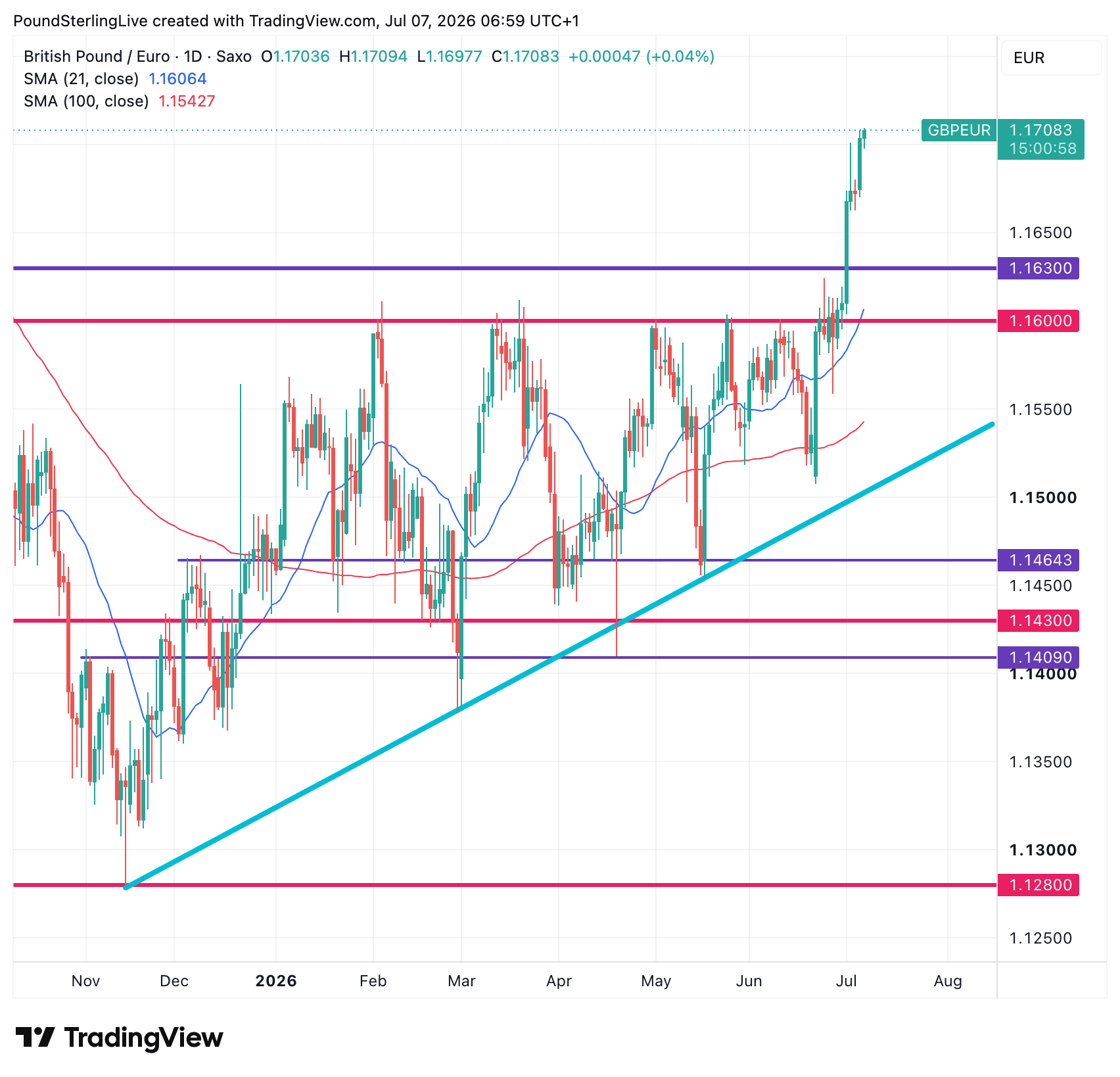
Above: GBP/EUR at daily intervals.
Another reason for the development is a recent slide in eurozone bond yields: where British yields have fallen, eurozone yields have fallen faster.
That's because markets have had to perform something of a u-turn in 'hawkish' expectations for future European Central Bank policy. Last week's inflation data release suggests inflation isn't as severe as previously thought. Therefore, the ECB might not need to raise rates again.
"At the start of last week pricing for a September ECB rate hike was roughly a two-thirds probability, now it is more like a fifty-fifty call," says Sam Hill, Head of Market Insights at Lloyds Bank.
The pricing out of future hikes has been particularly noticeable of late, ensuring the headline euro-dollar rate has fallen faster than pound-dollar.
When that happens, pound-euro has only one route open to it: higher.
Traders Weren't Ready for This
Certainly, one major element of the pound's 'unloved' rally has been a skewed market sentiment and positioning that left it ripe for a breakthrough.
"Speculators are heavily short sterling, close to levels seen shortly after the Brexit vote ten years ago," says Georgette Boele, Senior FX Strategist at ABN AMRO. "The market is net long the US dollar and slightly long the euro, according to the latest data. This matters."
Positioning is important. When market participants are betting too heavily in one direction (USD and EUR upside, GBP downside), there comes a time when a shakeout must happen and some mean-reversion ensues.
In this instance, GBP/EUR was positioned for downside, and with that not materialising GBP shorts are closed out and the exchange rate rises.
The market was probably very anxious about the prospect of political change and the arrival of Andy Burnham as the next Prime Minister. There's been a lack of policy news from Burnham, and he's committed to the UK's fiscal rules, which is a relief, although risks could build into his first budget later in the year.
"In the UK, the leadership crisis culminated in the retirement of Prime Minister Starmer. With Andy Burnham seen as his unchallenged successor, political uncertainty has remained surprisingly contained. The pound has benefited despite looming fiscal concerns, prompting us to raise our short-term forecast modestly," says a note from Swiss bank Julius Baer.
The Breakout
The technical setup has played a big part in the story of sterling's advance. It's been well documented that 1.16 has proven a solid and fast resistance zone that's frustrated the pound's steady rise since November.
There's been no major upside impulse; rather, it's been a steady grind higher, with more 'up months' than 'down months.
The gnawing away at support at 1.16-1.1630 was a feature of late-June trade in GBP/EUR, as a barrage of sell orders and take-profit trades were repeatedly tested, all of which offered a technical headwind to the advance.
But the shallow pullbacks and repeated inroads seem to have broken the resolve of the sellers: the dam burst and the pound suddenly found itself in clean air. That's the significance of a real resistance zone giving way: when it goes, the follow-through is significant.
Can the Pound Rise Further?
The pound has risen notably of late, we're looking at a 1% gain in five days, which is unusually rapid for this typically staid pair.
That matters, and there are signs that the move is about to exhaust itself. A look at the RSI on the daily chart is instructive: the RSI has reached 73, meaning its overbought.
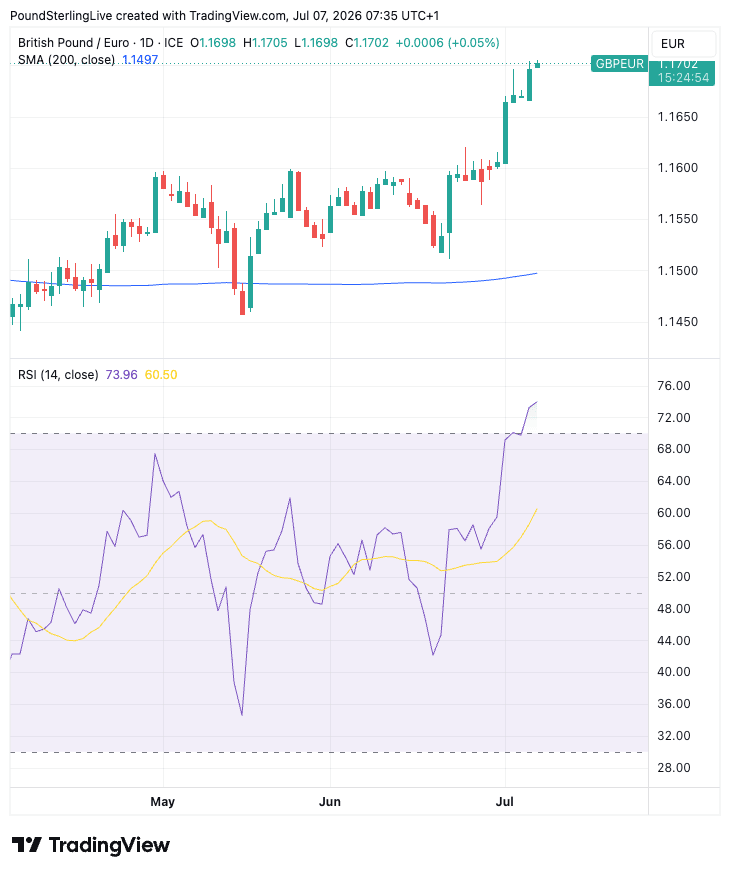
An RSI above 70 (see lower panel, above chart) tends to mean a pair is overbought, and that a retracement is about to take place. That's because the RSI indicator teans to have increasingly strong mean-reverting tendencies above 70 and below 30 (this is the oversold marker).
For the RSI to correct, we would require a period of sideways trade or a pullback.
With GBP/EUR tending to focus on the round numbers, the rise to 1.17 on Tuesday could represent a major milestone and limit for the rally, in the near-term at least.