Analysts at BNZ confirm they are maintaining their forecasts for a weaker New Zealand dollar in 2016.

The NZD continues to defy market sentiment as USD weakness kept NZD/USD stable overall while continued negativity towards the GBP saw the GBP/NZD pair fall further.
Interesting too that the kiwi has avoided being sold off in the current risk-off environment in which, "markets remain in the grip of ‘fear’ with the NZD relatively off the radar," note ANZ in a briefing to clients.
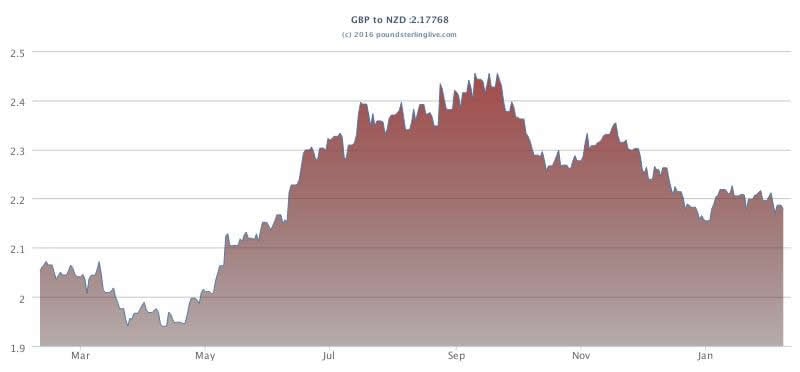
No matter which way you cut it, the New Zealand dollar is doing well, particularly against the British pound.
The below chart confirms that against the pound the NZ dollar has been on the front foot since September 2015 when the GBP’s longer-term move higher peaked.
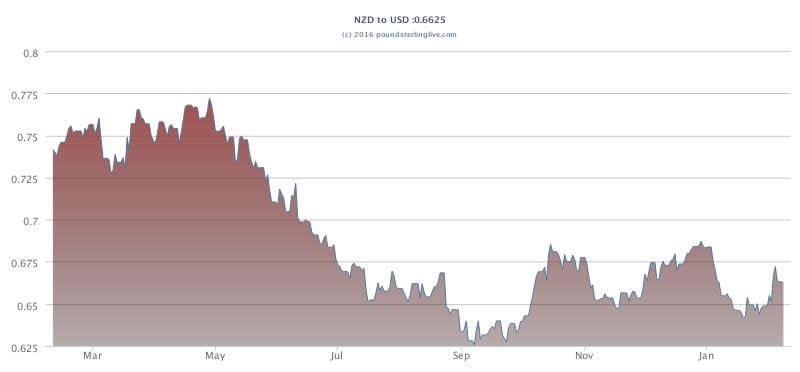
Against the US dollar the longer-term downtrend has failed in the 0.62-0.65 region and we find it difficult to advocate for a meaningful break below this broad range of support based on technical observations.
Fresh upside interest in the NZD was sparked at the start of February on some blow-out jobs numbers ensuring that the currency closed the week off as the best performer in G10.
Based on the labour market it is easier to argue that the New Zealand economy is not all that bad, even as milk prices remain suppressed. This will justify the laid-back approach adopted at the Reserve Bank of New Zealand (RBNZ) with regards to cutting interest rates further.
BNZ Stick With Their Forecasts on NZD
The currency forecast team at BNZ, whose job it is to anticipate the next big move in the kiwi, have however told clients they are still anticipating a lower currency in 2016.
The crux of the call lies on four drivers:
(i) low risk appetite in an uncertain global environment,
(ii) the falling/soft commodity price environment continuing,
(iii) narrower NZ-global interest rate spreads and
(iv) a weaker CNY and Asian currency dynamic spilling over into the NZD.
BNZ concede that point number three is not working out at this point in time.
“The one factor that isn’t playing ball is interest rate differentials. NZ rates have been on a downward path this year but so have most other developed countries. A defiant RBNZ amidst easier global policy expectations challenges our call that NZ-global rate spreads will continue to fall,” says Jason Wong at BNZ.
Latest Pound / New Zealand Dollar Exchange Rates
  | Live: 2.3468▼ -0.47%12 Month Best:2.4815 |
*Your Bank's Retail Rate
| 2.267 - 2.2763 |
**Independent Specialist | 2.3139 - 2.3233 Find out why this is a better rate |
* Bank rates according to latest IMTI data.
** RationalFX dealing desk quotation.
Nevertheless, BNZ note that three of four drivers remain relevant.
“There remains little sign that the weaker commodity price trend has been arrested. Oil prices are lower and average dairy prices have already fallen by 10% this year. And we’re confident that Asian currencies remain on a downward path this year,” says Wong.
While the Chinese currency has been stabilised for now, BNZ say it is only a matter of time before the PBoC devalues it again.
Could the Japanese Investor Boost the NZD?
As noted, there is one thing that could scupper predictions for a lower New Zealand dollar in 2016 - the attractiveness of New Zealand interest rates.
A source of strength for the New Zealand dollar over recent years has been New Zealand’s status as a destination for carry trade investors.
This refers to the borrowing of money in a low interest rate jurisdiction and investing it in a higher interest rate jurisdiction.
Think of Japan where interest rates are -10%, and then look at New Zealand where the rate is at 2.5%; your borrowed yen will earn you profit while you are sleeping if invested in New Zealand.
This dynamic has ensured a steady demand for the NZD over recent years. “This was evident in 2007/8 when Japanese investors sought the NZD for the carry trade, which pushed the NZD higher at a time when the RBNZ desired a much weaker NZD,” says Wong.
However, of late the demand for such a trade has waned, and we saw the NZD fall alongside.
“We think that the current market environment is not conducive to carry trades. Carry trades aren’t attractive in an uncertain economic environment and when volatility is higher,” says Wong.
But BNZ reckon one of the fears of the RBNZ is the return of the Japanese retail investor to take a punt on the NZD.
Data on net positions currently open on the Tokyo Financial Exchange as of the end of last month shows there were over 69k of net long positions, in line with the average over 2015.
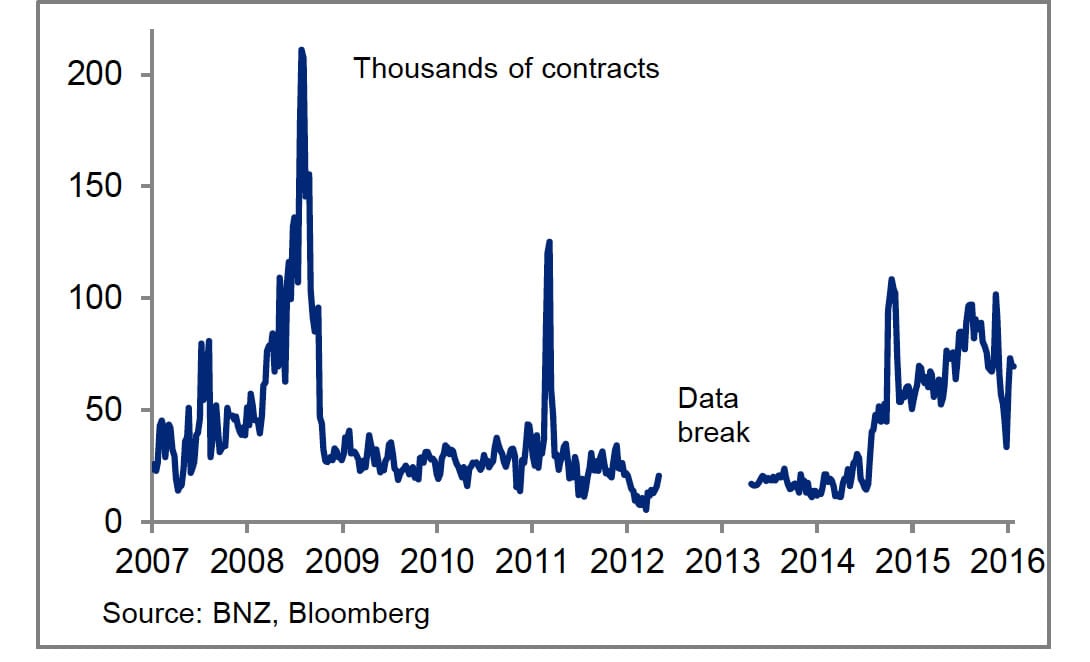
This is higher than seen over the early part of the decade, but well down on the 2007/8 experience.
BNZ New Zealand Dollar Forecasts 2016
“The NZD can still fall this year, even if one of our four negative factors for the NZD is challenged,” says Wong, “Yes, NZ’s interest rates remain attractive by global standards, and that could well hold back the NZD depreciation path this year.
But Wong and his team are sceptical that that carry trade will return in a hurry.
“At the very least, in terms of negative kiwi drivers, three out of four ain’t bad,” says Wong.
There is also the issue of the RBNZ fighting the strength in the NZD. Wong's colleague at BNZ, Craig Ebert, writing in a separate note says, "The RBNZ doesn’t like it when the NZD moves higher, against the grain of weaker fundamentals. It means a more difficult task of achieving its inflation objective, which is already proving difficult. Thus, in the last week, the hurdle for further easing has just been lowered."
This suggests we could soon hear the RBNZ attempt to talk the currency lower.
The pound is forecast to turn higher from the present levels quoted at 2.1723 with 2.2904 being seen at the end of March and 2.3164 in mid-year.
2.296 is forecast for September and 2.2789 for December. Of course the issue of the UK’s referendum on staying in the European Union makes calling sterling incredibly hard at this stage.
The NZ to US dollar rate is at 0.6634 at present and is tipped to decline to 0.6200 by March and 0.6000 by June.
A recovery to 0.6100 is expected by September and the rate is seen at 0.6100 in December.