Image © Adobe Images
Pound sterling risks falling against the dollar and the euro in 2027 as the Bank of England raises interest rates by less than markets expect and the Federal Reserve raises rates further, says Morgan Stanley.
Morgan Stanley forecasts the pound-to-dollar and pound-to-euro exchange rates to fall in 2027 because it sees the Bank of England raising interest rates by less than money markets price.
"We see GBP as a key underperformer," says a recent update from Morgan Stanley, the U.S. investment bank. "Our front-end GBP rates should amplify the GBP/USD downtrend stemming from a stronger USD."
"After November's hike to 4%, we see the BoE delivering two more hikes, in December and February, taking Bank Rate to 4.50%, against a market-implied peak of around 4.9%," the bank adds.
Its economists expect UK inflation to peak at around 4.2% in the first quarter of 2027, earlier and lower than the Bank's November forecast of 4.9% in the second quarter, with "minimal second-round effects". Second-round effects come when higher energy costs feed into wages and the prices of other goods and services, which would force the Bank to keep raising rates.
Higher expected Bank of England interest rates lift the yields on short-dated UK government bonds, the "front-end" Morgan Stanley refers to, and draw in foreign buyers who need pounds to buy them. If the Bank stops at 4.50%, those yields fall back and the pound loses part of that support.
Bank of England Governor Andrew Bailey told MPs on Wednesday, as Pound Sterling Live reported, that inflation may not rise as high as the Bank's 4.9% forecast if energy prices stabilise at current levels, a lower peak that Morgan Stanley's economists had already forecast.
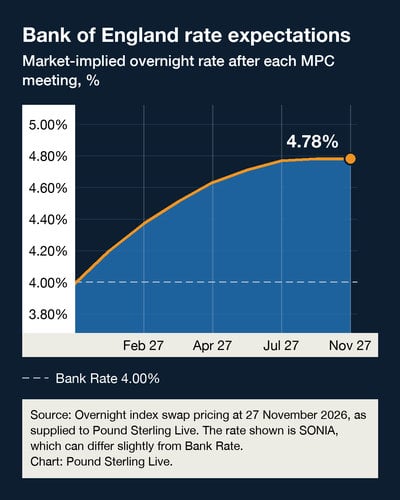
Money markets, which put odds on future interest rate moves through trading in interest rate contracts, now see Bank Rate peaking close to 4.8% in 2027, down from close to 4.9% on Monday, and give an 84% chance of a quarter-point rise to 4.25% on 17 December. That peak still sits 0.3 percentage points above Morgan Stanley's 4.50%, so the pound has further rate support to lose if Morgan Stanley is right.
The dollar side of the forecast adds to the pressure on GBP/USD. "We forecast modest USD strength as carry demand, wider USD-RoW rate differentials, and the US's investment appeal support the greenback," says Morgan Stanley, which expects the Federal Reserve to raise interest rates in December and March. Carry demand is buying by investors who borrow in low-yielding currencies to hold higher-yielding ones such as the dollar, and USD-RoW rate differentials are the gap between U.S. interest rates and those in the rest of the world.
Morgan Stanley expects the euro to struggle as well, which keeps the pound's losses against it smaller than against the dollar. "We expect the EUR to remain an underperformer, thanks to the combination of a modest widening in USD-EUR rate differentials and, more importantly, further increase in EUR-negative risk premium ahead of the French presidential election in spring 2027," says the bank.
A risk premium is the extra return investors demand to hold a country's assets when they worry about its politics or public finances, and France's election raises that worry for the euro.
Morgan Stanley's Forecasts Leave the Pound Lower Against the Dollar and Euro
Morgan Stanley's forecasts leave the pound lower against both currencies, with a smaller fall against the euro because French election risk weighs on the euro too:
1. GBP/USD at 1.27 by the end of 2027, cut from 1.38, and 3.0% below spot at 1.3099.
2. EUR/GBP at 0.85 in 12 months (GBP/EUR at 1.1765), 1.7% below the pound-to-euro rate's spot level of 1.1973.
3. EUR/USD at 1.08 by the end of 2027, cut from 1.16.
The bank's strategists also recommend selling GBP/USD.
Some Analysts See the Pound Gaining Against the Dollar and Euro Next Year
Bank of America takes the opposite view over the same 12 months, forecasting GBP/USD at 1.40 and EUR/GBP at 0.82 (GBP/EUR at 1.2195) as foreign money keeps flowing into the UK, as Pound Sterling Live reported.
Pantheon Macroeconomics finds UK price pressures still running hot in November's business surveys, which signal "annualised underlying services inflation around 4%, too high to hit the inflation target," says the economic research consultancy. That reading runs against Morgan Stanley's expectation of minimal second-round effects over the coming months.
Pound Sterling Live continues to hold a constructive medium-term view on the pound: the UK economy is outperforming, which keeps the Bank of England's rate support in place for longer than Morgan Stanley expects. France's fiscal troubles weigh on the euro. Pound Sterling Live expects GBP/EUR to trade in a new, higher range that incorporates 1.20, with its upper reaches in the mid-1.20s.
GBP/USD Needs to Break Its One-Year Low to Head Towards 1.27
Bank of America's technical analysts see the pound-to-dollar chart pointing lower, although their bank forecasts 1.40 in 12 months: "Range top and broken uptrend point lower," they say.
Resistance sits at 1.3215, the top of the range UOB sees GBP/USD trading in and a level where sellers have halted rises. Support sits at 1.3011, the one-year low set on 23 November and a level where buyers have stepped in to halt the fall. A daily close beneath 1.3011 would show the pound's downtrend resuming and open the way towards Morgan Stanley's 1.27.