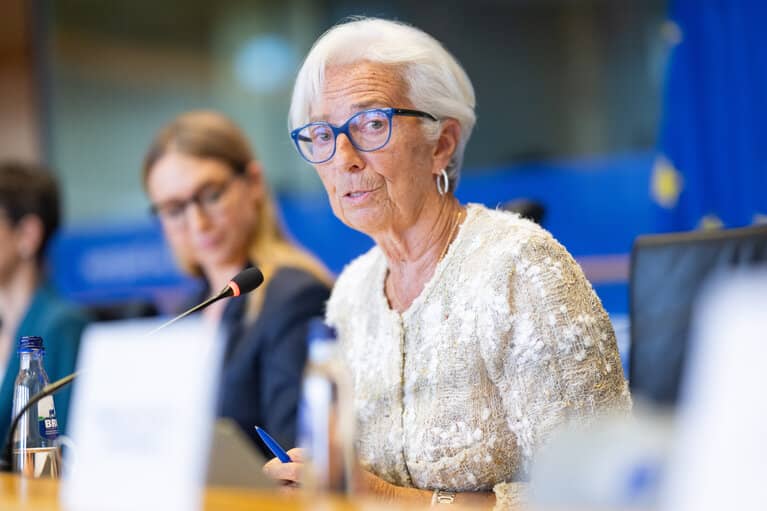
Above: File image of Christine Lagarde. Photographer: Denis LOMME. Copyright: © European Union - Source: EP.
PMIs showed inflationary pressures eased in June, underpinning ECB President Lagarde's dovish tilt.
The euro-to-dollar exchange rate dropped to its lowest level since March on Tuesday amid signs the European Central Bank (ECB) won't have to raise interest rates again.
Having raised rates earlier this month in response to building inflationary pressures, the ECB must now account for data showing the tide might have turned with the June PMI survey finding, "signs of inflationary pressures softening."
This comes about as input costs rose at the slowest pace since the outbreak of war in the Middle East and output charges increased at the weakest rate in three months.
The numbers suggest a period of disinflation is emerging, and gels with ECB President Lagarde's message to EU lawmakers on Monday that there is no need to step up the monetary response to the war.
She added she was confident that inflation is headed back to the target in the medium term.
With the prospect of another rise in interest rates rapidly receding, it's little surprise that the euro has come under pressure.
"Lagarde’s dovish tilt softens the euro," says Francesco Pesole, FX strategist at ING Bank. "It was a rare dovish-leaning comment, as the ECB has mostly tried to endorse the market's hawkish bets in the past three months."
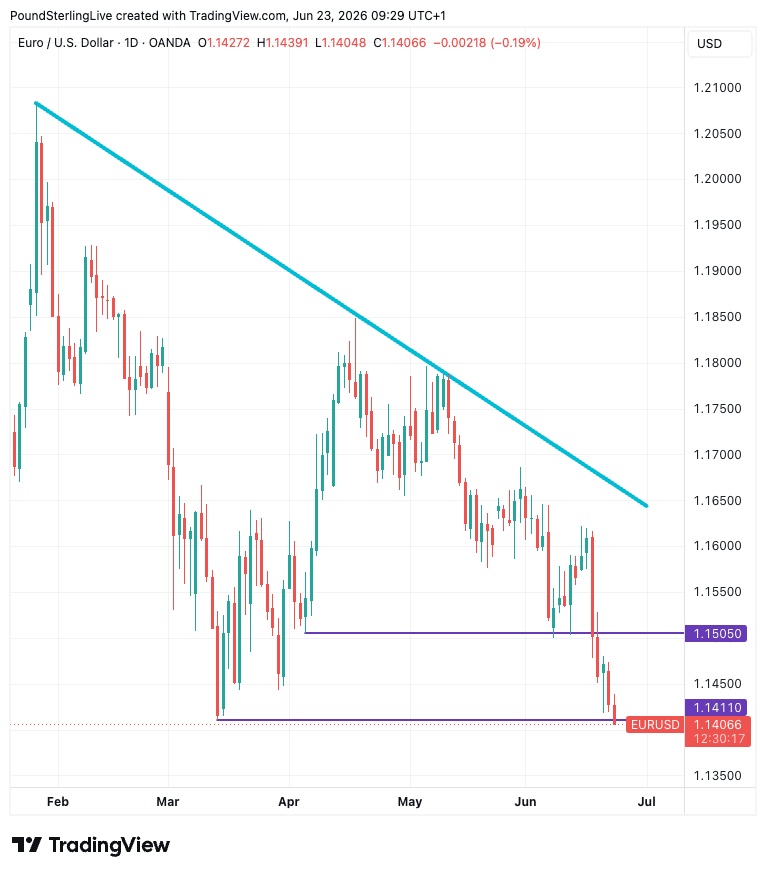
Euro-dollar fell to 1.14048 on Tuesday, its lowest since August 2025, and further downside awaits.
The ECB raised interest rates in June, delivering what was considered an 'insurance' response to rising inflationary pressures sparked by the Middle East conflict.
That hike, and the prospect of further hikes, has held regional sovereign bond yields aloft, which in turn tends to underpin the currency.
Money market data show a rate hike is priced as being more than 50% likely before year-end, meaning there's scope for further reductions in rate hike bets to weigh on the single currency.
"In any case, it’s hardly a positive development for the euro at a time when the dollar remains well-supported by both data and Fed communication (at least in-meeting). We still expect a test of 1.1400 in the near term," says Pesole.
Today's PMI data showed the Eurozone's private sector economy remains under pressure, although the worst might be behind it as the composite PMI recovered to 49.5 from 48.5, marking a 3-month high for the series.
The services PMI recovered to 48.9 from 47.7 and the manufacturing PMI was steady at 51.2.
"Encouragingly, lower energy prices are already filtering through to businesses and rates of input cost and selling price inflation have moved lower in June as a result, hinting at a potential peaking of the recent price spike," says Chris Williamson, Chief Business Economist at S&P Global Market Intelligence.