Given negative economic fundamentals, political woes and the looming threat of a credit rating downgrade the outlook argues for a weakening of the rand against the pound sterling.
Theory and reality are not however marrying when it comes to the GBP to ZAR exchange rate. In fact our analysis of the technicals suggest that on balance the ZAR is to be preferred.
Fresh declines in the British pound have been sparked in the wake of the Brussels terror attacks as the prospects for the UK voting to leave the European Union have risen notably.
The last time the 'Leave' camp garnered momentum was in the wake of the Paris attacks. Indeed, in the wake of the attacks bookmakers have slashed their odds of a Brexit.
A look at the structural setup of the GBP/ZAR market confirms a negative bias thanks to the sharpness of the sell-off seen at the start of 2016.
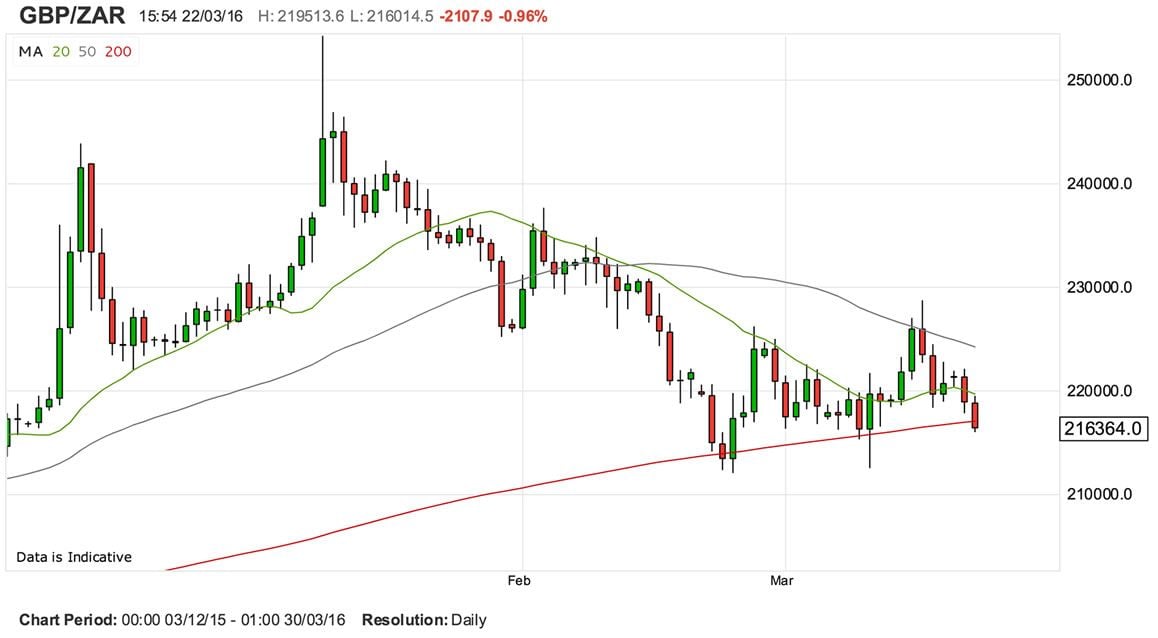
We are watching how GBP/ZAR handles that red line - the 200-day Moving Average.
This is a level traders often cluster their orders in expectation of a pause, bounce or consolidation of the rate and a break through it would likely accelerate further down-side.
A continuation down to 20.00 would be likely if this were the case. Note though that this level has provided support since February and could yet save the day for GBP bulls again.
For more upside look for a move above 22.8747 highs, leading to a move up to 23.5000.
Betting on a move higher would by no means by a conviction recommendation as there is hefty resistance from a sturdy trend-line in the way at about 22.9000.
This represents the former neckline of a topping pattern, which could prevent upside from gaining traction, therefore a break clearly above 23.0000 might be a less risky entry point as it is clearly above the neckline.
Latest Pound / SA Rand Exchange Rates
  | Live: 21.7772▲ + 0.24%12 Month Best:23.5398 |
*Your Bank's Retail Rate
| 21.0367 - 21.1238 |
**Independent Specialist | 21.4723 - 21.5594 Find out why this is a better rate |
* Bank rates according to latest IMTI data.
** RationalFX dealing desk quotation.
Commodity Recovery Remains the Rand's Biggest Positive
Driving improved sentiment to ZAR has been the gradual improvement in global commodity prices.
However, the recovery could be temporary halted by events in Brussels on Tuesday, markets do not take kindly to the uncertainty posed by terror attacks.
Stock markets and commodity prices are lower, the USD/ZAR exchange rate is also higher as a result.
Note though that terror-inspired losses are typically short-lived so we do not expect any lasting impact.
Politics is the ZAR's Biggest Risk
The South African rand slipped in the previous week, after coming under pressure from the threat of political instability, when president Jacob Zuma’s administration was once again mired in controversy after two scandals involving the Finance ministry hit confidence in the country’s political leadership.
The first scandal surrounded links between Zuma’s administration and the Gupta family, after the Deputy Finance Minister said the Gupta’s had offered to make him Finance Minister, inferring Zuma’s government was in their pocket.
The Finance Minister Pravin Gordhan was also involved in a separate dispute with a special unit of the police called the hawks, over a unit he set up at the revenue service. The Hawks were threatening legal action unless Gordhan answered three-pages of questions. Again the inference being that Gordhan might be involved in illegal dealings.
"On the local front, the political drama we’ve witnessed this year is far from done. This weekend’s ANC NEC meeting didn’t deliver the Hail Mary pass of recalling President Zuma, in all honesty, it was an unrealistic expectation considering the local the elections this year," says Alet Opperman at Treasury One.
The ANC did come out in support of President Zuma, but only to the extent that he has the authority to change ministers, but that’s not the end of the story as ANC will launch an internal investigation into the Gupta’s influence.
"The Political uncertainty will continue till the ANC’s 2017 elective conference as different sides within the ruling party vie for control," says Opperman.
There is a risk of an increase in political fall-out which could harm the rand over the short to medium term.
SARB raise interest rates by 0.25% - SA bonds skating on thin ice as rating down-grade threatens
The other major event of the previous week was the South African Reserve Bank’s (SARB) rate hike, which took the bank’s rates up to 7.0% from 6.75% previously.
The SARB’s governor, Lesetja Kganyago, said the rate hike had been to mitigate against a weakening currency and economic outlook. Indeed the rand appreciated to 21.8370 versus the pound on the day.
Mr. Kganyago said the central bank “remains concerned about the weak growth outlook and negative business and consumer confidence.”
He highlighted the negative outlook for the Chinese economy as a major source of concern.
It was the third meeting in a row in which the SARB increased rates.
A major concern for the country is that its bonds could be down-graded to junk status soon after several rating’s agencies recently changed their outlook to negative. This concern was heightened by the political scandals above.
As we reported last week, the macro-mix remains ZAR-adverse: economic growth is almost at a standstill, GDP grew only 0.6% in Q4 and other indicators suggest that the economy is on the verge of a recession.
The Current Account is sporting a 5.1% deficit which is a further weigh on the rand.
The main data release this week is inflation data (CPI) on Wednesday which is expected to rise to 6.7% from 6.2% yoy in February and by 1.1% mom from 0.8% previously.
Core CPI is expected to remain at 5.6% yoy in Feb and rise by 1.2% mom from 0.7% in January.
A surprise increase in inflation is likely to weaken the rand as it will decrease its purchasing power relative to the pound.
This is because more rand will be required to purchase a basket of goods compared to the number of pounds needed to buy the ‘same’ basket of goods, assuming that inflation does not rise at the same pace in the UK.
The normal rule that higher inflation lifts a currency’s worth because it leads the central bank to raise interest rates, which then attracts international investors seeking a higher interest return on their capital, is not so relevant in countries which are politically and economically unstable such as South Africa, as the increased risk tends to limit how much international capital is likely to be enticed.