A preview of the week ahead for the South African rand, including news, events and forecasts.
- Central bank could provide support in form of higher rates this week
- Longer-term outlook remains incredibly fragile as ratings agencies circle
- The 6 changes the government must enact to stabilise confidence
The highlight for the South African rand in the week ahead will be the meeting for South African Reserve Bank (SARB) on Thursday May 17.
The meeting comes as the ZAR continues to enjoy the supportive currents of the recovery in global commodity market prices that have resulted in a multi-week recovery.
While the pound to South African rand exchange rate has however been edging higher of late it remains well below its January peaks above 24.00.
Against the dollar we see the rand has been in decline for two days now, but again, USDZAR is below the January peaks at just below 17.00.
Further support is likely should the SARB increase interest rates this week, as expected by the majority of analysts, in a bid to keep a lid on rising inflation.
Higher prices are being sparked by by a drought and the weak currency which has raised the cost of foreign imports, most notably, fuel.
The side effect of higher interest rates is hightened demand for the rand as global investors look for a higher return on their investments.
Latest Pound / SA Rand Exchange Rates
  | Live: 21.7772▲ + 0.24%12 Month Best:23.5398 |
*Your Bank's Retail Rate
| 21.0367 - 21.1238 |
**Independent Specialist | 21.4723 - 21.5594 Find out why this is a better rate |
* Bank rates according to latest IMTI data.
** RationalFX dealing desk quotation.
Inflation data for January showed a higher-than-expected rise to 6.2% when it had been forecast to increase to 5.8%, from 5.2% previously.
This was above the SARB’s upper inflation band of 6.0%.
According to data compiled by Bloomberg, markets immediately began pricing in a 0.25% rate increase from the SARB after the release of the inflation data.
A rate rise at the next meeting seems almost inevitable, and depending on the extend of the rate hike could increase the value of ZAR – if, for example, SARB raised by 50 basis points, as it did in January.
Ratings Agencies Circle the Wounded Beast
While the SARB may shore up ZAR near-term, the longer-term structural concerns remain all the more pressing.
It has emerged that one of either S&P or Fitch was due to put South Africa’s credit rating on review for downgrade, which was subsequently postponed to June following the budget.
Moody’s, which rate the country’s foreign debt at Baa2 - two notches above non-investment grade and one notch above Fitch and S&P - put the country’s rating on review for downgrade and will be holding talks with Treasury and other institutions this week.
"South Africa will have three months before it is either downgraded or affirmed by Moody’s. Gordhan said that the country needed to take concrete action in order to avoid a downgrade to sub-investment grade," says Isaah Mhlanga at RMB.
6 Steps to Support the Rand Long Term
What do investors really want to see government do to gain confidence?
"It is a bitter cocktail, at least over a short three-month period, but doable should the politics put the country first,' says Mhlanga.
Selected measures, suggested by RMB, are as follows:
- Resolve the legislative framework that impedes investment, starting with resolving the “once empowered always empowered” principle.
- End the abridged birth certificate requirements for visas with immediate effect.
- Sign an improved, amended Mineral and Petroleum Resources Development Bill into law.
- Address legislation around protection of property.
- Announce a principle of at least 40% of boards at SOEs to come from the private sector.
- Establish an SME venture capital entrepreneurship fund funded by both government and the private sector.
Weak Domestic Fundamentals
Despite global forces mainly driving the price of the rand, the domestic economy remains a major factor too.
According to a report from HSBC the outlook for the South African economy is not very positive:
“Yet, the macro-mix remains ZAR-adverse. The economic growth is almost at a standstill. GDP grew only 0.6% in Q4 and leading indicators continue to suggest that the economy stays on the verge of a recession.”
Lack of growth has spear-headed fears that ratings agencies might down-grade SA debt, which would further exacerbate the country’s economic problems and severely weaken the rand again:
“The deteriorating macro panorama is all the more worrying given that the fiscal consolidation is highly dependent on growth. The credibility of the fiscal targets are pivotal for credit rating agencies and hence the financing of a widening current account deficit (5.1% of GDP).”
Technical Forecast for GBP/ZAR
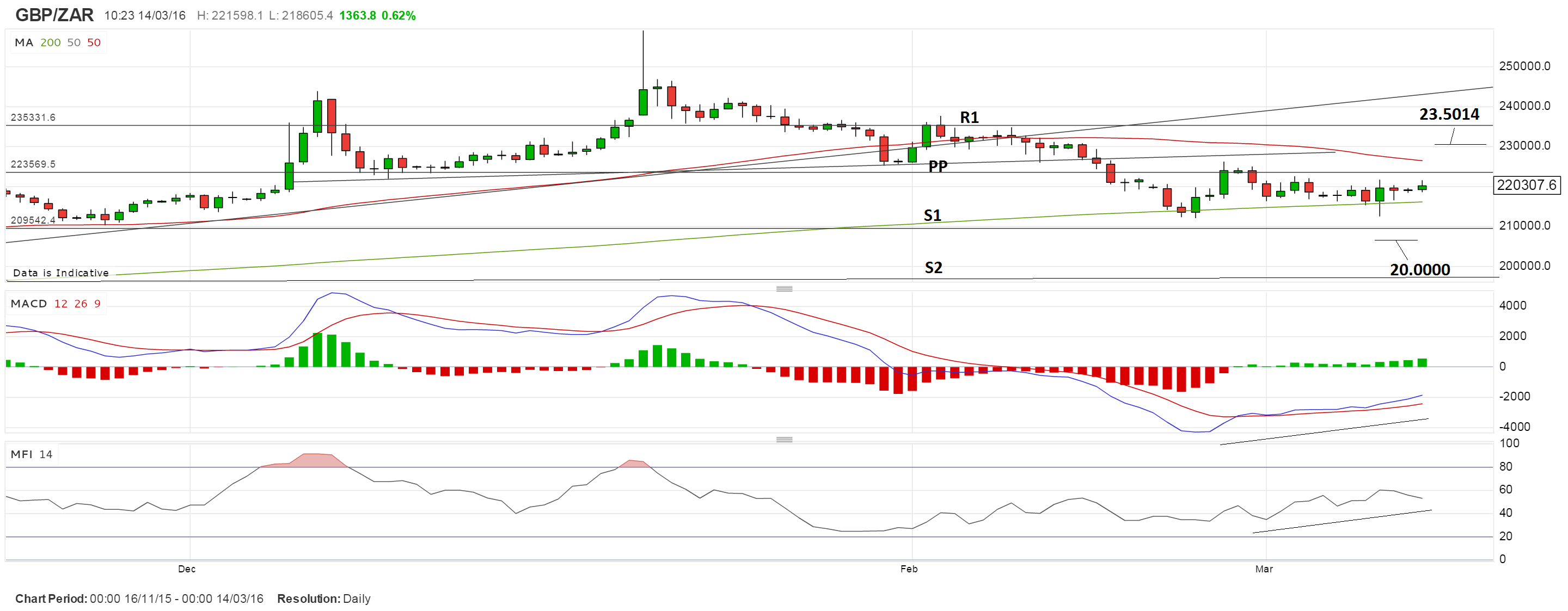
The chart of GBP/ZAR provides little in the way of clues as the next move for the currency.
The pair had been falling (in line with the rand strengthening) until it reached the 200-day moving average at 21.6195, where it based and started going sideways instead.
It remains in this sideways move just above the 200-day; with signs of underlying strength from the rising Chaikin Money Flow Index which is a useful indicator of which direction a sideways move is likely to break in.
MACD, which measures momentum, is also rising.
Nevertheless, the very short-term trend remains intact and likely to continue until it reverses – as such, a clear break below the 200-day MA and the S1 monthly pivot (another major support level) would be required to confirm further down-side, with a move below 20.9545 confirming a continuation down to 20.0000.
Alternatively if the pair does go higher again, a break clearly above the 50-day MA and the 23.0000 level would probably signal an extension to 23.5014.