
We see the potential for further advances in the GBP to USD conversion but others are more bearish on the pair's prospects with RBC Capital confirming their long-term target at 1.15 remains intact.
GBP/USD is seen trading higher than where it started the week at 1.3315 following Fed Governor Lael Brainard's speech to an audience in Chicago.
The speech saw Brainard warning against hasty interest rate rises, particularly in light of US employment growth failing to stimulate inflation.
Brainard believes that caution is warranted, particularly with the global economy remaining subdued and potential risks remaining high.
The comments contrast to the pro-USD comments of several Fed officials who have suggested interest rates should be increased as soon as September.
Markets were pricing in a 30% chance of a September rise ahead of the Brainard speech.
Higher Fed interest rates would be positive for the Dollar as they attract more inflows of foreign capital from investors seeking higher yields.
"With the Fed’s Brainard (dove, voter) remaining true to form and not displaying any undue hawkish shifts on Monday, the dollar may continue to remain vulnerable in the near term, perhaps all the way into the FOMC next week," says Emmanuel Ng at OCBC in Singapore.
From a technical/chart perspective, the outlook remains positive for the Pound.
The GBP/USD pair has broken above the neckline of a double-bottom basing pattern, providing confirmation that the trend is changing on the daily chart:
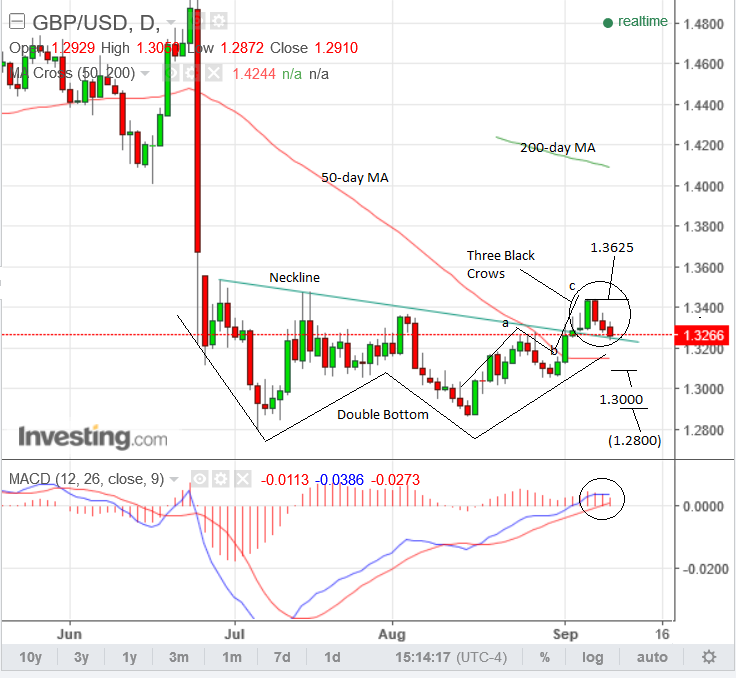
GBP/USD has risen strongly up to a high of 1.3447 following the break, and although it has pulled back and formed a bearish 'Three Black Crows' Japanese candlestick pattern, it has met support at the neckline of the double bottom, and it will probably rotate from here and continue higher eventually.
A break above 1.3450 would provide further confirmation of a continuation up to its initial target, as calculated using the height of the double-bottom as a guide, at 1.3625.
The Parabolic Sar indicator, shown as lines of dots under the exchange rate, is supporting more upside since the dots remain below the pair, although because it is below the 200-day moving average that weakens the bullish signal.
The MACD is above its zero-line which is bullish.
Others are not so optimistic. Ipek Ozkardeskaya at London Capital Group believes, for GBP, the bears remain in charge:
"The critical 1.3296 (major 38.2% retrace on Aug 29th – September 2nd advance) has been broken on the downside, sending the GBP/USD in the short-term bearish consolidation zone for a further pullback to 1.3205 (major 61.8%) and 1.3150 (minor 76.4%).
"Intra-day resistances are eyed at 1.3285 (200-hour moving average), 1.3296 (major 38.2%) and 1.3337 (100-hour moving average)."
Latest Pound / US Dollar Exchange Rates
  | Live: 1.3239▼ -0.01%12 Month Best:1.3867 |
*Your Bank's Retail Rate
| 1.2789 - 1.2842 |
**Independent Specialist | 1.3054 - 1.3107 Find out why this is a better rate |
* Bank rates according to latest IMTI data.
** RationalFX dealing desk quotation.
GBP/USD Downtrend Still not Done
While near-term activity in Sterling has been positive, the outlook remains challenging.
The invocation of Article 50 looms on the horizon and with it a Pandora’s Box of unforeseen issues.
Should data cool over coming months we could well see the prospect of another interest rate cut from the Bank of England in November rise, which would in turn trigger another bout of GBP weakness.
This is one reason why there are many in the analyst community who foresee another leg lower in Sterling on the horizon.
“Only when we start to get a clear picture of the economy in Q4 (around the turn of the year) will we really have much idea what the short-term impact of the vote has been and the real household income squeeze resulting from GBP’s fall alone should ensure that the impact is negative,” says a note from RBC Capital.
Indeed, many of the activity indicators currently being released, although relating to activity post-referendum, will have been heavily influenced by decisions made pre-referendum and on the assumption of a vote to remain.
RBC Capital also see scope for disappointment on the positive impact of GBP’s fall on economic activity, which is likely to be limited to higher exporter margins, with little follow-through volumes and hence employment and investment.
“The UK’s current account position and its domestic counterpart (the budget deficit) remain a medium-term funding concern for GBP and the impact of GBP weakness so far will be limited and still leave the external imbalance unsustainable in the medium-term. Our 1.15 target for GBP/USD is unchanged,” say RBC Capital.
Ahead: BoE Rate Meeting, Inflation, Employment, Retail Sales Data in focus
The main event for sterling in week ahead is the Bank of England rate meeting.
There will be much speculation as to whether the governor of BOE will increase stimulus measures or not.
In his testimony to the House of Commons Select Committee, Carney said that there was still scope to expand stimulus.
He added, however, that there was now a lower probability of the UK falling into a recession.
Carney said that the Current Account deficit, which stands at 7.0%, is likely to fall to 4.0% due to sterling depreciation.
The Bank could therefore stand accused of jeopardising savings accounts while sowing the seeds for aggressive inflation in the future by acting too soon and without the requisite hard data from which to base such important decisions.
Nordea Bank do not expect the BoE to make any changes next week given how well the UK economy has held up:
“The UK economy is by now holding up better than expected, and that’s why we expect no policy changes from the Bank of England next Thursday,” said analyst Holger Sandte
Key data will include UK inflation data out on Tuesday, which is expected to show prices edging up by 0.7% in August, as a result of the weaker pound pushing up the cost of foreign imported goods.
On Wednesday July Unemployment data and Average Earnings are released.
Earnings are closely-watched by the BoE as they see it as a major influence on higher future inflation and growth.
Thursday sees the release of Retail Sales which are forecast to come in at -0.4%, down from the previous month’s surprisingly strong 1.4% rise.
In fact it was the best reading from the retail sector since 2014 announced in August that triggered the recent GBP/USD recovery.
For the US, the main economic data releases in the week ahead is headline and Core Retail Sales out on Thursday, which are expected to show a 0.1% and 0.2% rise respectively.
Philadelphia Fed Manufacturing in September, out on the same day, is expected to show a 2.0 result - the same as previously.
Producer Prices in August are forecast to show a 0.1% rise
Any results above what is expected in the inflation data, is likely to increase the probability of the Federal Reserve moving forward with a rate hike, which certeris paribas will strengthen the dollar.