The GBP to USD conversion could come under pressure this week as a G10 modelling tool at Westpac suggests they US dollar is giving off a strong buy signal.

Today's fundamental picture for the British pound is dominated by inflation numbers. Having come in-line with economist forecasts we see the GBP/USD edge higher ensuring the February recovery in the pair remains valid.
Through the entirety of last week, GBP/USD showed remarkable stability in the face of significant volatility in equity and commodity markets.
We remain within the interim 1.4375/50 to 1.4600/50 range as the GBP to USD conversion has trended higher since late January as markets turned decidedly negative on the USD.
Latest Pound / US Dollar Exchange Rates
  | Live: 1.3335▲ + 0.23%12 Month Best:1.3867 |
*Your Bank's Retail Rate
| 1.2881 - 1.2935 |
**Independent Specialist | 1.3148 - 1.3201 Find out why this is a better rate |
* Bank rates according to latest IMTI data.
** RationalFX dealing desk quotation.
To calibrate that sentence a little further; markets aren’t so much negative on the US dollar, rather they are no longer single-minded in their pursuit of a higher USD.
As such, we see improved prospects for the USD over the remainder of February.
We are not alone. The G10 FX Model at Westpac Bank is flashing a strong buy signal for the USD in the week ahead.
Westpac’s Richard Franulovich tells us more:
“A bullish US data surprise index signal remains the feature theme for the G10 FX model portfolio. The signal remains live for another two weeks, betting on yet further improvement in the complexion of the US data.
“A slightly firmer total yield signal for the USD adds to the model's strong predilection for USDs. For the week ahead the model has an over the top 65% long USDm exposure, almost double last week's long USD position.”
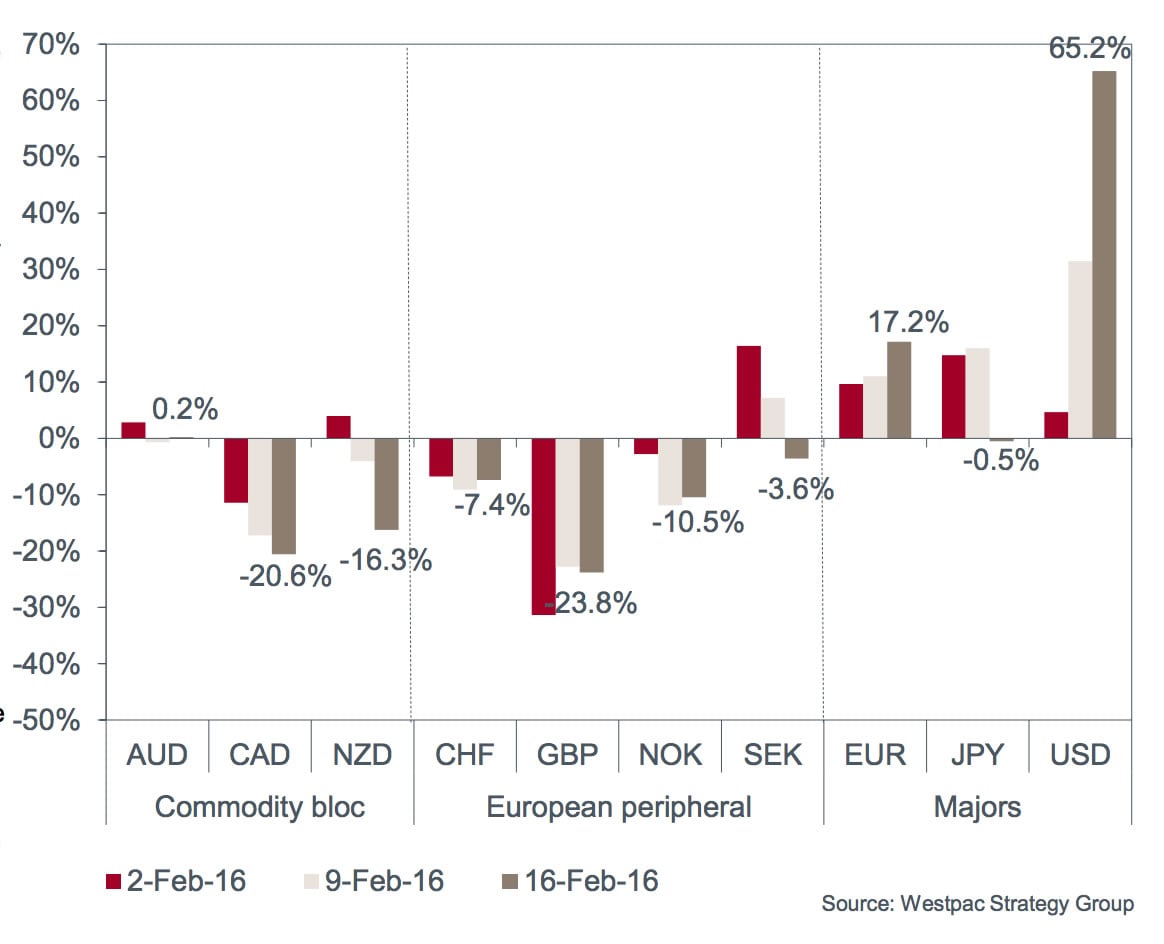
The above model is interesting; look at who is in the negative camp. GBP.
“GBP and CAD remain the big bearish bets for another week, the model short these two currencies to the tune of 20.6% and 23.6% respectively,” says Franulovich.
The Westpac model is a comprehensive one in that it uses four long-term signals, three medium-term signals and two short-term signals.
The forecast model identifies the relative attractiveness of the G10 currencies based on 9 dynamically weighted macro-economic factors.
The 9 factors are based on a combination of; 1) modifications to the "standard FX model" (i.e. carry, trend and value); and 2) various signals sourced from Westpac's suite of FX indicators.
Technicals Advocate for Declines
Turning to the charts analysis from Lloyds Bank shows that while below 1.4650 there is a bias for a gradual move back towards the 1.4200 congestion region and potentially beyond to the key long-term support zone between 1.40 - 1.35.
"The nature of further moves to the downside is unlikely to be as aggressive as in the previous month, given that markets have already accounted for drastic changes to interest rate expectations and re-priced the risk around the EU Referendum," says Gajan Mahadevan at Lloyds.
But, a move above 1.4650 could trigger a period of consolidation says Mahadevan, as part of a broader correction into the 1.48 – 1.50 region.
Meanwhile, the technical analyst team at Societe Generale are more constructive over GBP's prospects:
"GBP/USD almost achieved projection for c wave of abc down move since 2014 (1.3950) and is now undergoing a rebound.
"With weekly stochastic pulling back from a floor, test of 1.48, 38.2% retracement since last June is not ruled out. Short term downside is likely to be cushioned at 1.43; recent lows 1.4080/40 will be important."
This is a Sterling-Centric Week
Hold onto your hats, this week is an interesting one for the pound and promises heightened volatility which will no doubt create some noise that will mess with most forecasting signals.
UK inflation data is due on Tuesday, labour market data on Wednesday, retail sales on Friday and an EU Summit with Brexit on the agenda takes place on Thursday-Friday.
Inflation data is key we think as this is key to the Bank of England's thinking on interest rates, should the data beat expectations then we could well witness sterling strength. GBP/USD still remains heavily sold, and therefore surprises remain heavily biased in favour of a bounce near-term.
Pound / Dollar Should be at 1.60: HSBC
Longer-term, the debate on where the pound should be against the dollar rages with most big-name analysts that we follow arguing that the exchange rate should be higher.
Putting a wedge between these forecasts and reality is that already well-worn issue of the UK’s EU referendum.
“We believe GBP-USD should be trading around 1.60 based on our base case that the UK rejects “Brexit” and the BoE hikes rates sooner than expected. But the exchange rate is trading closer to 1.40, which means that the market has a different view of the probabilities surrounding the two drivers,” says David Bloom at HSBC.
What probability is the currency market attaching to each of these two drivers?
On the interest rate front, HSBC say we can assume a high probability that the market thinks it is accurately forecasting the timing of the first hike, even if the consensus among economists is less dovish.
For “Brexit” risk, odds from various bookmakers suggest that the likelihood of “Brexit” is between 25% and 35%.
“Given the opinion polls are at roughly 50-50 this seems strange to us. It means that the betting shops don’t believe the opinion polls and the actual probability may be somewhere in between,” says Bloom.
BNP Paribas: Pound to Dollar Fair-Value is Higher
Also making the case for a fundamentally under-valued GBP/USD exchange rate are BNP Paribas where analysts say their fair-value modelling has the pair at 1.64.
A combination of an overvalued US dollar, and undervalued sterling, have had the predictable impact of ensuring the GBP/USD is lower than where it should be.
“There are two previous periods when the USD appeared significantly overvalued: in 1986 when the Plaza Accord of co-ordinated intervention weakened the dollar and in 2002 when the US stock market bubble and introduction of the euro prompted the USD’s overvaluation,” says Michael Sneyd at BNP Paribas.
“EURUSD appears cheap, trading around one standard deviation below its FEER, while GBPUSD is also cheap, trading 14% below its FEER of 1.64,” says Sneyd.
Dollar Today: Bounce on President's Day
The dollar enjoyed a bounce that was likely exacerbated by thin holiday conditions with Wall Street off today for Presidents’ Day.
Hopes for Japanese stimulus and Chinese currency stability helped buoy the dollar and temper appetite for safety in the yen," says Joe Manimbo, Senior Market Analyst at Western Union, "market fears rather than sturdy U.S. fundamentals have driven the dollar, throwing forecasts for its continued outperformance this year off course"
Recent U.S. reports on jobs and the consumer depict the dollar as somewhat of a sleeping giant.