We have witnessed some significant declines in the dollar exchange rate complex (USD) of late.
The dollar basket – a summary of US dollar performance against a number of currencies – has fallen substantially from an August high of 9861 to a-time-of-publication low of 9556.
The majority of the losses have come against the euro which has surged higher from below 1.09 in early August to 1.1385. Resistance at 1.14 now looms and we watch with interest if the dollar can be punished to the extent that a break of this level takes place.
What is driving the sell-off in the dollar?
Interest rate expectations remain key to the outlook for the USD. News that the US Fed may shy away from a September rise has prompted a new bout of weakness in the dollar (and indeed the pound sterling) confirming just how sensitive markets are to the issue.
The dominant school of thought suggests that the dollar will rise in tandem with increases in US interest rates.
Goldman Sachs are basing their forecasts of parity between the euro and dollar on the basis that this trend will continue.
However, we have heard from another prominent analyst that a move higher by USD in tandem with rising US interest rates cannot be guaranteed.
Analysis conducted by Commerzbank points to the fact that in previous interest-rate-raising cycles the dollar failed to rally; could this be the case once more?
According to analysts Christoph Balz and Bernd Weidensteiner, in the last three rate hike phases the dollar has actually lost value initially as measured in terms of the Fed’s exchange rate index.
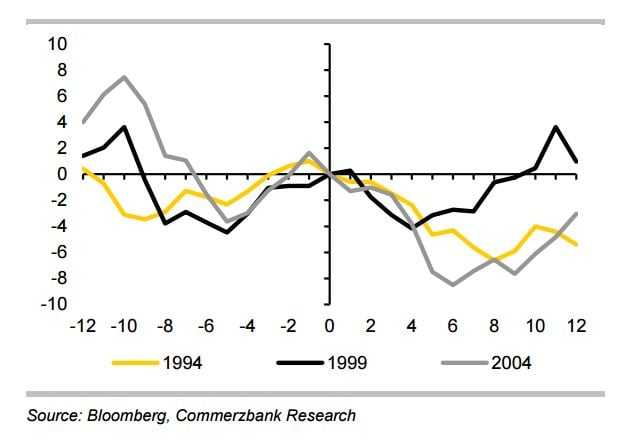
The reason that the US dollar did not rise is likely because the US economy and interest rate cycles are highly correlated with those elsewhere.
i.e The yield differential of 10-year Treasuries thus did not rise compared to corresponding securities in Germany, the UK and Japan despite Fed rate hikes and the “bond market crash” in 1994.
The dollar therefore did not become more attractive. This lack of differential is highlighted in the pound to dollar exchange rate pair (GBPUSD) that has bottomed, strengthened, and now settled into a sideways trend.
Latest Pound / US Dollar Exchange Rates
  | Live: 1.3372▲ + 0.51%12 Month Best:1.3867 |
*Your Bank's Retail Rate
| 1.2917 - 1.2971 |
**Independent Specialist | 1.3184 - 1.3238 Find out why this is a better rate |
* Bank rates according to latest IMTI data.
** RationalFX dealing desk quotation.
UK and US interest rates are expected to largely move in tandem.
Another reason for the USD’s inability to rally in the past were special factors which weighed on the dollar: in 1994, many market participants presumed that the US government was pursuing a weak-dollar policy against the backdrop of rising trading deficit.
Commerzbank also note that the sideways movement of the dollar in 1999 was moderate compared to the previous considerable appreciation between 1995 and 1998.
And in 2004 the discussion on the sustainability of the US trade deficit adversely impacted the dollar, leading to a significant negative dollar risk premium.
This Time the Dollar Will Rise
The upcoming cycle will be different argue Commerzbank.
Balz and Weidensteiner say:
“In our view, the present situation is not comparable with 1994, 1999 or 2004 and we expect substantial dollar strength (forecast EUR-USD 1.01 in Q3 2016).
“Firstly, in the case of euro zone and Japanese monetary policy, further expansionary steps are more likely than tightening, resulting in a rising yield advantage in favour of US Treasuries, which points towards a more attractive dollar.
“Secondly, we do not see any special factors weighing on the dollar. The trade deficit for example is stagnating at a relative unproblematic level.”
But Beware Short-Term Weakness
Those betting on a dollar rally will be licking their wounds after a week of heavy selling.
Hearing that the dollar is forecast to undergo major gains will be questioned and we are watching the euro / dollar exchange rate at 1.14 - if this level is broken then we could be in for further gains.
But, and this is our base-case, the 1.14 level has in the past thwarted euro strength and may do so again in the final days of August.
The Relative Strength Index (RSI) on the EURUSD daily charts now reads at 71 - and is officially considered over-bought.
The RSI has barely stayed above 70 on this market in 2015 and we would expect some pullback action over coming days.