The euro exchange rate complex is on a tear higher – forcing the GBP/EUR pair below 1.40 and the EUR/USD back towards 1.14.
How long can the euro’s strength last?
Looking at the pound to euro exchange rate the 1.40 region appears to have given way and in the process opens up the prospect of a test of 1.38 and then 1.36 in extension.
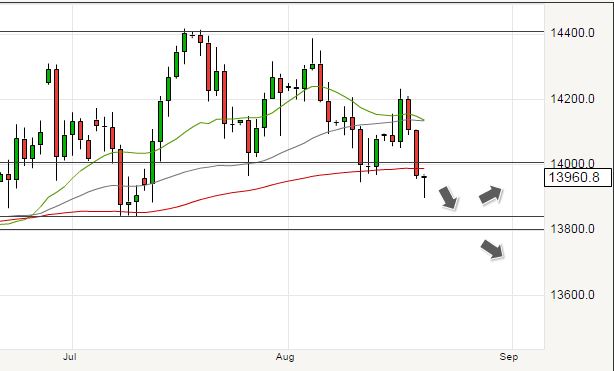
Should the region around 1.36 provide adequate support buying interest could prompt a rebound - in short these are familiar ranges within the context of 2015 trade but large international payments will be feeling the pinch nevertheless.
However momentum is now negative, confirmed by the pair breaking below the 100, 50 and now 20 day moving averages.
The pound and dollar sit in the same bucket - two currencies whose recent strength has come largely from expectations that their two central banks will start raising interest rates soon.
The closer the date, the stronger the two currencies become; the lions share of gains have been taken from the euro.
So when expectations on those rate rises disappoints the euro is usually the first to take revenge.
Another important point to note is that the Bank of England traditionally follows the US Federal Reserve when embarking on interest rate raising cycles. As such, any delay to the Fed is widely seen as a delay to the Bank of England’s plans.
Latest Pound/Euro Exchange Rates
  | Live: 1.187▲ + 0.03%12 Month Best:1.1913 |
*Your Bank's Retail Rate
| 1.1466 - 1.1514 |
**Independent Specialist | 1.1704 - 1.1751 Find out why this is a better rate |
* Bank rates according to latest IMTI data.
** RationalFX dealing desk quotation.
Fed Prompts Euro Strength, Pound and Dollar Weakness
This dynamic played out on Wednesday when the minutes of the July Fed meeting were released.
“Most judged that the conditions for policy firming had not yet been achieved, but they noted that conditions were approaching that point,” said the Fed.
 Markets took this as a sign the expected September interest rate rise had pushed back. On cue, demand for the euro grew.
"In our view, recent developments on the international front (i.e., China’s devaluation of the yuan) together with a renewed decline in commodity prices are certainly giving the doves the upper hand. It appears that the odds of a September rate hike have significantly diminished, at least for the time being. We still think that a Fed rate hike is more likely in October if financial conditions stabilise," says a note from Canada's NBC's research unit.
The dollar index has fallen significantly over the past 48 hours and now reads at 9330 confirming all-round weakness for the USD.
“The reaction of financial markets suggests that investors had expected a more hawkish tone, possible a detailed hint about the timing of the first rate hike. Accordingly, the USD weakened after the release of the minutes, while yields declined. We think that this is an overreaction. After all, the overall message of the minutes is: we are getting there!” says Harm Bandholz, Chief US Economist with UniCredit Bank in New York.
This view is echoed by ABN Amro’s Senior Economist Maritza Cabezas:
“We expect “some” further improvement ahead as the gains in the job market continue to support the economy. This is what the Fed wants to see before a rate hike. Consequently, a rate hike in September remains very likely in our view. Tighter financial conditions will, however, lead the Fed to opt for a significantly slower pace of rate hikes compared to past cycles.”
Barclays are also sticking to their call for a September hike. However, analyst Rob Martin warns the risks of no interest rate rise are growing:
“To an extent, we feel that the committee has once again shifted the goalposts slightly (see When in doubt, move the goalposts, 18 March 2015). After several meetings with the focus squarely on labor market slack, the shift to inflation as the predominant criterion for lift-off comes as a bit of a surprise.
“We are especially taken aback that the FOMC chose not to downgrade its outlook for inflation in the July statement, but rather retained its previous language: “The committee expects inflation to rise gradually toward 2 percent over the medium term.”
“We take some signal from this difference and place higher weight on the statement, which is explicitly the consensus view of the committee at the time of the July meeting.
“As a result, we retain our call for September lift-off. However, we see the bar for the rate hike as having been pushed a bit higher. The higher bar, combined with lower energy prices and a modest deterioration in the international outlook since the July FOMC, has raised risks over our retained September call.”
Those watching the pound / euro exchange rate it must be noted that developments in the United States over the course of the next month will be central to sterling direction.