Image copyright: World Economic Forum / Thibaut Bouvier.
Dollar ticks higher on hopes of a diplomatic de-escalation between EU and U.S. in Davos.
The midweek dollar recovery comes as currencies broadly retrace Tuesday’s losses amid hopes of a diplomatic de-escalation between the United States and the European Union.
Investors are positioning ahead of remarks from U.S. President Donald Trump, who is scheduled to address the World Economic Forum in Davos on Wednesday.
Markets are focused on whether Trump signals a so-called landing zone in his confrontation with the EU over Greenland and trade policy.
“Markets actually expect him to try and de-escalate tensions with the EU over Greenland and Tariffs. That view is aiding the risk recovery and allowing the USD to recover some of Tuesday’s losses,” says Richard Pace, a Reuters market analyst.
The pound to dollar exchange rate (GBP/USD) pares recent gains as U.S. dollar strength re-emerges midweek.
GBP/USD rallied to a 24-hour high at 1.3498 before reversing lower, slipping back to around 1.3411 as buying interest fades.
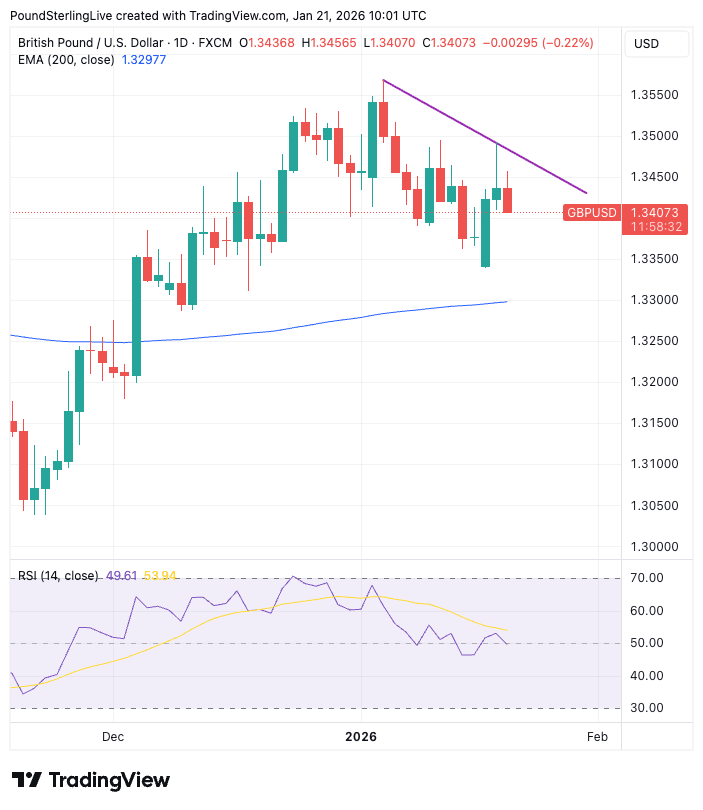
The pullback presents a risk that a recent rally is fading and there is no transition to a fresh upward trend. Renewed U.S. dollar demand leaves GBP/USD vulnerable to a deeper retracement toward its 200-day exponential moving average near 1.3297.
A move to that level would place the pair below the March 2026 consensus forecast derived from more than 30 investment bank analysts, suggesting undervalued levels are being tested.
(More information on the consensus forecast of over 30 investment bank analysts can be found here).
Expectations for positive developments in Davos help stabilise broader risk sentiment, reducing demand for alternatives to the dollar and encouraging a partial unwind of earlier USD selling.
For sterling, the shift underscores how external political developments and dollar-side dynamics continue to dominate near-term direction in GBP/USD.
Unless the pound can reclaim and hold levels above the mid-1.34s, traders say risks remain skewed toward a test of longer-term support rather than a renewed push higher.
Consensus projections for the next four quarters, compiled from leading investment banks.
Access the full forecast →
✳️ Looking at the multi-month horizon, the dollar is vulnerable to further losses. Indeed, the consensus of investment bank analysts still thinks GBP/USD upside is the most likely outcome this year, with dollar weakness being re-engaged once this current spell of resilience fades.
Central pillars to this view include diminished Federal Reserve independence as the White House pushes for lower rates. This risks fiscal dominance as the Fed subsidises the U.S. government's deficit indirectly.
President Donald Trump is radically altering the post-war order, of which the U.S. staddled as hegemon. That hegemony bestowed the dollar reserve status and privilege. It's therefore likely that the breakdown of this pro-USD regime fundamentally weighs on the Greenback.
"Over the longer term, loss of confidence in US trade and security policies, combined with political interference with the Fed’s independence threaten to accelerate the dollar’s declining role as the primary reserve currency. That’s a structural drag on USD," says Elias Haddad, Global Head of Markets Strategy at Brown Brothers Harriman.