One institutional researcher suggests the NZD is likely to struggle against the US Dollar going forward while our studies suggest the currency could yet paint a fresh 2016 best against the Pound.
- The Pound to New Zealand Dollar exchange rate: 1.7905
- The Australian to New Zealand Dollar exchange rate: 1.0529
- The New Zealand to US Dollar exchange rate: 0.7249
- The Euro to New Zealand Dollar exchange rate: 1.5506
A bad week of trade for the New Zealand Dollar leaves analysts wondering whether one of the star performers of 2016 has had its time in the sune.
NZD has the dubious distinction of sharing the bottom of the G10 FX performance board with perpetual bottom-feeder the British Pound for the week 19th-23rd September.
Through much of 2016 the New Zealand dollar has been rising strongly on the back of the country's advantageous interest rate, which at 2.0% is the highest in the G10, and therefore attracts a lot of foreign capital to New Zealand’s shores.
This combined with ultra-low – sometimes negative – interest rates in much of the rest of the developed world has made New Zealand’s guaranteed 2.0% return even more attractive to foreign investors.
The economy has also been helped by a rebound in the price of Dairy products, its main export, and a hefty above 10% rise in almost all its new wave of commodities, including kiwifruit, apples, wine and seafood.
A steady stream of hardworking immigrants and an increase in tourism have improved the island’s human capital, kept demand buoyant and encouraged the recent property boom, which has created more domestic wealth.
On the back of these factors the New Zealand dollar has risen.
NZD/USD has risen steadily from its October 2015 lows at 0.62 to recent highs of 0.74, GBP/NZD meanwhile has fallen from August 2015 highs of 2.52 to recent lows in the 1.75s.
However, there are signs now the party is over and perhaps it’s time to leave the table whilst the going’s good.
NZD/USD is off its highs September 7 highs of 0.7497, trading currently at 0.7335, and looking set to go even lower, whilst GBP/NZD has been unable to breach support at just above the 1.75 barrier.
Credit Agricole anticipate the New Zealand Dollar will fall and advocate selling the currency on strength, particularly against the US Dollar.
“The currency has been holding well of late. However, capped rate expectations and elevated long positioning keep it subject to downside risks should risk sentiment soften anew,” say Credit Agricole in a strategy note to clients.
Strategists advocate a sell of NZD/USD from 0.7292, targeting a fall back to 0.70.
Any weakness in NZD/USD could well aid a recovery in GBP/NZD, which as we note in our technical studies below, is at a multi-year support level from which a rebound could take place.
Latest Pound / New Zealand Dollar Exchange Rates
  | Live: 2.3468▼ -0.47%12 Month Best:2.4815 |
*Your Bank's Retail Rate
| 2.267 - 2.2763 |
**Independent Specialist | 2.3139 - 2.3233 Find out why this is a better rate |
* Bank rates according to latest IMTI data.
** RationalFX dealing desk quotation.
RBNZ Triggers Latest Bout of NZD Weakness
The latest Reserve Bank of New Zealand (RBNZ) meeting rate statement appears to be the trigger of recent weakness in NZD.
While the RBNZ left rates on hold they cited concern for the high-flying NZD, noting:
Weak global conditions and low interest rates relative to New Zealand are placing upward pressure on the New Zealand dollar exchange rate. The trade-weighted exchange rate is higher than assumed in the August Statement."
As such, some action directly targetting the value of the currency could be warranted:
"The high exchange rate continues to place pressure on the export and import-competing sectors and, together with low global inflation, is causing negative inflation in the tradables sector. A decline in the exchange rate is needed."
In the statement the central bank made it clear a decline in the exchange rate, “is what is needed.”
It stated the overly-strong New Zealand dollar is the reason for inflation remaining low.
By pushing down the price of foreign imports the NZD caps inflation.
Given the main reason the kiwi’s strength is foreign capital inflows attracted by the country’s relatively high 2.0% interest rates, the way to curb the kiwi would be to reduce the interest rate.
It is because of the strong NZD and weak inflation that many analysts anticipate a November interest rate cut at the RBNZ, and this should keep the currency in check for the time being.
However, the sheer scope of cuts required to align New Zealand's 2.0% base rate with the the rest of the developed world (Japan and Europe are actually seeing negative rates) suggests that the RBNZ simply will not be able to diminish the country's yield advantage.
The RBNZ is faced with the problem of a ‘hot’ housing market and any cut in base lending rates by the RBNZ would likely heat the housing market further.
The NZD should remain supported as a result.
“The overall tone of the statement suggests the risks are more weighted towards a neutral stance and against a backdrop of limited USD volatility supportive of the 'carry theme', NZDUSD dips are likely to be bought with the 0.7250 support area looking to hold," says a note from CitiFX advocating a strategy that contrasts with that held at Credit Agricole.
Technical Outlook for NZD Against GBP and USD
From a purely technical perspective the NZD/USD looks likely to continue a little lower in the immediate future, and then possibly maker a deeper retrenchment after that.
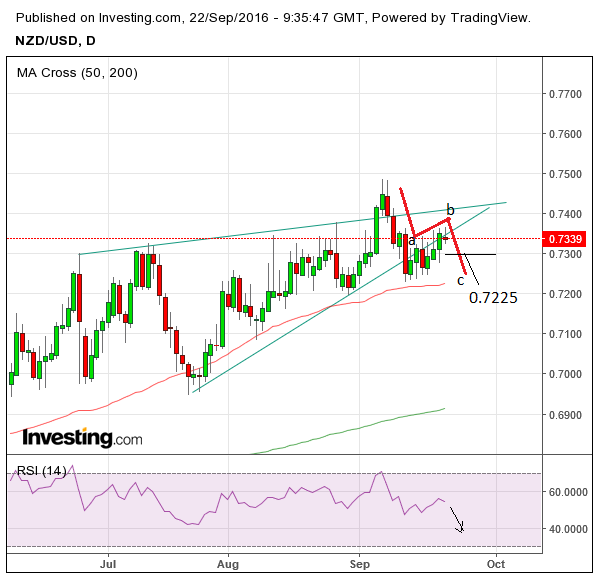
The pair has corrected back from the 0.7497 highs in what looks like an incomplete three wave a-b-c pattern (see below) which has not yet begun ‘c’ wave down, but probably will soon.
The onset of such a wave would be confirmed by a break below 0.7300, with a target at the 50-day moving average at 0.7225.
The ascending wedge-like, or ending diagonal pattern which has been forming since late July also suggests more downside – in a potentially volatilesweep.
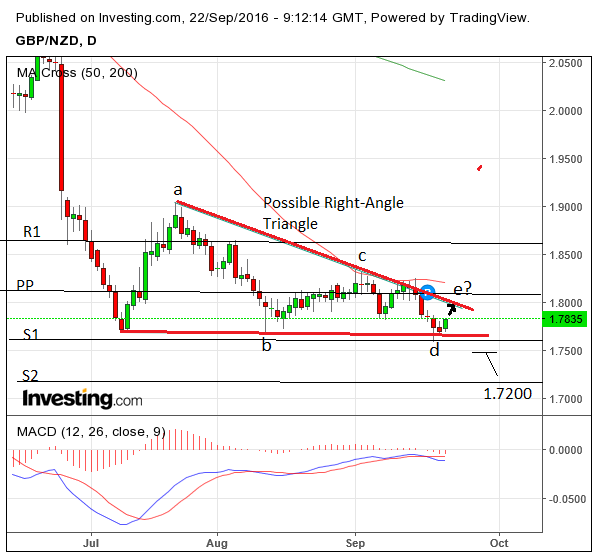
GBP/NZD has continually been rebutted by support at the 1.75 level and after making a sequence of smaller recovery highs has ended up tracing out a right-angled triangle.
Right-Angled Triangles (RATs) indicate the direction the break will probably occur in, which is always through and then below the flat edge, which in this case means a break down, below the 1.75 level.
Such a break confirmed by a move below 1.75 would probably run to support at 1.7200 initially from the S2 monthly pivot, a level of support and resistance, traders use to gauge the trend and launch counter trend trades.
The triangle, however, is as yet incomplete and still needs to finish its ‘e’ wave higher before it has finished the minimum compliment.