✳️ Secure today's exchange rate for a future payment. You may also book an order to trigger your purchase when your ideal rate is achieved. Learn more.
Image © Adobe Images
Pound sterling is lower against the dollar and firm against most peers, but there's a sense that this stability is brittle.
The price of a barrel of Brent crude crossed $100 again on Thursday, amidst ongoing strikes on shipping and infrastructure in the Persian Gulf and the realisation that the conflict with Iran is nowhere close to ending.
"Investors are increasingly pricing in a more protracted conflict that causes extensive economic damage," says Henry Allen, Strategist at Deutsche Bank.
The currency reaction is, for now, relatively contained: the dollar has firmed up in response to rising oil prices, pressuring pound-dollar rate back to 1.3385.
Pound-euro rallies towards the cusp of 1.16 as pound sterling is bolstered as the Iran conflict drives up domestic UK bond yields. The Canadian and Australian dollars are amongst the outperformers. "This latest leg higher in oil is giving broad-based support to USD, CAD and AUD, the three big winners so far in G10," says Francesco Pesole, FX Strategist at ING.
President Trump said overnight that the war with Iran was "going great" and could end "soon" because there was "practically nothing left to target."
However, the situation on the ground this Thursday begs to differ from his optimistic assessment:
💥 Iran’s leader says the Strait of Hormuz should stay closed and warns that other fronts may be opened if the war persists
💥 US likely to start tanker escorts by the end of month, so at least two more weeks of this
💥“The reports have become clearer and clearer... the Iranians may have started mining in the strait" - UK Defense Secretary John Healey.
💥 Oman is clearing ships from Mina Al Fahal, a key export terminal outside of the Strait of Hormuz.
💥 Iran attacked two tankers in Iraqi waters.
💥 Iran launched further strikes against targets in Persian Gulf states.
🚫 Chinese refiners cancel agreed refined-fuel export cargoes.
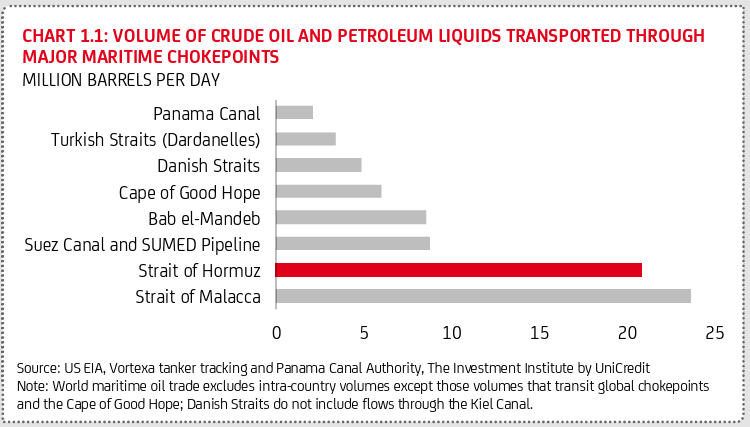
Image courtesy of UniCredit.
Thursday's gains add to oil's 3% advance on Wednesday, when we reported that markets were becoming increasingly worried that Washington's rhetoric on ending the war and clearing the Strait of Hormuz was empty.
Classified security briefings in the U.S. Capitol revealed the U.S. administration had no clear plan on reopening the Strait of Hormuz, which is currently shut to shipping, creating a severe global energy supply shortage.
At home, higher energy prices will boost inflation and prevent the Bank of England from lowering interest rates further. Markets see at least one rate hike in the pipeline. UK bond yields have risen sharply, outpacing the advance in the U.S. and the Eurozone, suggesting markets see the UK's inflation headwinds as more troublesome.
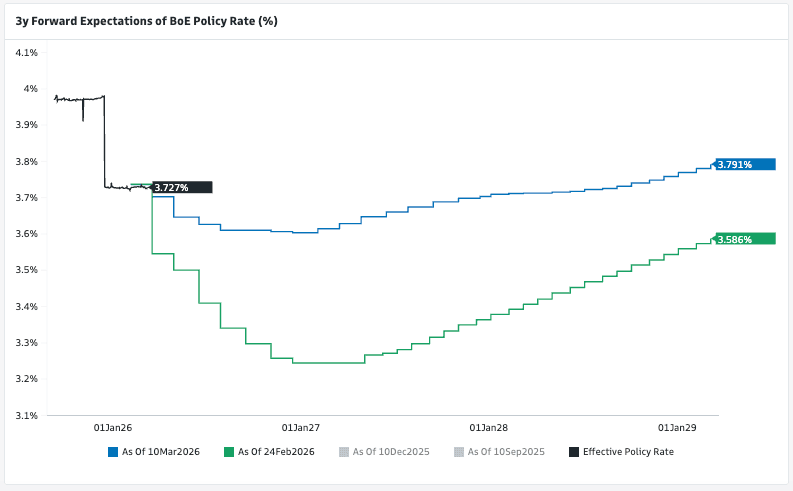
There's been a sizeable shift higher in UK interest rate expectations.
The UK's shift from an expected two cuts in 2026 to one hike is a long way to travel in just two weeks, and eclipses the shift seen in European and U.S. rate expectations.
For now interest rate expectations (via bond yields) are limiting the pound's losses against the dollar, and 1.3356 continues to be a significant technical line in the sand that GBP/USD has not closed below since December. However, as we note in this report, we think the trend will extend lower here.
That rise in yields means sterling is advancing against the euro and is well supported against the rest of its G10 peers, consolidating against most, even against safe havens such as the franc and yen.
🚩 Yet, he risks for the pound are considerable.
We maintain the view that an unruly stock market selloff and a significant deterioration in investor sentiment will hurt the pound.
This is because the UK runs a sizeable current account deficit that leaves the pound dependent on the inflow of foreign investment capital. When that dries up, GBP/EUR and GBP/USD tend to fall sharply.
"With no concrete signs of de-escalation yet, that’s keeping oil prices elevated, and raising the risk of a broader stagflationary shock," says Deutsche Bank's Allen.
"Indeed, we know that investors are pricing in the longer scenarios, because the 6-month Brent future is also up +3.06% this morning to $82.97/bbl, and with each passing day it gets harder to argue that the disruption to shipping and energy infrastructure will only prove temporary," he adds.
GBP resilience can only last as long as investors look on the bright side of life.
Albert Edwards at Société Générale says, "despite the turmoil of war in the Middle East, it would be fair to say that equity markets remain resilient, e.g. the S&P Composite is hovering only 3% below its all-time high."
"It seems the market has gone all-in with the optimistic view of the war, ignoring at its peril the entirely plausible risks of a more prolonged rise in inflation and its consequences. Investors should at least be cognisant of this asymmetry and the risks thereof," he adds.