Image © Adobe Images
Pound sterling extends a recovery against the euro as markets rapidly reassess the outlook for UK interest rates.
Pound-euro rises to 1.1578 by the time of mid-day trade in London, driven higher by another uptick in oil prices.
Brent crude is up 3% at the time of writing amidst little indication that the U.S. has a credible plan to unblock the flow of energy through the crucial Strait of Hormuz.
"On the Strait of Hormuz, they had NO PLAN. I can't go into more detail about how Iran gums up the Strait, but suffice it say, right now, they don't know how to get it safely back open," says Chris Murphy, U.S. Senator from Connecticut following a two-hour classified briefing on the Iran situation held by the Administration.
The pound has tended to benefit against the euro in an environment of rising global fuel prices which have prompted markets to bet on the Bank of England raising interest rates in the coming months.
Sure, the ECB also has a rate hike priced in, but the journey travelled by UK rate expectations is far more significant, as there were as many as two rate cuts priced in just two weeks ago.
That 80 basis point journey in UK rate expectations contrasts to an approximate 50bp journey for the Eurozone, and that's a powerful driver of GBP/EUR.
GBP/EUR has risen to 1.1578, having started the month near 1.1385. In doing so, it reverses a trend that threatened to propel the pair to the big 1.11 level (0.90 in EUR/GBP) before long.
The recovery is significant from a technical perspective as the exchange rate has now crossed and held the 21-, 50-, 100- and 200-day moving averages.
Moving averages smooth out price action and help traders identify the underlying trend, confirming the GBP/EUR outlook has flipped after weeks of weakness.
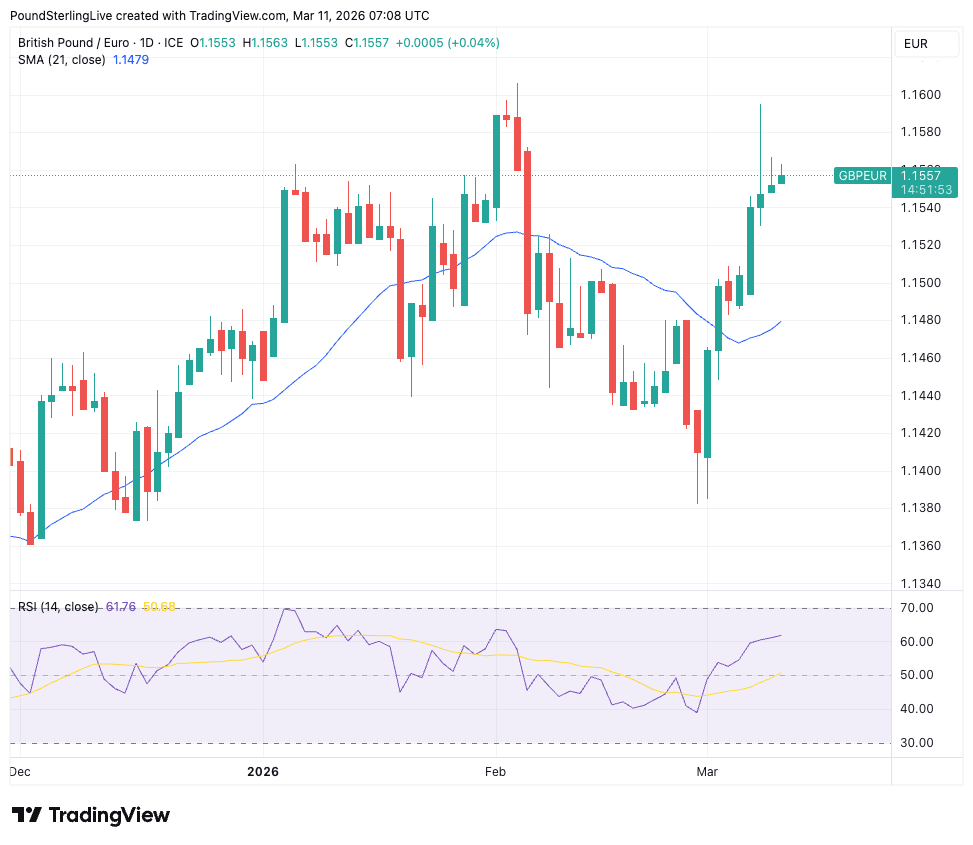
GBP/EUR trades above the 21-day moving average and the RSI (lower panel) suggests positive momentum.
Momentum indicators reinforce the improvement in sentiment: the Relative Strength Index currently stands at 61 and is pointing higher, suggesting buyers remain in control even though the pace of gains has slowed slightly in recent sessions.
The week's high currently stands at 1.1595, reached on Monday when markets were reacting to a surge in global oil prices.
Although the initial panic in energy markets has eased somewhat, the pound-euro recovery has largely held, leaving investors watching for a potential retest of that 1.1595 high and the psychologically important 1.16 level.
The driving force behind the turnaround is a significant repricing of UK interest-rate expectations that follows events in the Middle East:
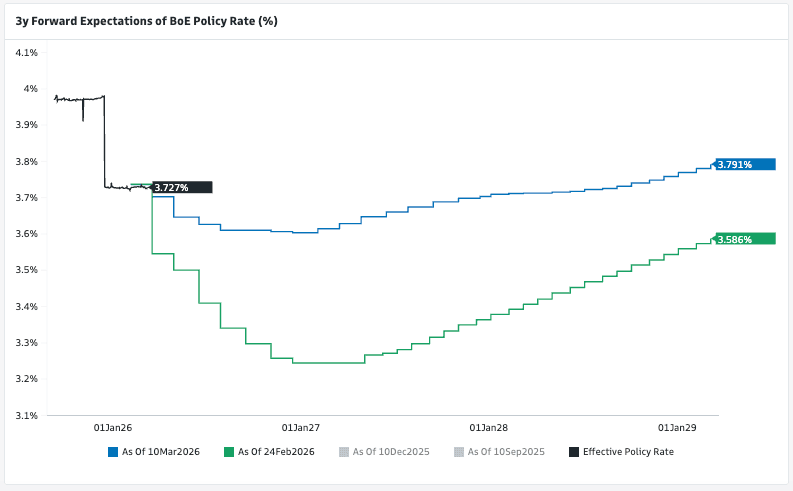
Above: There's been a material shift higher in UK rate expectations.
Only two weeks ago, when GBP/EUR was trading below 1.13, investors widely expected the Bank of England to deliver two interest-rate cuts as it responded to falling inflation.
Those expectations have since been turned on their head: markets are now increasingly pricing the possibility that the Bank of England will need to raise rates again to respond to renewed inflation pressures.
Importantly, the repricing has been larger in the UK than elsewhere.
Interest-rate expectations for the eurozone have been revised around 65 basis points higher, while sterling overnight index swaps have risen by roughly 80 basis points, a shift that tilts the balance of monetary policy expectations in favour of the pound.
GBP/EUR
ING analyst Francesco Pesole says pound-euro "continues to trade on the soft side, having dropped around 1.5%."
"This dynamic reflects both the larger hawkish repricing in the GBP curve and the relative resilience of equity markets, which have prevented a rotation from the higher beta GBP to the lower beta EUR," he explains.
The trigger for this change has been the surge in global energy prices: economists warn that the spike in oil and gas prices will prove inflationary and comes at a time when Britain is still grappling with elevated domestic price pressures, whereas inflation had been becalmed near 2.0% in the Eurozone.
These different starting points at the start of the Middle East conflict lead investors to conclude that the Bank of England has less room to tolerate a fresh inflation pulse.
A Flimsy Rally
As long as energy markets remain tight, the resulting inflation risks are likely to keep upward pressure on UK interest-rate expectations.
This should support recent interest rate market developments, which, for now at least, are proving supportive of pound sterling.
However, ING's Pesole warns "the move does, however, start to look a bit stretched according to our short-term valuation metrics."
He says a decline in oil prices below $90 may well encourage some "dovish reassessment in UK rate expectations" and prompt a correction lower in GBP/EUR.
ING continues to favour a return to 1.15 rather than a rise to 1.1630.