Consensus projections for the next four quarters, compiled from leading investment banks.
Access the full forecast →
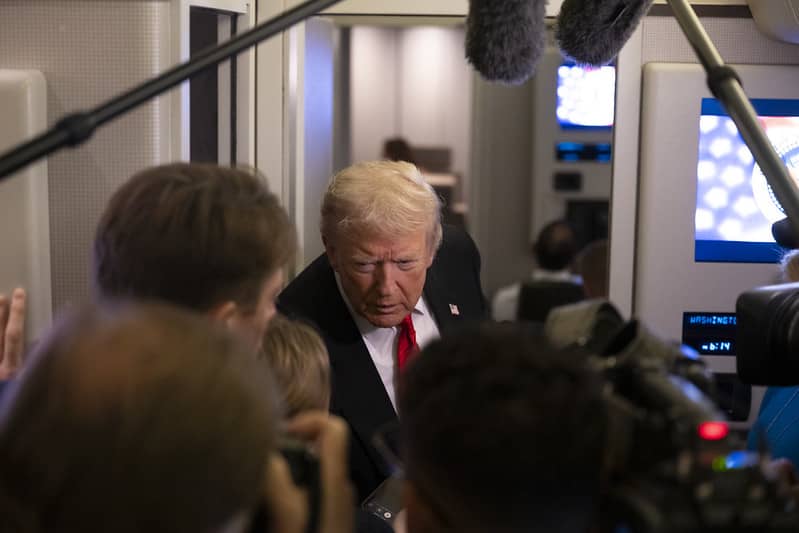
President Trump said the rise in oil prices were a small price to pay. Official White House Photo by Joyce N. Boghosian.
Intriguingly, oil price dynamics are etched into GBP/EUR's behaviour.
Pound sterling spiked against the euro in early Monday trade and reached a new multi-week high at 1.1559, with the move associated with another surge in oil and gas prices prices as supply from the Middle East effectively remains offline.
However, an initial spike in oil during the Asian morning has since faded, with the GBP/EUR pair responding and retreating to 1.1526.
Our interpretation of this behaviour is two-part: 1️⃣ The euro is judged to be particularly vulnerable to the spike in oil and gas prices, with memories of the impact of Russia's invasion of Ukraine still fresh in mind.
European gas prices gained as much as 30% to reach €69.50 per megawatt hour when trading opened on Monday. Prices have more than doubled since the crisis began.
2️⃣ The pound: Before the Middle East conflict, traders had expected the Bank of England to cut interest rates more than elsewhere, which had weighed heavily on the pound. But, the UK, like everywhere else, is now facing a new inflationary hit.
The reversal in UK interest rate expectations has been more significant: where two weeks ago there were at least two rate cuts expected in 2026, there's now one hike priced in. In short, there was always more room for a hawkish repricing in UK rate expectations than elsewhere, and this has helped the pound.
So there's this headline-driven interplay between oil, gas and interest rates that will be in the driving seat this week. It makes for a market that is highly reactive to news concerning the Middle East war, where the U.S., Israel and Iran are entrenched in their positions, with little hope for a ceasefire being imminent.
Commentators speculate whether President Donald Trump has the appetite to prosecute the war in the event of an oil price shock, but he seemed to spook markets when he said overnight: "Short term oil prices, which will drop rapidly when the destruction of the Iran nuclear threat is over, is a very small price to pay for U.S.A., and World, Safety and Peace."
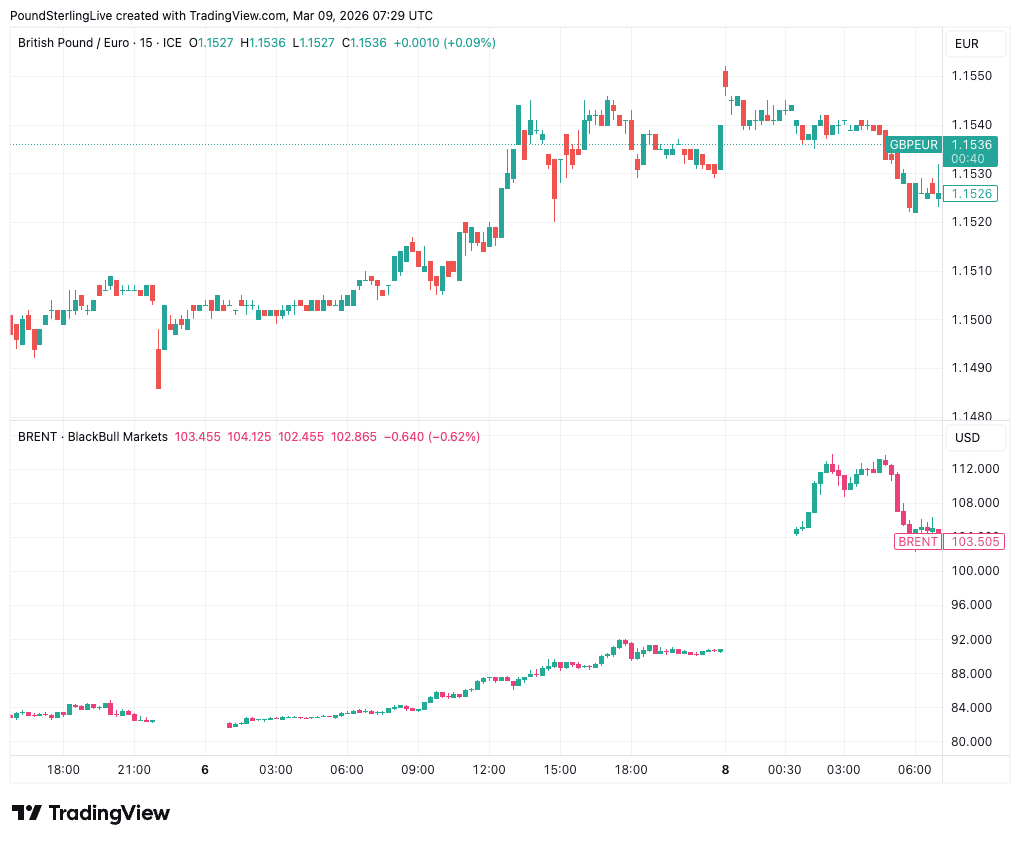
Above: GBP/EUR (top) and brent crude price.
The cost of a barrel of Brent crude rose as high as $113 a barrel in Asian trade, but then soon started falling and is down to 103 at the time of writing.
The pullback followed news that G7 finance ministers will discuss a possible joint release of petroleum from reserves, coordinated by the International Energy Agency, in an emergency meeting on Monday.
Three G7 countries, including the US, have so far expressed support for the idea, according to the people familiar with the talks.
Although the war in the Middle East is proving somewhat supportive of GBP/EUR, there are significant dangers in the event of a market rout and those with outgoing payments should not underestimate the risks.
Thus far, stock markets have shown a degree of resilience, with traders compartmentalising risks and looking through the short-term spike in oil and gas.
But, what if this isn't a short-term thing? We worry that a moment will arrive where investors realise a big economic hit is coming.
Under such circumstances, we would expect a major risk-off episode to drive FX markets, and for GBP/EUR, this is always negative as GBP has a higher beta to sentiment.