Studies suggest Pound to Australian Dollar exchange rate may have formed a potential bottom but we would expect any recovery to be short-lived in nature as fundamentals continue to favour the Aussie Dollar.
The GBP/AUD exchange rate is quoted at 1.6257 at the time of writing, Friday's close is observed at 1.6387 confirming it is down on the week.
However, the pair is slightly higher than Monday's close in sympathy with a broad-based weakness seen in the antipodean currency complex.
The Australian Dollar is sharply lower against a rampant US Dollar and a stronger Euro confirming markets are starting to focus on monetary policy once again.
U"SD is strong again overnight, with AUD and NZD bearing the brunt of the move but all G10 currencies weaker against USD. Diminishing political uncertainty is leading to greater monetary policy certainty," says Adam Cole at RBC Capital Markets.
The probability of a Fed hike by year-end hit a new four-month high of 75% - the promise of higher interest rates in the United States would likely see investors opt to repatriate capital to the US where higher returns are promised which in turn bids the Dollar higher.
For years now funds have been flowing the other way - from low a low-yielding US to high-yielding Australia and New Zealand.
Latest Pound / Australian Dollar Exchange Rates
  | Live: 1.8917▲ + 0.28%12 Month Best:2.0851 |
*Your Bank's Retail Rate
| 1.8274 - 1.8349 |
**Independent Specialist | 1.8652 - 1.8728 Find out why this is a better rate |
* Bank rates according to latest IMTI data.
** RationalFX dealing desk quotation.
Relief for the GBP/AUD
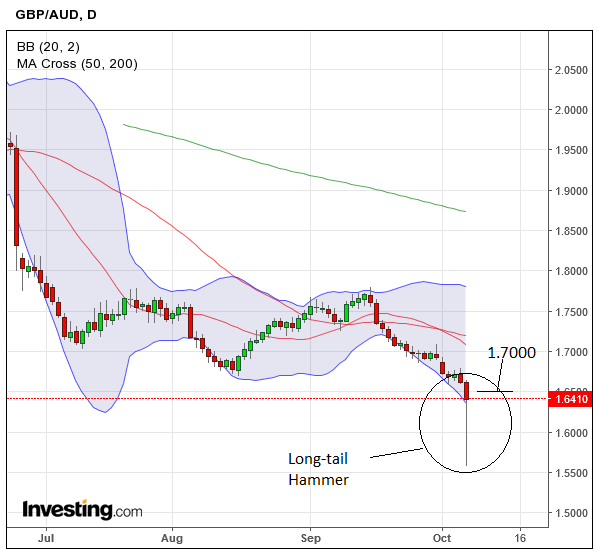
We observe technical patterns on the chart which could herald a potential exhaustion of the recent down-trend.
One explanation for the apparent contradiction may be that the pair has now priced in the possibility of a ‘hard Brexit’ – at least for now – so risks could be of a recovery rather than more downside.
Markets are also so negatively aligned against Sterling that bouts of profit-taking could see it correct sharply higher.
The technical picture is actually surprisingly bullish, and there are signs the pair may have bottomed.
A 'Hammer' Japanese candlestick with a long 'wick' or 'tail' has formed below the lower Bollinger Band, the light blue, shaded region around price.
The Bollinger Band is an envelope around prices, calculated by taking the 20-period simple moving average and then marking two lines, one above and other below which sit at 2-standard deviations from the mean.
Theoretically, prices move within the bands for 95% of the time.
This means that when they stray outside there is a high probability that they will revert to the mean – or in layman’s terms move back inside towards the central area.
When a move outside the bands happens in conjunction with a long-tail hammer it increases the odds prices will move back inside the bands or even reverse trend.
These set-ups have a high probability success rate of reversal and a move above 1.6500 would likely lead to 1.7000.
However we would expect any relief in Sterling to remain short-lived in nature.
The Pound remains at risk of further downside owing to heightened negative sentiment; and we urge all those with an interest in the pair to remain vigilant of political newsflow, particularly that relating to Brexit.
“The near-term picture still looks bleak: in a low conviction market, hard-Brexit and the low UK interest rate environment means GBP will remain the go-to short in the G10 space,” says ING's Viraj Patel.