
The Aussie Dollar extends its recent strength against Pound Sterling with the pair once again looking to test the 2016 lows reached back in August.
Sterling is quoted at 1.6904 at the time of writing as the decline from mid-September highs at 1.78 extends.
The 2016 lows at 1.68 are fast approaching and based on the strong support witnessed at these levels in mid-August we could expect the selling pressure to temporarily ease as we anticipate the market to witness increased buying interest at this point.
Looking at the chart from a broader perspective, however, suggests the possibility that the pair may be forming a bottoming pattern, perhaps an inverse head and shoulders:
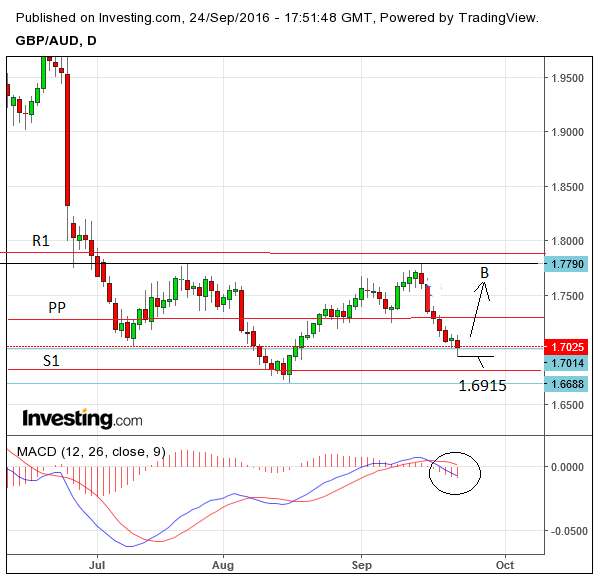
Inverse head and shoulders patterns signal a reversal in the trend from down to up.
It is however too early to determine whether this is the case on GBP/AUD.
Nevertheless, there is a possibility the pair might rise back up from its current level, completing the right shoulder of the pattern, as illustrated by the arrow marked ‘B’ on the chart.
Latest Pound / Australian Dollar Exchange Rates
  | Live: 1.8765▼ -0.19%12 Month Best:2.0851 |
*Your Bank's Retail Rate
| 1.8127 - 1.8202 |
**Independent Specialist | 1.8502 - 1.8578 Find out why this is a better rate |
* Bank rates according to latest IMTI data.
** RationalFX dealing desk quotation.
The fundamentals also point to more Australian dollar strength.
Whilst the pound continues to get support from economic data which suggests the economy is holding up remarkably well after the referendum there is still huge uncertainty over what sort of a Brexit deal the government negotiates with the EU.
We have seen Pound Sterling under-perform rivals notably over recent days as sentiment towards the currency deteriorates in line with growing concerns over impending Brexit negotiations.
Chancellor Hammond has indicated the UK may leave the common market, which would be expected to impact negatively on trade and would have a detrimental short-term impact on the pound.
The threat of a ‘hard’ Brexit will probably cap sterling until dismissed.
For the Aussie the outlook remains broadly positive as commodity prices move higher and the domestic economy continues to do relatively well.
The country’s 1.5% base interest rate, set by the Reserve Bank of Australia (RBA), continues to attract foreign capital flows via the carry trade.
The carry trade is a form of investment which sees investors borrow in a currency with low lending rates and purchase a currency with high interest rates.
Australian Dollar: The Key Triggers to Watch
Friday September 30 is likely to the most important day for the Australian dollar, purely from a data perspective, as it is when significant domestic economic data is published and when tier-one Chinese data is also released.
China is Australia’s largest trading partner and so the health of the Chinese economy impacts on demand for Australian exports, which then impacts on the value of the Aussie dollar.
Friday sees the publication of Caixin Manufacturing PMI and important barometer for the Chinese economy, and demand for Aussie resources – a lower-than-expected reading, therefore, would weigh on the currency.
No economist estimates have yet been published but we will update accordingly when they do. The August result showed the index had weakened to 50, suggesting manufacturing had reached a standstill - the release was understandably a negative one for the Aussie Dollar which traded lower following the release.
On the domestic data front, Friday the release of New Home Sales for September and Private Sector Credit in August will catch attention.
The previous month saw a release of 0.4%.
"Growth in monthly credit aggregates has eased recently. This has underpinned a moderation in the y/y rate to 6%, its slowest pace since mid-2015. We expect a modest 0.4% increase in August," says a note from Elsa Lignos at RBC Capital Markets.
Data to Watch for the Pound
Friday September 30 sees the release of the most significant data for the pound, in the form of the first revision of second quarter GDP.
The preliminary result already released, surprised to the upside, coming out at 2.2% rather than the 2.0% forecast, but on Friday we shall see if that upbeat result holds in the first revision.
Although it does not cover much of the period after Brexit, and is therefore not representative of the impact of the referendum, it still reflects a period in which there was a high degree of uncertainty prevalent in the run up to the vote, and so is some sort of measure of how the economy coped under uncertain conditions.
Second quarter Business Investment is also out on Friday and will also be closely watched by analysts trying to make sense of how well the economy has managed with the uncertainty stemming from the referendum – again in the run up to the vote in this case rather than afterwards.
Common sense dictates that Business Investment would fall in the run up to the referendum as many businesses would have delayed investment decisions on major projects until after the vote, however, Friday’s data will tell for sure.
There is a possibility of a surprise to the upside since data has up until now, more often than not, beaten expectations which were tilted to the downside for the referendum period.
Nationwide house price data is the other major release on Friday, whilst BBA Mortgage Approvals data, out on Monday (September 26) is a major release for the week.