
The GBP/AUD exchange rate could extend recent gains towards the 1.82s but fundamentals continue to favour the Australian Dollar over the longer-term.
Pound Sterling is pointed lower against its Australian counterpart and continues to probe the recent September lows towards 1.7266.
Positive sentiment amongst global investors is seen to be behind the move higher in AUD. When stock markets and commodity prices move higher, so too does this high-yielding commodity currency.
Markets are bouyed by firmer oil prices and fading fears that the US Federal Reserve will raise interest rates this Wednesday.
The losses in GBP/AUD are however not deep enough to negate what we believe to be the birth of a very young short-term uptrend:
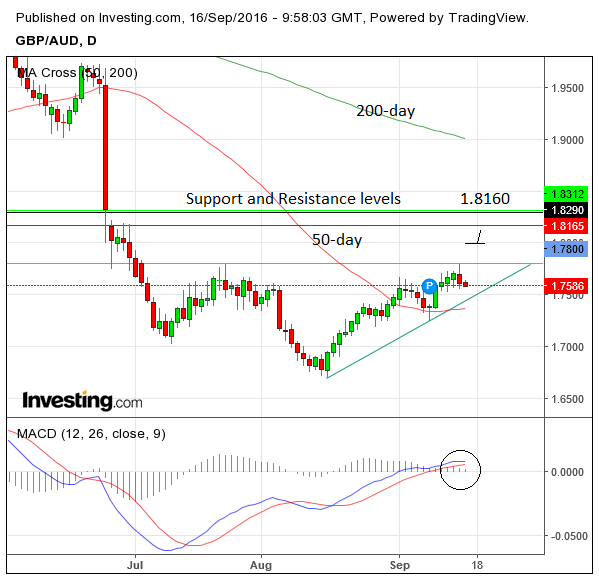
The next level to overcome is the resistance at 1.7797 which has continually rebuffed the price's advance.
A clear move above that and the R1 monthly pivot at 1.7837 would signal a continuation higher.
Confirmation of more upside would come from a break above the 1.7900, and would result in a move up to a target at 1.8160, just under another strata of several layers of resistance in the early 1.82s.
MACD remains above the zero line contributing supporting evidence that the trend is bullish.
Latest Pound / Australian Dollar Exchange Rates
  | Live: 1.88▲ + 0.07%12 Month Best:2.0851 |
*Your Bank's Retail Rate
| 1.8161 - 1.8236 |
**Independent Specialist | 1.8537 - 1.8612 Find out why this is a better rate |
* Bank rates according to latest IMTI data.
** RationalFX dealing desk quotation.
Fundamentals: The AUD is Favoured
The key event in the week ahead for the Aussie Dollar is the appearance of the newly-annointed Governor of the Reserve Bank of Australia (RBA) Philip Lowe before the House of Representatives' Standing Committee on Economics on September 22.
Markets will be looking for a steer on future monetary policy from Lowe - is there the potential for further interest rate cuts, and just how does he see the economy performing?
These events can often lead to ungaurded comments and therefore have the potential to spark otherwise unforseen moves in currency markets.
Other significant data includes the House Price Index in Q2, which is forecast to rise by 2.5% and the release of the minutes to the RBA's September meeting.
For the Pound, the data calendar is decidedly second-tier with the main release being the CBI's Industrial Trends Orders in September, on Thursday, which came out at -5 in August.
The CBI (Consortium of British Industry) data could nevertheless be important as it will be the first release for September and traders will be keen to see whether the relatively robust performance of the UK economy has extended into another month.
The British Pound came under sustained selling pressure last week, but there are reasons to expect it to recover.
According to analysis from SEB, the Pound could rise further owing to the week Pound, an accommodative Bank of England and sound economic data.
In short, the currency looks to have been oversold in the aftermath to the Brexit vote and should stabilise at higher levels.
However most analysts remain constructive about the Aussie, which they say is supported by continued high carry trade flows.
The carry trade is an investment strategy in which an investor borrows money in a funding or low interest rate currency, such as the yen (-0.1%), the euro (0.0%) or the pound (0.25%), and uses that money to buy a high interest rate currency such as the Aussie (1.5%) or New Zealand Dollar (2.0%), profiting from the resulting difference.
According to RBC Capital Markets, the strategy has grown in popularity due to the lack of other investment avenues, since stocks are overvalued, bond yields are in negative territory in many parts of the world and commodities are bumping along the bottom.
This in turn is likely to support the Aussie, particularly if yields remain as low as they currently are elsewhere.
Recent data, showing a further decline in unemployment to a 3-year low of 5.6%, is expected to further lessen the chances that the RBA will feel it is necessary to cut rates any lower.
This should keep the Australian Dollar bouyant as global investors continue to seek out Australia's superior yield.
Morgan Stanley: Further AUD Upside
Analysts at Morgan Stanley meanwhile agree with the view that AUD has further room to appreciate particularly if global stock markets continue to rise and domestic data remains firm enough to keep the RBA on hold and investors seek higher-yielding assets.
RBA Assistant Governor Kent struck an upbeat tone in his most recent public outing and better-than-expected GDP growth (though with a mixed breakdown) as well as a falling UE rate are good enough to limit the risks of RBA rate cuts, despite a still worrisome inflation outlook.
"With AUDUSD at 0.75, it still has room to go higher before the RBA becomes too worried about overvaluation," say Morgan Stanley.