The GBP to AUD conversion remains pointed lower, but the trend could be questioned in what promises to be a busy week in terms of data.

Pound Sterling continues to trend lower against the Australian Dollar and at the time of writing GBP/AUD is at 1.6750.
This represents a fresh two-and-a-half year low for the pair.
Our studies of the charts confirms the pair remains locked in the midst of a strong short-to-medium term down-trend:
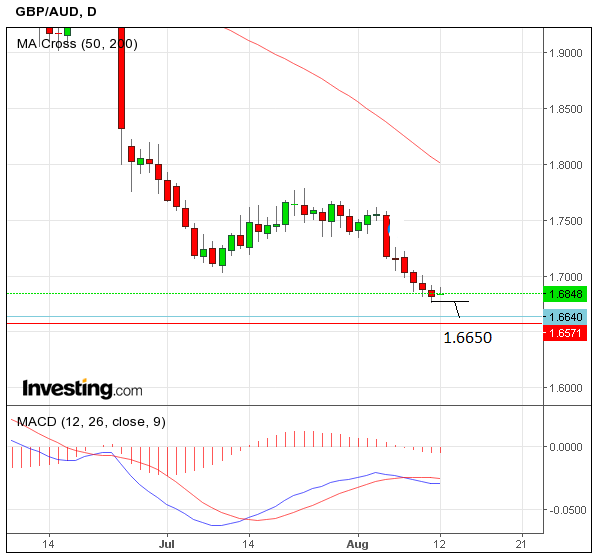
Apart from the up-day recorded on Friday August 14 there is little to suggest a reversal is taking shape yet, however, so from a technical standpoint the pair remains in a down-trend.
The MACD momentum indicator has crossed its signal line, indicating the down-trend is likely to continue.
The next target is at the level of support from lows in October 2013, at 1.6650.
Further support is also to be found at 1.6270 at the level of the S2 monthly pivot.
Latest Pound / Australian Dollar Exchange Rates
  | Live: 1.8949▼ -0.34%12 Month Best:2.0851 |
*Your Bank's Retail Rate
| 1.8305 - 1.838 |
**Independent Specialist | 1.8684 - 1.8759 Find out why this is a better rate |
* Bank rates according to latest IMTI data.
** RationalFX dealing desk quotation.
The AUD appears to have reclaimed its swagger following a notable dip on Friday the 12th when data from China knocked confidence in AUD allowing the GBP/AUD a rare rally.
The headline Industrial Production data for July, came in below expectation, raising concerns demand would fall for Australia'a all-important commodity exports.
We were however more concerned by data which showed a dramatic fall in the availability of Chinese credit, which is feeding expectations for a drop in demand for Aussie iron ore, coal and natural gas.
GBP/AUD rebounded on the Chinese data, rising back up to close the week at 1.6900, and some analysts started to see the possibility of a reversal taking shape.
However, it appears Australia's high interest rate environment continues to suck up foreign currency from investors seeking out higher yield.
Until this yield advantage is cut notably we would expect the AUD to dominate the GBP.
More Australian Rate Cuts Due in 2016
On Tuesday the 16th August markets were able to sink their teeth into the minutes of the latest RBA meeting.
Recall the RBA cut rates to 1.5%?
Traders wanted to get further insights into the move which would likely answer whether further interest rate cuts were to be expected down the road.
The theory goes that lower interest rates help stimulate inflation as businesses and consumers are able to borrow at cheaper rates, and therefore spend more.
The RBA clearly believes the economy is not growing at the pace required to push inflation back towards its target. Indeed, it appears the RBA expects only growth towards 3% would see inflation head towards target and the last time we saw this kind of growth was back in 2012 when the mining boom was in bloom.
"We expect that persistently low inflation will lead the RBA to lower official interest rates to as low as 1.0%. We expect the RBA will cut official interest rates by 25 basis points at its November meeting," says Janu Chan, Senior Economist with St George Bank.
There is a chance that a basic interest rate of 1% could well anchor the AUD which would certainly have lost a huge portion of its yield advantage against the likes of the United Kindom, the Eurozone and Japan which are all seeing interest rates towards and below 0%.
Data for the Australian Dollar to Watch
On Wednesday the Westpac Leading Index and the Wage Cost Index are released for the second quarter.
Wage costs will be of significant interest to the RBA as they have highlighted sluggish wage growth as a dampener of inflation so a weak result in wage costs will weigh on the Aussie dollar, as it will increase expectations of the RBA further cutting rates in 2016.
On Thursday employment data comes to the fore, with the Unemployment Rate (July) expected to stay at 4.9%, and employment change to rise by 11k.
A Big Week for the Pound on the Data Front
With the Bank of England pumping money into the economy, and devaluing Sterling in the process, analysts will be watching for evidence in the economy that would suggest even more easing will be announced before the end of 2016.
One of the key numbers to watch will be inflation.
With Sterling falling following the EU referendum the Bank has recently had to ramp up their inflation forecasts, owing to the rising cost of imports.
The Bank notes the 2% level they are tasked with targeting could be hit a lot sooner than originally envisaged.
Should inflation rise faster than reflected in the inflation upgrades, the Bank will certainly get nervous. Such an uninvited acceleration in prices could well prompt the Bank to consider holding back on that stimulus, which in turn is a positive for the Pound.
In this week's release analysts are forecasting a 0.5% rise compared to July last year.
On a monthly basis inflation is expected to rise 0.2%.
On Wednesday the UK will release important employment and earnings data, however, due to it covering only June which is mostly before the EU vote its significance this time will be lessened.
Average Earnings is expected to rise a basis point to 2.4% from 2.3% previously. The Unemployment rate stands at 4.9% and quarterly change was 194k in May.
Retail Sales data on Thursday rounds off the week.
This data will be important because it is also for July, and so will provide an idea for how well certain parts of the economy are bearing up.
Recent data from the British Retail Consortium (BRC) showed an unexpected 1.1% rise in retail sales in July when investors had been forecasting a Brexit-inspired contraction.
The higher than expected result was explained as a ‘life goes on’ shrug of the shoulders response from consumers and due to households not yet feeling a material impact from the referendum result. Especially hot weather which increased barbeque, charcoal, food and drink sales, as well as fashion sales was also a factor.
The 0.2% rise from -0.9% previously and steady 4.2% gain y-o-y forecast by analysts reflect BRC data’s increased optimism about July.