
The Pound to Australian Dollar pairing is forecast to maintain its bearish bias in the coming week as the difference in policy intentions at the Bank of England and Reserve Bank of Australia becomes more pronounced.
The GBP/AUD exchange rate is quoted at 1.6993 - a new 2016 low and the lowest level witnessed since 2013..
Bank account rates are noted in between 1.6516 and 1.6397 while specialist FX providers are quoting closer to the market rate with rates seen between 1.6720 and 1.6839.
The move lower comes as the Bank of England starts to buy up UK government debt on the London market ensuring the yield paid on that debt falls to record lows.
The stark contrast in yield paid between UK and Australian government debt is the primary reason why the GBP/AUD is as low as it is, and will remain the primary reason behind future losses
The move by the Bank of England, "adds to the global super low interest rate complex and should continue to support demand for higher yielding assets. That implies ongoing GBP underperformance against the AUD, NZD and Asian currencies," says Brian Martin at ANZ.
GBP/AUD appears to be resuming its down-trend after falling almost to as low as the 1.70 lows at the end of last week following the announcement of the BOE’s stimulus bazooka.
The pair may be breaking down after the formation of a bearish flag pattern:
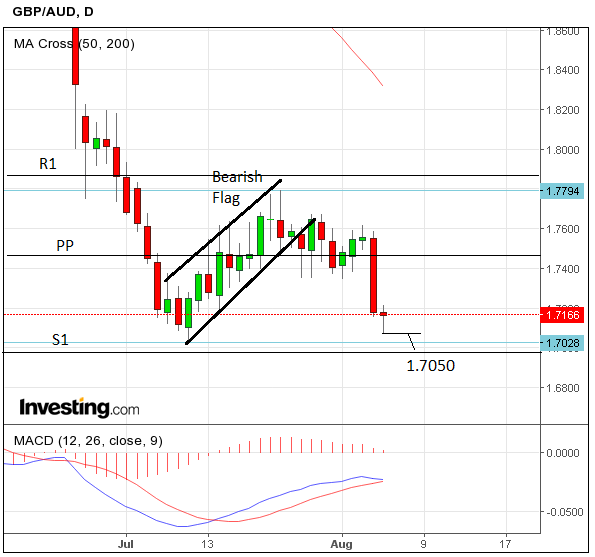
Flag patterns are continuation configurations, which once they break down indicate much steeper downside to come.
For this one, we calculate that the full length of the ‘pole’ could well be similar to the move just prior to the formation of the flag, went down from 1.95 to 1.75 - a move of 20 cents!
Therefore, a similar length pole could go down as far as 1.5500!
Initially, however, we see a move down to 1.7050 - not far below the current level.
There is a double layer of support in the 1.70s, however, from the S1 monthly pivot and historic support not far below (black line).
Latest Pound / Australian Dollar Exchange Rates
  | Live: 1.88▲ + 0.07%12 Month Best:2.0851 |
*Your Bank's Retail Rate
| 1.8161 - 1.8236 |
**Independent Specialist | 1.8537 - 1.8612 Find out why this is a better rate |
* Bank rates according to latest IMTI data.
** RationalFX dealing desk quotation.
Aussie Outlook: The RBA's Next Move
At their August meeting officials of the RBA lowered interest rates from 1.75% to 1.50%, and this fuelled the recovery in the GBP/AUD pair.
However, few analysts seem to think this is the start of a new cycle of easing for the RBA, who gave no hint in their monetary policy statement of further cuts being in the pipeline.
While the RBA’s statement fell short of providing explicit forward guidance, analysts at ANZ interpreted the larger number of risks to the outlook and the RBA’s forecast that average underlying inflation will be stuck at the bottom of the 2-3% target band by the end of 2018 as a strong easing bias.
"Our base case is that rates remain on hold at 1.5%, but we see a clear risk of further cuts given the RBA expects persistently low inflation," says a note from ANZ on the matter.
The AUD is also important given the RBA thinks it still poses a “significant source of uncertainty” around the outlook.
ANZ believe that with the cash rate now close to the 1% floor, the RBA is likely to be looking more closely at unconventional options if downside risks to the outlook materialise.
However, will lower rates necessarily prompt a weaker currency?
Analyst Honglin Joan of Credit Suisse, sees AUD valuation more as a product of global capital flows than RBA interest rate setting, which had, “little more than an hour’s worth of effect in subduing the currency.” When they cut on August 2.
Rather he sees the continued flows of capital into AUD for its mixture of yield potential and stability as the overwhelming driver for the currency at the moment.
Overall Joan sees less than an even chance of a 2016 cut.
Given both these factors the Australian dollar may well evaluate – and indeed Credit Suisse have raised their three month AUD/USD forecast.
“That said, the lack of dovish guidance and enhanced rhetoric around the currency in the statement, in conjunction with the reasons cited above, leads us to believe that the RBA is biased to hold rates steady in the meetings leading up to and including November (barring a further significant deceleration in inflation or global shock),” summed up Joan.
The Pound: ‘Data in the Driving Seat’.
In relation to the Pound there are some who think ‘the worst may be behind the currency’, although that does not mean there will necessarily be much upside ahead in the short-term either.
Financial markets sold off heavily after the UK voted to leave the EU, but they have now recovered and made new highs – we maintain that if the fallout was still a major risk factor equity markets for one would not be in such good shape.
The Bank of England (BOE) also appears averse to lowering interest rates any further, and of the various different forms of monetary stimulus this would be the most negative for sterling; monetary stimulus in general, globally that is, also appears to be losing its impact, the UK included.
Nevertheless, as pointed out by broker TD Securities, the key to the pound remains data for the period after Brexit, in other words for July.
The problem is that there is still a lack of data for July on which to base a fair assessment of the impact of the referendum on the economy, and in the week ahead this remains a problem as there are only two release for the period.
One is the British Retail Consortium's (BRC) retail sales figures out on Tuesday, and the other is the NIESR GDP Estimate for July on the same day.
Whilst BRC sales is normally a tier three release of little significance, in the week ahead its importance will be temporarily exalted.
Clearly a positive result for July data could help sterling recover; whilst a negative would confirm fears that the economy is declining steeply following the impulsive breakaway from Europe.
Has the Pound hit Bottom?
For BK Asset Management’s co-founder Kathy Lien, the big question is, has sterling bottomed?
According to her analysis there is a strong possibility the pound has since she sees it as unlikely that the BOE will cut interest rates any lower, after BoE governor Carney expressed a clear aversion to negative interest rates at the last press conference:
“Yes, the central bank is ready to lower the bank rate further if needed and increase all elements of Thursday’s package but Carney also made it very clear that the 'lower bound in interest rates is above zero' and he is 'not a fan of negative interest rates.'"
He believes that helicopter money is a “flight of fancy” and he doesn’t see a scenario where negative rates is discussed, so if BoE were to ease again, it would be in other ways like additional bond purchases. The bank reduced its GDP outlook for 2017 but kept its 2016 forecasts unchanged. It also believes that inflation will rise given the weakness of the pound.
"Having taken such an aggressive stance, the Bank of England is now in wait-and-see mode, which could actually lift sterling because of the extreme level of short positioning,” says Lien.